Client: Mid-Sized Digital Marketing Agency
Industry: Digital Marketing
Engagement: Custom CRM Transformation
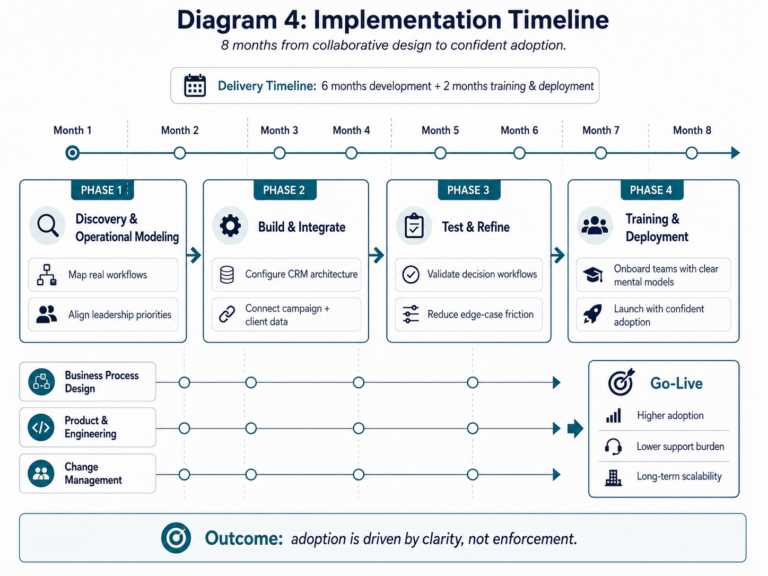
Delivery Timeline: 6 months (development) + 2 months (training & deployment)
Impact: Improved client experience, faster execution, reduced operational friction, and sustained profitability growth
From Fragmented Tools to a Living Client Intelligence System
In digital marketing, client success depends on speed, coordination, and judgment. As this growing agency expanded its service offerings and client portfolio, its internal systems struggled to keep pace. Client data lived in disconnected tools, campaign insights arrived too late, and teams operated with partial context—creating execution risk at scale.
The agency didn’t need another off-the-shelf CRM. It needed a system that could continuously align client information, campaign activity, and team decisions as the business evolved.
Ingenuity delivered that capability by designing a custom CRM grounded in its Living Information Model (LIM)—ensuring client data, workflows, and decision logic remained synchronized over time.
The Challenge: Static Systems in a Dynamic Agency
The agency’s challenges weren’t rooted in a lack of effort, but in how information was structured and shared:
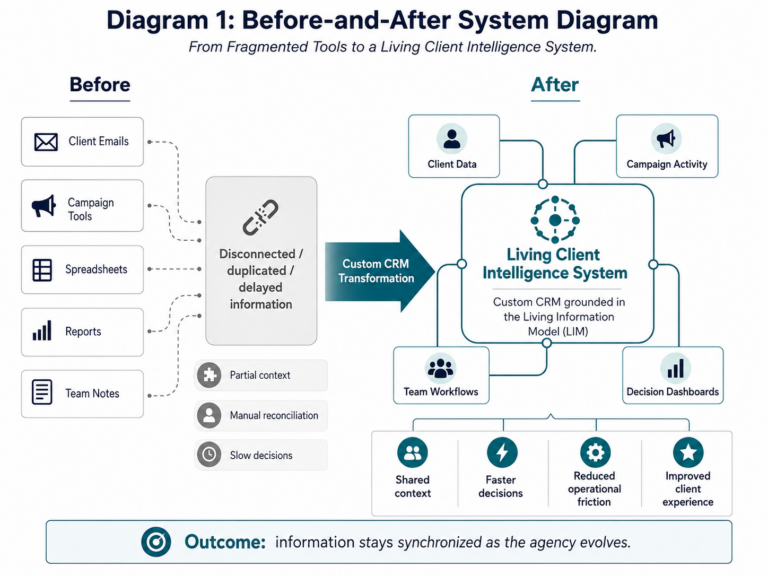
- Disconnected Systems. Client interactions, campaign data, and performance metrics were spread across platforms, creating inconsistencies and duplicated effort.
- Low Decision Certainty. Leadership lacked real-time visibility into campaign performance and client health, slowing corrective action.
- Siloed Execution. Teams operated with incomplete context, leading to rework, delays, and missed client expectations.
- Manual Reporting Burden. Insights required time-consuming manual consolidation, limiting the agency’s ability to pivot quickly.
As complexity increased, so did operational friction—and with it, the cost of growth.
The Ingenuity Approach: Applying the Living Information Model
Rather than treating CRM as a data repository, Ingenuity applied its Living Information Model to reframe how the agency’s information ecosystem worked.
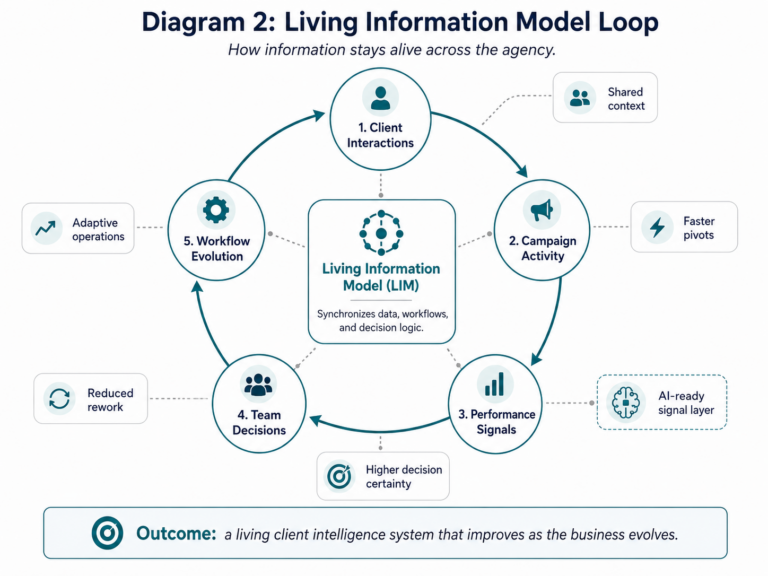
LIM ensured that:
- Client data reflected real-time engagement, not historical snapshots
- Workflows evolved without breaking downstream processes
- Decisions were made with shared, current context across teams
This transformed the CRM into a living system of client intelligence—one that adapted as the agency’s services, clients, and operating model changed.
The Solution: A CRM Designed for Certainty, Speed, and Adaptability
The custom CRM embedded LIM principles directly into its design:
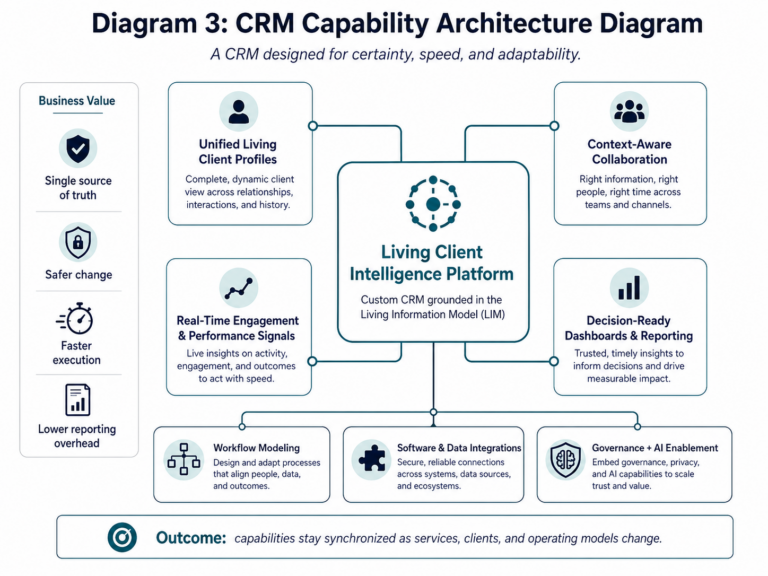
Key Capabilities Enabled by LIM:
- Unified, Living Client Profiles. All interactions, campaign activity, and relationship context were continuously updated and accessible—eliminating duplicate work and misalignment.
- Context-Aware Collaboration. Internal teams and clients operated from the same source of truth, reducing handoff friction and communication gaps.
- Real-Time Engagement & Performance Signals. Campaign data flowed directly into decision dashboards, enabling faster adjustments and higher-quality client conversations.
- Decision-Ready Dashboards & Reporting. Leadership accessed live performance insights without manual reconciliation—improving judgment while reducing reporting overhead.
Because workflows and data relationships were modeled intentionally, changes could be introduced without triggering system-wide rework.
Reduced Rework, Faster Pivots, Lower Total Cost of Ownership
By grounding the CRM in a Living Information Model, the agency achieved structural benefits beyond feature improvements:
- Rework was minimized. Teams no longer reconciled conflicting data or reassembled client histories across tools.
- Pivots became faster and safer. New service offerings, reporting needs, and client engagement models were introduced without destabilizing operations.
- Total cost of ownership declined. Fewer manual processes, less reliance on institutional knowledge, and a system that scaled without constant reconfiguration.
The CRM evolved with the business—rather than becoming a bottleneck.
Implementation: Designed for Adoption, Built for Longevity
- 6-Month Collaborative Development. Ingenuity worked closely with agency leadership and delivery teams to model real operational flows—not theoretical ones.
- 2-Month Training & Deployment Phase. Teams were onboarded with clear mental models, enabling confident use from day one and reducing long-term support needs.
Adoption was driven by clarity, not enforcement.
Results: A High-Performance CRM That Scales with the Agency
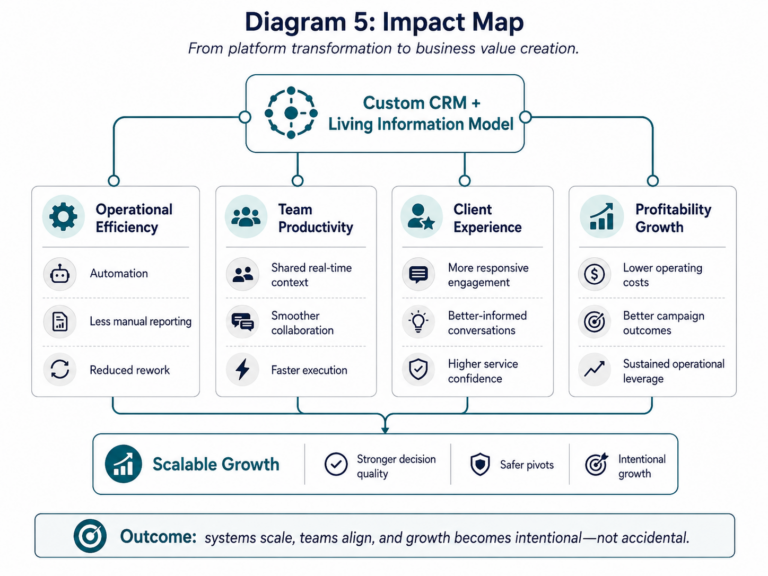
- Operational overhead reduced through automation and elimination of manual reporting
- Productivity and collaboration increased with shared, real-time client context
- Client experience elevated through more responsive, informed engagement
- Profitability improved via faster execution, better campaign outcomes, and lower operating costs
Conclusion: Client Engagement as a Living Capability
By implementing a CRM built on Ingenuity’s Living Information Model, the agency moved beyond static systems to a continuously adaptive client engagement platform.
The result was not just better visibility—but greater certainty, faster execution, reduced rework, and sustained operational leverage.
This is what happens when information stays alive: Systems scale, teams align, and growth becomes intentional—not accidental.