Product Design has traditionally made complex systems understandable through interfaces.
We model journeys.
We organize information.
We design states, interactions, handoffs, and feedback.
Agentic products change the unit of design.
A user does not necessarily navigate a sequence of screens. They express intent, and an agent interprets that intent, chooses actions, interacts with tools, changes external state, observes results, and adapts.
The experience is therefore larger than the interface:
user intent → agent interpretation → action → environment change → feedback → future behavior
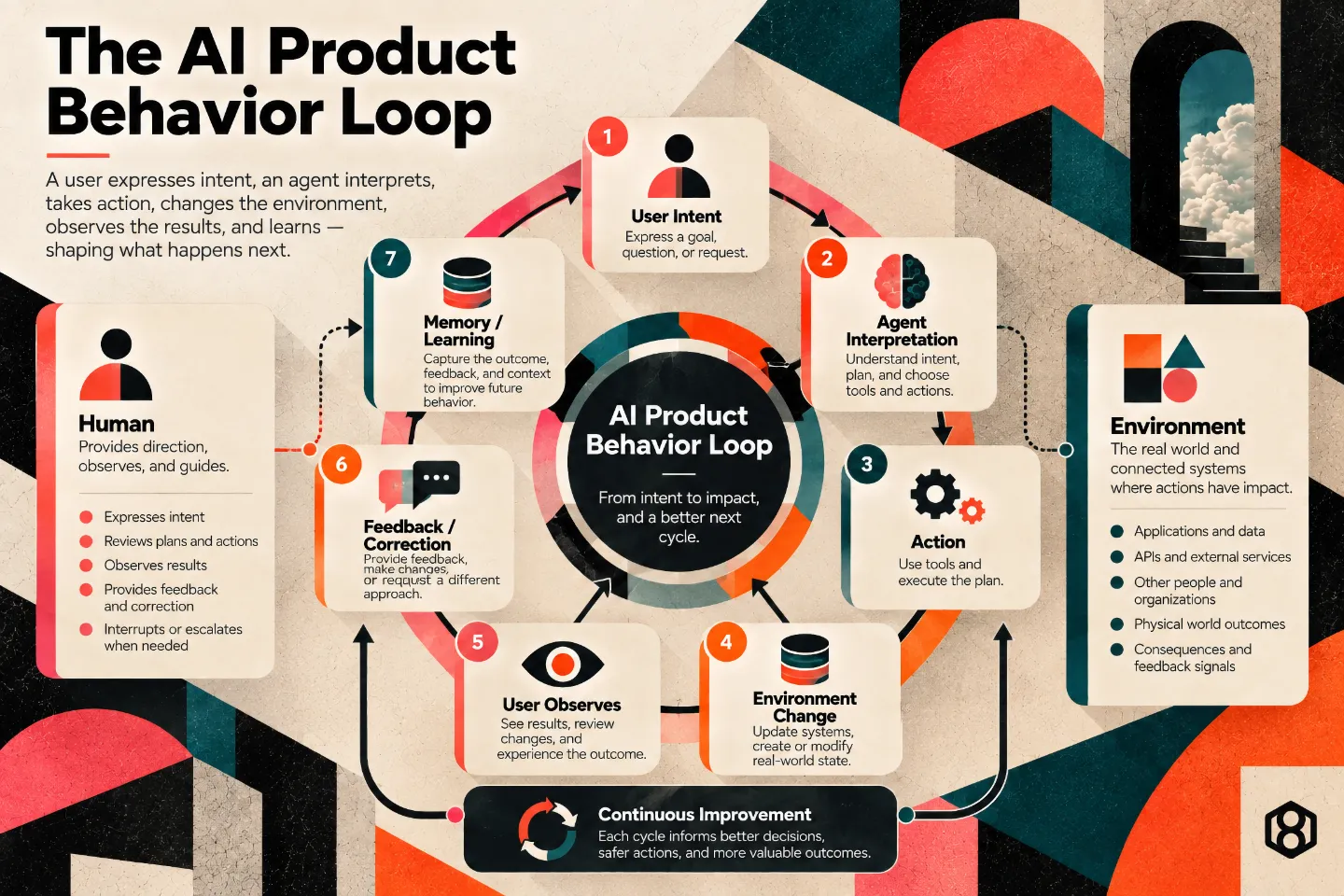
Designers are no longer shaping only an interaction.
They are shaping a behavior loop.
From deterministic flows to probabilistic trajectories
A conventional checkout flow might have a known number of steps.
Agentic systems can reach the same destination through multiple trajectories.
Two users can enter the same intent and experience different plans, decisions, tools, and intermediate states.
That introduces a different design question.
Not merely:
What screen comes next?
But:
What classes of behavior can emerge from here?
That includes what the agent is allowed to do, how uncertainty is represented, what evidence the user sees, when the system asks permission, how the user interrupts it, and how errors are recovered.
The environment is part of the experience
If an agent sends an email, reschedules a meeting, changes a database record, or books a reservation, the experience extends into the world outside the interface.
The product experience now includes:
the user;
the agent;
the tools;
the surrounding environment;
the consequences of action;
and the feedback generated by those consequences.
A polished interface cannot compensate for an agent that changes the wrong state.
Design feedback and recovery
Designers have traditionally invested heavily in happy paths.
Agentic systems demand equal attention to:
uncertainty;
reversibility;
interruption;
verification;
history;
correction;
recovery.
The user needs ways to understand not merely what the system says, but what it has done and what will happen next.
That makes action history, evidence, previews, permissions, undo mechanisms, and escalation part of the core experience.
Map the behavior loop
Journey maps remain useful.
But they are no longer sufficient.
Add another artifact:
a behavior-loop map.
For each significant interaction, identify:
what the user intends;
what the agent infers;
what action becomes possible;
what state changes;
what the user can observe;
what the agent learns;
what becomes more likely on the next cycle.
This is the broader shift agentic products demand.
Product Designers are moving from designing screens, to designing interactions, to designing systems whose behavior evolves over time.
The interface still matters.
But the product is becoming the loop.
Evidence
Sources & references
-
Guidelines for Human-AI Interaction
Supports: Provides a foundational human-AI interaction framework covering uncertainty, correction, adaptation, user control, and interaction over time rather than static interface states.
Source checked
-
People + AI Guidebook
Supports: Supports designing AI products around mental models, feedback, control, explainability, failure, and evolving user-system interaction rather than screen layout alone.
Source checked
-
AI evals for product managers
Supports: Supports evaluating AI products as nondeterministic behavioral systems whose trajectories and outcomes are not fully captured by traditional interface analytics.
Source checked