


Nine years after I left Ateneo de Davao, I was given the opportunity to set foot inside the very walls that kickstarted my career in design. I came back not as a scholar, but as an industry practitioner, someone who has seen the messy, beautiful reality of the work, ready to pass something forward.
SAMAHAN SysDev, the organization responsible for building digital systems for different departments, invited me to give a talk on building an effective design portfolio. The audience was a mix: designers preparing for internships, and a handful of developers curious about how portfolios translate across disciplines.
Like all the talks I give, I didn’t start with rules. I started with a story. I told them how I had no idea how to build a portfolio at their age, and how even today, seasoned designers joke about their portfolios being perpetually unfinished. The truth is: no one really teaches you how to do this. You figure it out in fragments, through rejection, iteration, and quiet observation.
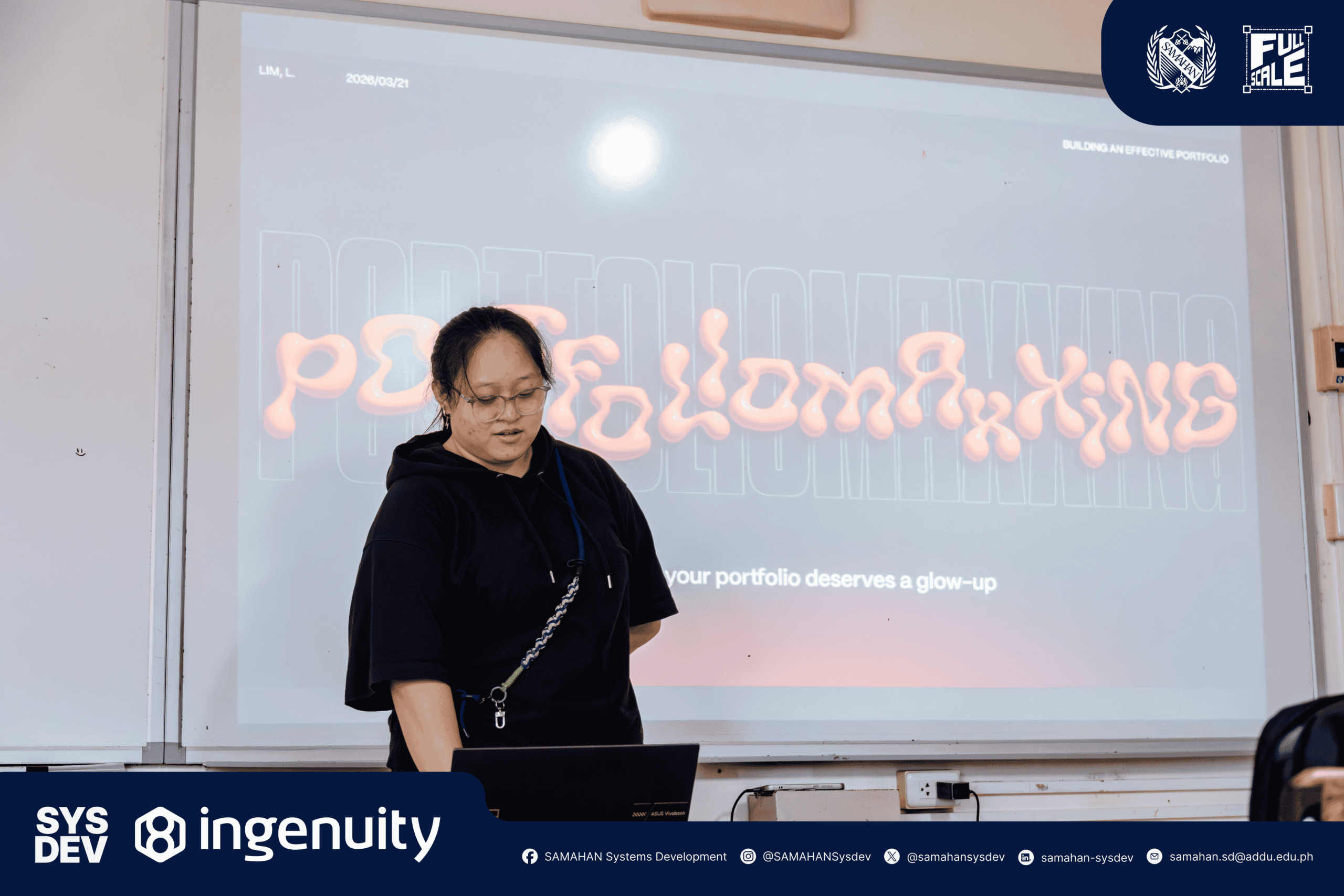
Lessons From My Talk Called “Portfoliomaxxing: Building an Effective Portfolio”
It’s a term I made up from the Gen Alpha slang “looksmaxxing.” Call it what you want: portfoliomaxxing, leveling up, sharpening your edge. At its core, building a portfolio is not about compiling work, it’s about making a case for yourself. A portfolio is not a gallery, not a scrapbook, not a dumping ground of everything you’ve ever made. It is a narrative of your strengths, a curated argument for your value, and a decision-making tool.
1. At First Glance
A recruiter should understand you within seconds who you are, what you do, what you want to do, how you think, what problems you solve, and why they should trust you. If they have to work to figure that out, you’ve already lost them.
2. Curate, Don’t Archive
Most portfolios fail because they try to say everything and end up saying nothing. Your portfolio is not your entire history, it is your direction. Show your best work, show relevant work, and show the kind of work you want to be hired for. If you want to be a UX designer, your portfolio should not leave room for doubt.
3. Show How You Think
Anyone can replicate visuals, but not everyone can explain decisions. This is where case studies come in. Talk about the problem, your approach, the constraints, the trade-offs, and the outcome. Make your thinking visible. That’s where your real value lives.
4. Common Mistakes
After reviewing countless portfolios at Ingenuity, patterns start to reveal themselves: all visuals with no story, process with no point, too much work with too little explanation, and no clear sense of what the person is trying to be hired for. A good portfolio is also a good experience. If it confuses me, I won’t hire you.

5. What Decision-Makers Actually Look For
Yes, craft and visual quality matter but that’s just the baseline. What sets people apart is clarity of thinking, intentionality in curation, and the ability to connect their work to real outcomes: business impact, user value, and measurable results.
6. The “Rainbow Sprinkles”
Once the fundamentals are solid, you earn the right to add flavor. Show your personality, your side quests, and the things you do outside of design. Let people see how you think beyond deliverables, and don’t hide the messy middle, That’s often the most honest, and the most impressive, part of the work.
7. Be Unapologetically You
Stop curating for the person you think they want, and start documenting the designer you actually are. The right opportunities will follow the right story.
What Stayed With Me
What surprised me wasn’t the lack of knowledge, it was the hunger. Everyone had so many questions that were all thoughtful, honest, sometimes uncertain, but never passive. After the talk, a handful of students even stayed behind to ask more questions, conversations stretching longer than expected. Even later, some reached out online to say they learned a lot from the session. That kind of response stays with you. I felt like I made a difference.

Closing the Loop
There’s a strange kind of clarity that comes from returning to where you started. You realize how much of what you know was never formally taught, and how much of it came from doing, failing, adjusting, and trying again. Spaces like this, where industry meets academe, matter because they shorten the distance between confusion and clarity.
Back in my day, we didn’t have talks like this. So if I can stand in that gap, even for a moment, and make the path a little less unclear for someone else, that’s already worth it. Because at some point, someone else will walk back into those same halls, and they’ll have something of their own to pass forward.
