
The fastest-moving conversation in software engineering is still disproportionately focused on models.
Which coding model reasons best? Which benchmark does it lead? How large is its context window? How many hours can it work autonomously?
These are useful questions. But they are no longer the most important ones.
As agents move from suggesting code to planning work, invoking tools, modifying repositories, running tests, interacting with infrastructure, and participating in deployment, reliability becomes a property of the entire engineering system.
A useful way to express the shift is:
Reliability = f(Model, Context, Tools, Memory, Evals, Controls)
The model contributes intelligence. It does not provide the complete reliability boundary.
A capable model can still build the wrong thing
Imagine asking a strong coding agent to add role-based access control to an administrative application.
The agent may understand RBAC perfectly. It may produce elegant code and comprehensive tests.
But several unanswered questions remain:
Where is authorization authoritative? Are roles tenant-specific? Should enforcement occur in the interface, API, database, or all three? What happens to existing sessions? What actions require additional approval? Which events must be auditable?
A capable model can infer answers.
That is precisely the risk.
Weak models often fail visibly. Strong models can produce plausible failures: coherent implementations of assumptions nobody intended.
The code compiles.
The tests pass.
The architecture looks reasonable.
The wrong system ships.
Generation needs assurance
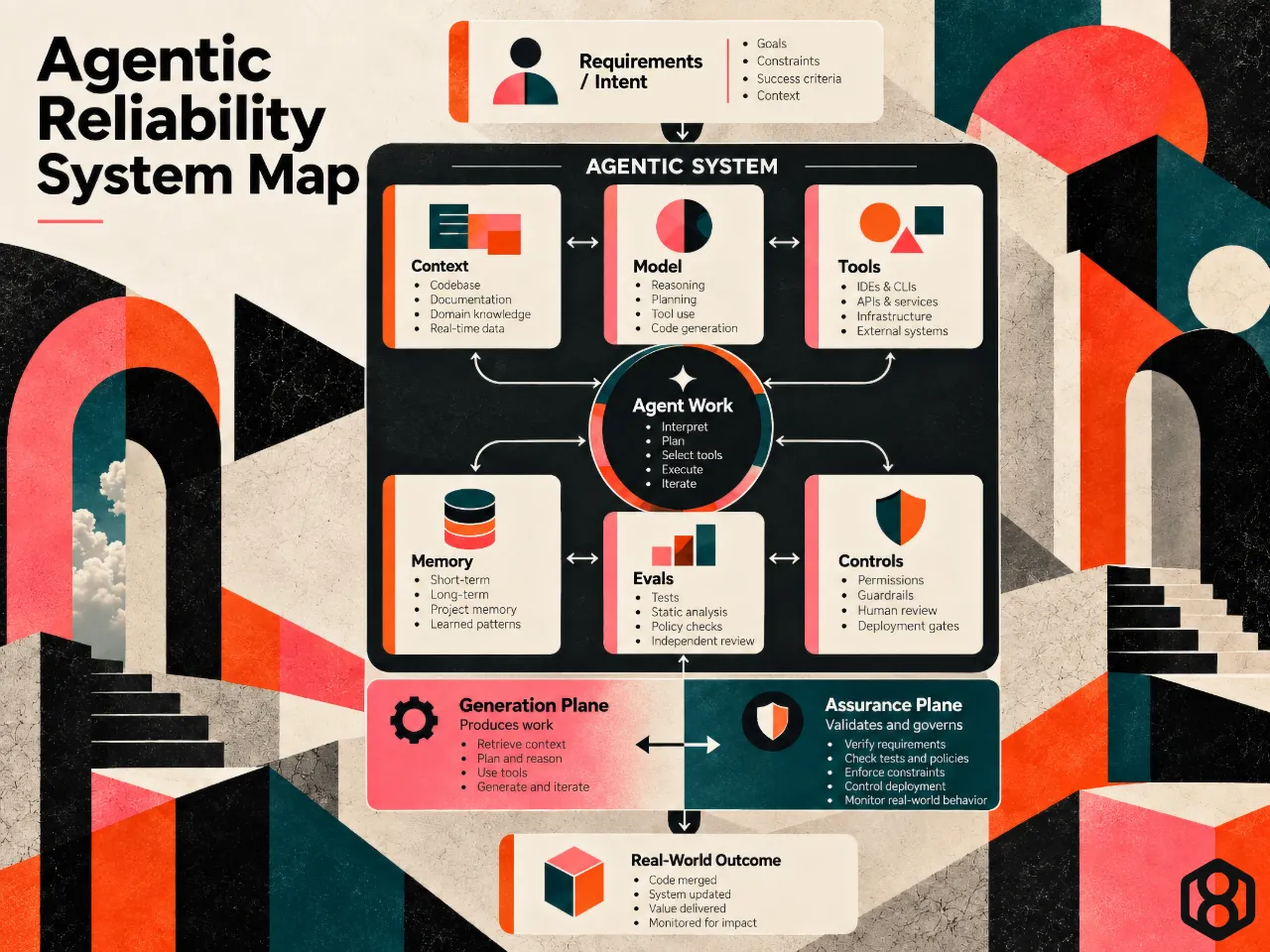
Agentic engineering therefore benefits from separating two related functions.
The generation plane produces work. It interprets the request, retrieves context, plans, selects tools, writes code, executes commands, and iterates.
The assurance plane asks whether that work deserves to progress.
It checks requirements, permissions, architectural constraints, tests, policies, evidence, review conditions, deployment gates, and runtime behavior.
This distinction matters because the same probabilistic process that generates an answer should not always be the only mechanism deciding that the answer is correct.
Agents can review agents. Models can critique models. But wherever correctness can be determined through stronger evidence, the system should use it.
Compile the code.
Validate the schema.
Enforce dependency boundaries.
Run independent tests.
Restrict credentials.
Require approvals for high-blast-radius operations.
Observe production behavior.
Deterministic boundaries around probabilistic workers
Agentic systems do not need every component to be deterministic.
That would defeat much of the value of agents.
Planning benefits from flexibility. Implementation can take multiple valid paths. Investigation often requires exploration.
But permissions should not depend on whether the model remembers a policy.
Architectural invariants should not disappear because an instruction fell out of context.
A destructive database migration should not become acceptable because the agent sounds confident.
The less deterministic the worker becomes, the more important deterministic infrastructure becomes around it.
This changes the engineering problem.
Instead of asking only:
Can the model accomplish this task?
we begin asking:
Under what conditions can this system repeatedly accomplish the task without producing unacceptable outcomes?
Reliability must be end-to-end
Model benchmarks measure a component.
Production reliability measures a journey.
For an agentic engineering system, that journey begins with intent and ends with an observable result in the world.
Did the system understand the right requirement?
Did it use authoritative context?
Were the correct tools selected?
Were actions within permission boundaries?
Did verification challenge the implementation independently?
Was the resulting change safely deployable?
Did production confirm the assumptions?
Could failure be detected and reversed?
These questions define a much more demanding standard than whether an agent completed a coding task.
They also point toward a broader discipline.
Agentic engineering is not simply software engineering performed by AI agents. It is the engineering of the environment in which increasingly autonomous agents can produce dependable results.
That environment includes models.
But the agent is not the system.
And the organizations that understand that distinction will be much better positioned to turn rapidly increasing model capability into something more valuable:
reliable engineering capacity.
Evidence
Sources & references
-
Harness engineering: leveraging Codex in an agent-first world
Supports: Supports the premise that agent performance depends on the surrounding engineering environment, including tools, architecture, tests, constraints, and context—not model capability alone.
Source checked
-
Quantifying infrastructure noise in agentic coding evals
Supports: Shows that infrastructure configuration can materially change measured coding-agent performance, supporting a system-level view of reliability.
Source checked