

”Chats were scattered. Court availability was unclear. Open play schedules were hard to track. Club owners needed better tools to be discovered, manage demand, and grow their community.
Building the Digital Home for Philippine Pickleball
PickleHub is a product created by Ingenuity to support one of the fastest-growing sports communities in the Philippines: pickleball.
Designed for players, coaches, organizers, and club owners, PickleHub brings court discovery, bookings, open plays, tournaments, payments, and club management into one focused digital platform. What started as a simple local opportunity became a full product system built around a very real problem: people wanted to play more, but the coordination around playing was still fragmented.
Why
Players needed a faster way to find where to play.
Coaches and organizers needed better tools to manage sessions.
Club owners needed visibility, scheduling, and booking support.
Coaches and organizers needed better tools to manage sessions.
Club owners needed visibility, scheduling, and booking support.
We Help
Players discover where and when to play
Organizers create and manage open plays
Club owners make their facilities visible, bookable, and easier to operate
PickleHub was built to solve that.
Not as a side project. Not as a generic booking tool. But as a focused local platform designed around the actual rhythm of the Philippine pickleball community.
The Opportunity
Pickleball is growing quickly across the Philippines, with new clubs, courts, open plays, and player groups emerging in different cities.
But as the sport grew, so did the coordination problems.
- Players needed a faster way to find where to play.
- Beginners needed a welcoming way to join open plays.
- Coaches and organizers needed better tools to manage sessions.
- Club owners needed visibility, scheduling, and booking support.
- Communities needed a shared place where the game could happen more easily.
The opportunity was not just to create another sports app.
The opportunity was to create the operating layer for local pickleball activity.
The Challenge
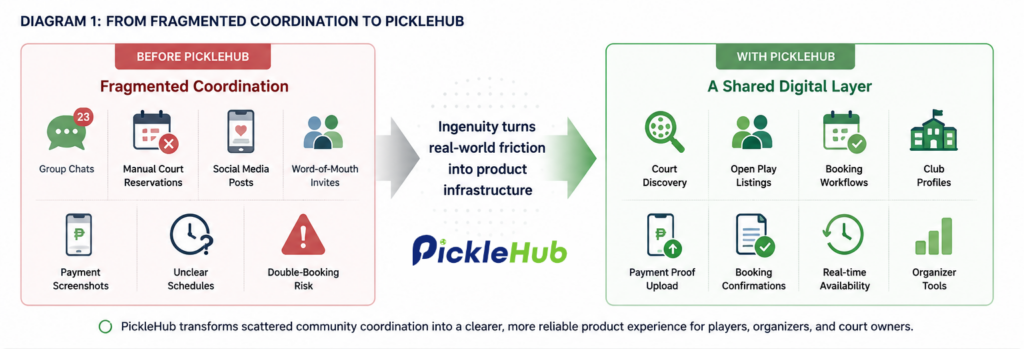
Most recreational sports communities grow through informal systems first: group chats, spreadsheets, manual reservations, walk-ins, social media posts, and word-of-mouth referrals.
That works in the early stage. But once demand increases, informal coordination starts to create friction.
- Players do not always know which courts are available.
- Organizers spend too much time answering repetitive questions.
- Club owners struggle to keep schedules updated.
- Open plays become harder to manage as attendance grows.
- Payments and confirmations become manual and error-prone.
- New players can feel excluded if they are not already inside the right group chat.
PickleHub had to make the experience simpler without making the community feel cold or transactional.
The product needed to feel easy enough for casual players, useful enough for organizers, and credible enough for club owners.
The Ingenuity Approach
Ingenuity approached PickleHub the same way we approach client products: by connecting product strategy, user experience, and software engineering around the real-world behavior of the people using the system.
We were not just asking, “What features should this app have?”
We were asking:
- What makes someone decide to play today?
- What stops a beginner from joining?
- What does a club owner need to manage demand?
- What creates trust before someone books?
- What needs to happen before, during, and after a session?
- Where does manual coordination slow everyone down?
Approach
We were not just asking, “What features should this app have?” We were asking:
From there, we shaped PickleHub around three connected user journeys:
- Players discovering where and when to play
- Organizers creating and managing open plays or events
- Club owners making their facilities visible, bookable, and easier to operate
This helped turn PickleHub from a simple booking idea into a practical product ecosystem.
What We Built
PickleHub was designed as a centralized platform for the Philippine pickleball community.
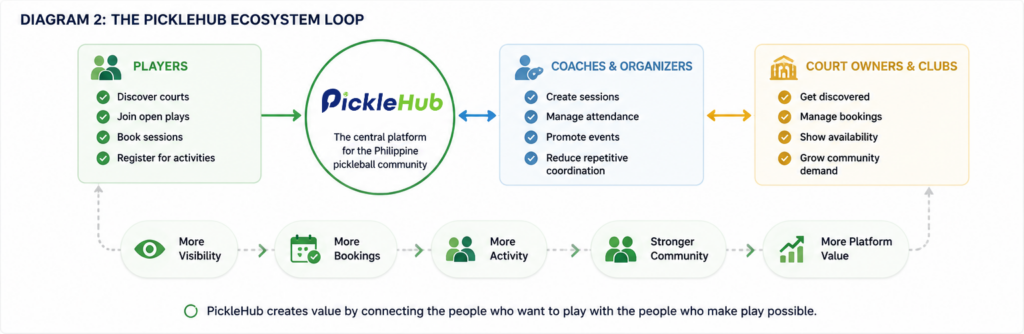
For players, the product makes it easier to discover clubs, join open plays, register for tournaments, and book courts.
For organizers, it provides a more structured way to create sessions, manage participation, and reduce repetitive coordination.
For club owners, it creates a digital presence where their courts can be discovered, listed, promoted, and eventually managed through booking and payment workflows.
Core Product Capabilities Include
Club and Court Discovery
Find nearby pickleball clubs and courts more easily, with key details in one place.
Open Play Listings
Browse available open play sessions so players can join games without relying on private group chats.
Tournament and Activity Visibility
See upcoming tournaments, clinics, and community activities that help players stay active and involved.
Court Booking Workflows
Reserve court time through a clearer booking process designed to reduce back-and-forth coordination.
Booking Confirmation Flows
Give players and organizers a clearer way to confirm reservations and reduce uncertainty.
Club Profile Pages
Help clubs showcase their courts, schedules, location, and community details in a dedicated profile.
Free Club Listing
Allow clubs and club owners to get discovered by the pickleball community at no initial listing cost.
Host and Organizer Pathways
Give hosts and organizers a structured way to create sessions, manage participation, and promote activities.
Real-time Schedule Visibility
Make court and activity schedules easier to view, update, and act on as availability changes.
No More Double Bookings and Manual Coordination
Replace scattered messages and manual tracking with clearer tools that help prevent scheduling conflicts.
The product was built to support both sides of the marketplace: the people who want to play and the people who make play possible.
Product Design: Making the Community Easier to Enter
One of the most important product design challenges was accessibility.
Pickleball is social by nature. But for new players, joining can feel intimidating when activity is hidden inside private chats or closed circles.
PickleHub helps lower that barrier.
Instead of needing to know the right person or belong to the right group, players can discover what is happening, find open plays, and take action through a clearer digital experience.
The design priority was simple: help people move from curiosity to court time with less friction.
That meant making the product feel welcoming, direct, and easy to understand. Players should not need to decode a system just to play a game.
Engineering: Building for Real-World Operations
Behind a simple booking experience is a more complex operational system.
PickleHub needed to account for real schedules, real payments, real venues, real organizers, and real player behavior.
That required engineering decisions focused on reliability, maintainability, and future growth.
The product had to support dynamic listings, changing availability, payment confirmation, club profiles, activity management, and different user roles. It also needed to be flexible enough to evolve as the local pickleball market matured.
Ingenuity built PickleHub with the long-term product in mind: not just what the platform needed on launch, but what it could become as clubs, players, coaches, and organizers adopted it.
Why PickleHub Matters
PickleHub is more than an internal product.
It is a proof point for how Ingenuity thinks and builds.
It shows that strong products do not begin with technology. They begin with a clear understanding of people, behavior, friction, and opportunity.
The technology matters. But the deeper value is in knowing what to build, why it matters, and how it should work in the real world.
PickleHub reflects Ingenuity’s ability to:
- Identify a local market opportunity
- Translate community behavior into product strategy
- Design user journeys for multiple audiences
- Build software that supports real operations
- Create scalable systems for growing markets
- Move from idea to execution with product discipline
This is the kind of work Ingenuity does best: turning complexity into clarity, and turning real-world problems into digital products built to last.
Built Locally. Designed for Growth.
PickleHub was created for the Philippine market, but the thinking behind it applies to many industries.
Sports facilities. Clinics. Schools. Training centers. Membership communities. Local marketplaces. Service businesses. Operations-heavy companies.
Many businesses still run on fragmented workflows: group chats, spreadsheets, manual approvals, repeated follow-ups, disconnected payments, and unclear schedules.
PickleHub shows what happens when those workflows are redesigned into a product experience.
- It becomes easier for customers to take action.
- Easier for operators to manage demand.
- Easier for communities to grow.
- Easier for the business to see what is happening.
That is the deeper value of custom software when it is done well.
It does not just digitize a process.
It creates a better way for the business to operate.
The Result
PickleHub gives the Philippine pickleball community a clearer, more reliable way to discover, organize, and play.
For players
It reduces the friction of finding games and booking courts.
For coaches and organizers
It simplifies session management.
For club owners,
It creates visibility and a path toward more structured operations.

PickleHub Milestones
110
Clubs Listed
445
Open Plays Hosted
140
Bookings Processed
PickleHub is not just a product with Ingenuity’s name behind it.
”It is a living example of Ingenuity’s belief that the best software is built with context, care, and a deep respect for how people actually move through the world.
Have a local product idea worth building?
PickleHub started with a simple insight: a growing community needed a better way to coordinate, book, and play.
Your business may have a similar opportunity hiding inside its daily workflows, customer experience, or manual operations.
Ingenuity helps founders and business owners in Davao City turn real-world problems into digital products, platforms, and systems built for growth.