


Agility Isn’t About Speed. It’s About Coherence.
For years, organizations have treated agility like a race.
Faster sprints.
Shorter cycles.
More frequent releases.
The modern software engineer is trained to move quickly. Ship often. Iterate relentlessly. Optimize for velocity.
And yet, many of the fastest teams still struggle to scale.
Velocity increases.
Clarity fades.
Decisions are revisited.
Architecture drifts.
Strategy becomes something discussed quarterly and compromised daily.
The problem is not execution.
It is coherence.
The Hidden Tradeoff of Speed
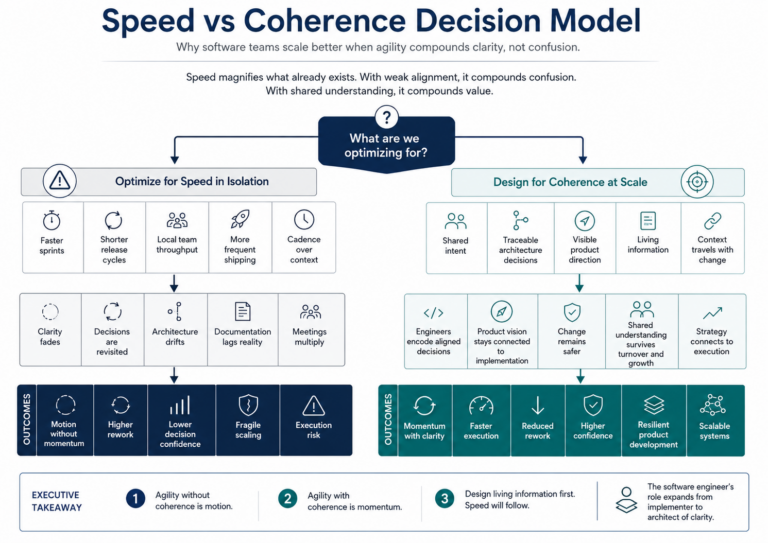
Speed does not create alignment. It magnifies whatever already exists.
If shared understanding is strong, speed compounds value.
If alignment is weak, speed compounds confusion.
Most Agile frameworks optimize local efficiency. Team throughput. Sprint predictability. Release cadence.
But global coherence is different.
It is the invisible architecture that connects product vision to technical decisions. It is the continuity between what leadership intends and what the software engineer implements. It is shared meaning that survives turnover, growth, and market shifts.
Without coherence, agility collapses under scale.
Why This Matters to Every Software Engineer
A software engineer does not just write code. They encode decisions.
Every abstraction, every API boundary, every data model carries assumptions about how the organization thinks and where it is going.
When those assumptions are misaligned, the system fragments.
Refactoring becomes constant.
Meetings multiply.
Documentation lags behind reality.
The codebase becomes a reflection of organizational entropy.
True agility is not about moving faster. It is about ensuring that movement remains aligned with intent.
That requires something deeper than sprint rituals.
It requires living information.
Coherence Is an Information Problem
High-performing organizations share a defining trait.
They retain shared understanding even as people, priorities, and markets evolve.
They do not rely on memory.
They do not rely on heroic leaders.
They do not rely on meetings to re-establish clarity.
They encode intent directly into how information lives, changes, and connects.
Architecture decisions remain traceable.
Product direction stays visible.
Strategic intent is not lost between Jira tickets and production releases.
For the software engineer, this changes everything.
Instead of building in isolation, they build within a system that carries meaning forward.
Agility without coherence is motion.
Agility with coherence is momentum.
From Speed to Living Systems
When information becomes living, the organization becomes adaptive.
Documentation evolves with code.
Strategy connects to execution.
Context travels with change.
The role of the software engineer expands from implementer to architect of clarity.
Because scalable systems are not built on speed alone.
They are built on shared understanding.
This realization became the first step toward what we now call the Living Information Model.
It begins with a simple shift:
Stop optimizing for velocity in isolation.
Start designing for coherence at scale.
Speed will follow.
But this time, it will compound clarity.
