


Most organizations don’t fail at Agile adoption.
They succeed.
Right up until they don’t.
Scrum works beautifully for small, focused teams. Kanban improves flow. SAFe introduces coordination. At first, everything feels lighter. Faster. Clear.
Then complexity grows.
And something subtle begins to fracture.
The frameworks multiply.
Understanding fragments.
The Scaling Illusion
Scaling Agile often looks impressive on paper.
More teams.
More ceremonies.
More tooling.
More layers of coordination.
What it rarely creates is more shared meaning.
Teams optimize locally. Roadmaps begin to diverge. Architectural decisions drift quietly over time. Customer intent dissolves into tickets and metrics.
Everyone is productive.
Few are aligned.
This is where the illusion reveals itself.
Activity increases.
Coherence decreases.
The best design agency sees this early.
Because great design is not decoration. It is decision architecture.
The Hidden Cost of Fragmentation
At scale, friction rarely comes from disagreement.
It comes from decision amnesia.
Why did we choose this approach?
What constraints shaped this architecture?
Which tradeoffs were intentional?
When decisions are not preserved, organizations pay for them again and again.
Refactoring becomes routine.
Revisiting strategy becomes normal.
Alignment becomes a recurring meeting instead of a sustained state.
Agile frameworks assume decisions are lightweight and disposable.
Complex systems prove the opposite.
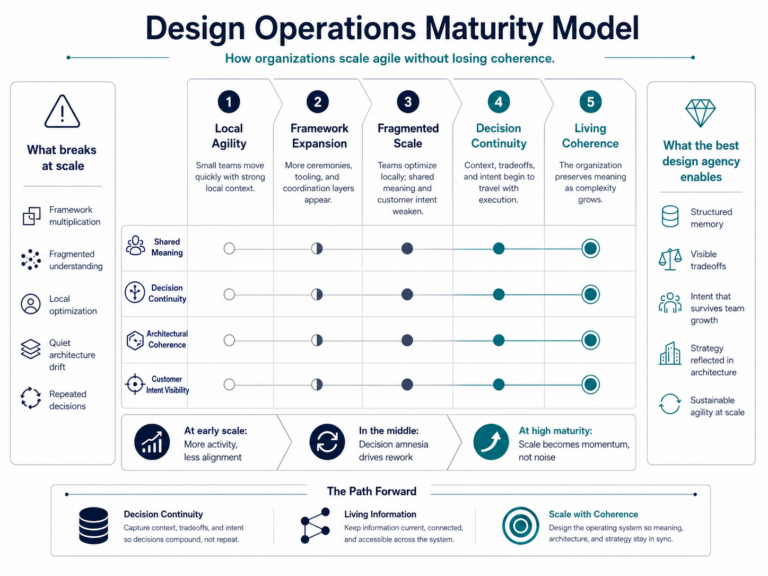
The Missing Ingredient: Decision Continuity
The best design agency does not simply implement frameworks.
It designs for continuity.
Decision continuity means:
-
Context travels with execution
-
Tradeoffs remain visible over time
-
Intent survives team expansion
-
Architecture reflects strategy, not just velocity
In other words, the system remembers.
Because without memory, scale becomes noise.
Beyond Process: Designing a System of Memory
Agility is a powerful execution engine. But execution alone cannot sustain coherence.
At scale, organizations need more than process.
They need structured memory.
They need living information that evolves with the system.
They need design thinking applied not just to interfaces, but to how decisions live inside the organization.
This is the difference between adopting Agile and scaling intelligently.
It is also what separates good from exceptional.
The best design agency understands that scaling is not about multiplying frameworks.
It is about preserving meaning as complexity grows.
And meaning, once designed well, becomes momentum.
