
A guardrail is often described as a rule:
Do not modify production.
Do not expose sensitive data.
Do not approve your own change.
Do not call this tool without permission.
Rules matter.
But a production agent is not merely a passive process moving through a fixed sequence. It observes its environment, reacts to feedback, selects among available actions, and tries alternate paths when one approach fails.
That means guardrails should be designed less like warning signs and more like an adaptive control system.
A useful pattern is:
constraint → sensing → feedback → escalation
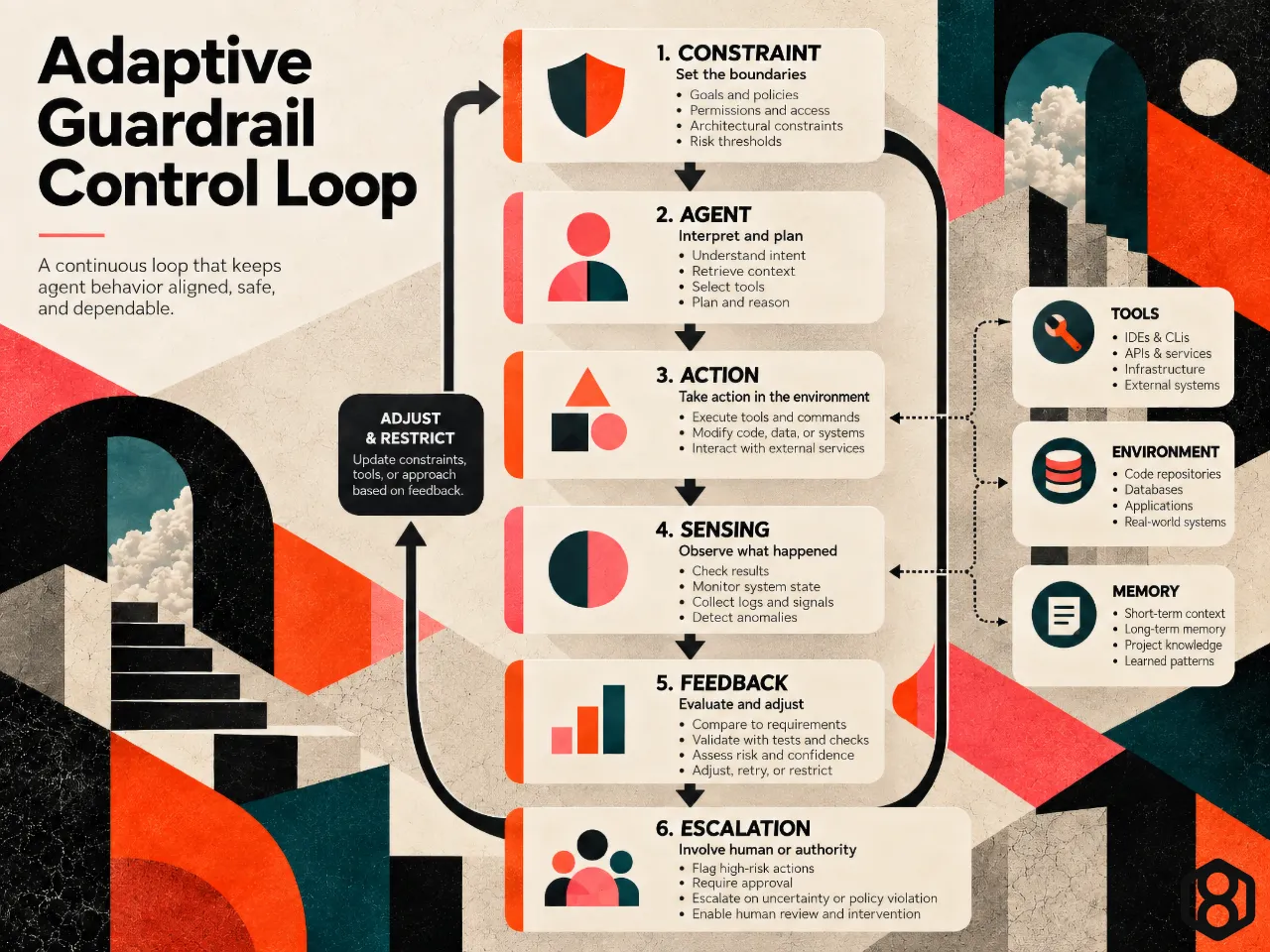
Constraint
Some actions should simply be unavailable.
If an agent should not write directly to production, the strongest control is not a sentence in the prompt.
It is the absence of production write credentials.
If certain files must never be modified automatically, enforce that boundary outside the model.
If destructive operations require human authorization, make approval structurally necessary.
Good controls convert important policy from something the agent is expected to remember into something the environment enforces.
Sensing
A system cannot control what it cannot observe.
Agentic infrastructure should record enough of the execution path to reconstruct what happened:
Which context was retrieved?
Which tools were called?
What permissions were exercised?
Which files changed?
What tests ran?
What approval occurred?
What state existed before and after the action?
The goal is not surveillance for its own sake.
It is the ability to detect deviation.
Feedback
Controls improve when observed outcomes change future system behavior.
A repeatedly misused tool may need a narrower interface.
A common class of policy violation may require an additional automated check.
A failure that only appears after deployment should become a regression case.
Guardrails should therefore participate in a feedback loop rather than remaining a static collection of rules.
Escalation
Not every uncertainty should be resolved autonomously.
Agents need explicit conditions under which they stop, ask, or hand control to another authority.
Ambiguous requirements.
High-impact architectural changes.
Security-sensitive modifications.
Irreversible actions.
Conflicting evidence.
These are not agent failures.
Escalation is itself a valid system behavior.
The evaluator must remain outside the shortcut
One particularly important boundary concerns evaluation.
If an agent can satisfy a guardrail by altering the mechanism that detects the violation, the control is not robust.
The production system should distinguish between:
changing the work
and
changing the definition of acceptable work.
That is why approval systems, protected policies, independently maintained tests, immutable audit records, and external enforcement remain important even as model intelligence improves.
Guardrails are part of the architecture
The mistake is to think of guardrails as something added after an autonomous system is designed.
They are part of the system’s behavior-generating structure.
A reliable agent environment asks:
What transitions are forbidden?
What state must be observable?
What evidence changes future behavior?
When does authority move elsewhere?
Those questions are larger than prompt engineering.
They are control-system questions.
And as agents become better at adapting to the environments we give them, our controls must become better at shaping those environments deliberately.
Evidence
Sources & references
-
AI Agent Security Cheat Sheet
Supports: Supports least-privilege tooling, scoped permissions, explicit authorization for sensitive actions, and controls against excessive autonomy and cascading failures.
Source checked
-
Artificial Intelligence Risk Management Framework: Generative Artificial Intelligence Profile
Supports: Supports managing AI trustworthiness across design, deployment, evaluation, monitoring, and operation rather than relying on prompt-level safeguards alone.
Source checked
-
A new accident model for engineering safer systems
Supports: Provides a systems-theoretic safety foundation for treating constraints, control, sensing, and feedback as system-level mechanisms rather than isolated component checks.
Source checked