
Five agents checking one another sounds safer than one.
Sometimes it is.
But the number of agents is not the same thing as the number of independent judgments.
A useful reminder is:
N_agents ≠ N_independent evaluators
Imagine five reviewers.
They use the same model family.
They receive the same requirement.
They read the same repository context.
They inherit the same design document.
They use the same evaluation rubric.
If the original requirement contains a mistaken assumption, each reviewer may reproduce it.
Consensus rises.
Truth does not.
Independence is a system property
Traditional reliability engineering has long recognized the danger of common-mode failure.
Redundancy helps only when redundant components do not fail for the same reason.
Agent systems inherit the same problem.
Two evaluators may appear independent because they are separate processes while remaining strongly correlated through:
model architecture;
prompt structure;
retrieved context;
training assumptions;
shared tools;
identical examples;
shared data sources;
the same flawed specification.
This makes evaluator diversity more important than evaluator count.
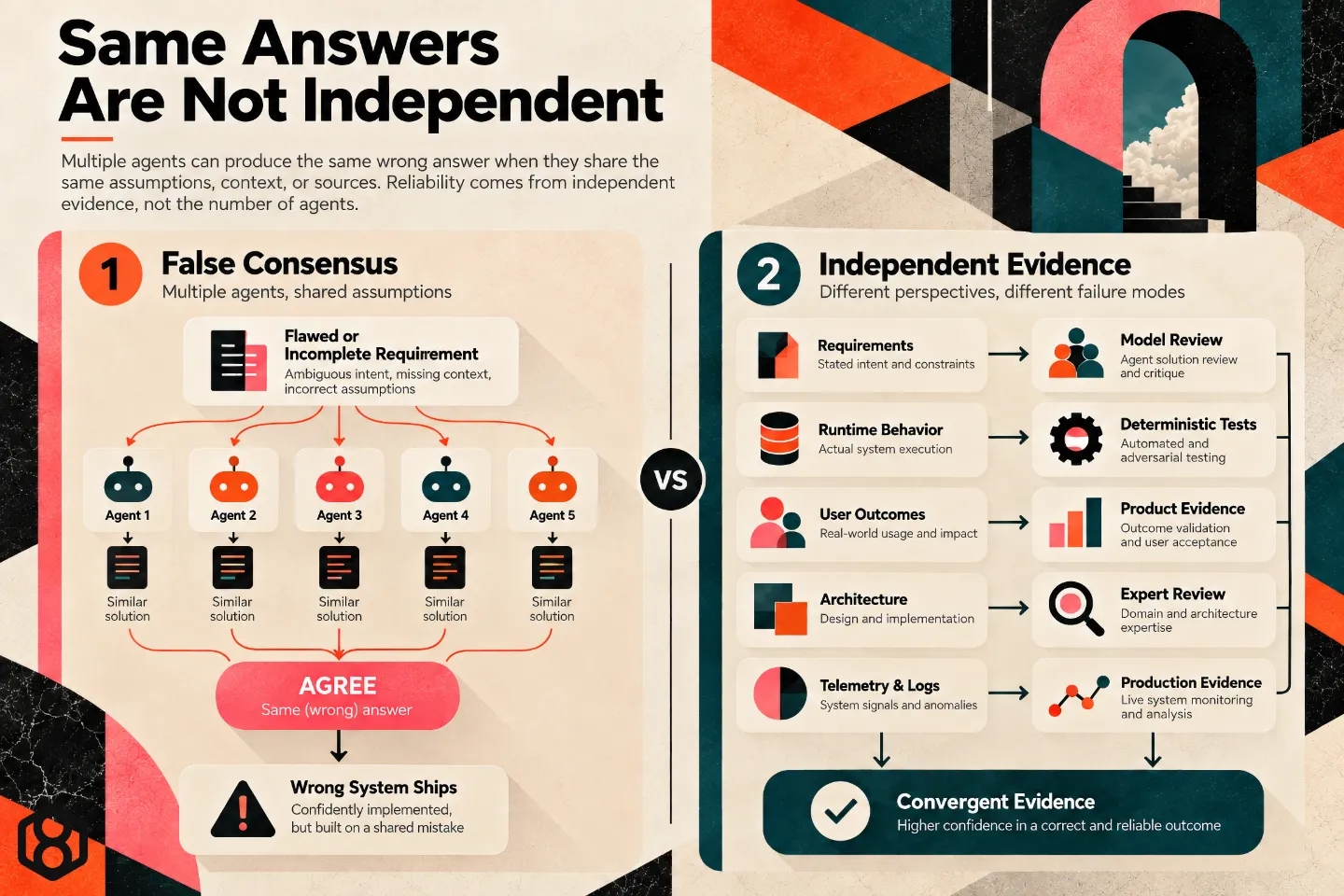
Design disagreement deliberately
Independence can be increased across several dimensions.
Use a different model family for critical review.
Generate some tests without exposing the implementation.
Give one evaluator only the requirements and another only observed behavior.
Use deterministic tooling where it provides stronger evidence than model judgment.
Assign explicit adversarial roles.
Bring production telemetry into evaluation rather than relying exclusively on synthetic cases.
Ask a human specialist to review the highest-consequence assumptions.
The point is not to maximize disagreement.
It is to make agreement more meaningful.
Consensus can be inherited
Suppose an architecture document contains an incorrect statement about an API.
The implementation agent reads it.
The test agent reads it.
The documentation agent reads the generated code.
The reviewer reads all three artifacts.
The same false assumption now appears in four places.
To a later agent, those sources may look like independent corroboration.
They are not.
They share an ancestor.
This suggests another requirement for reliable systems:
trace the lineage of evidence.
Where did this claim originate?
Which artifacts derive from it?
Which sources were genuinely independent?
Once agentic systems create large volumes of mutually reinforcing artifacts, provenance becomes part of reliability.
Effective evaluator independence
A future reliability metric may therefore need to capture not only the number of reviewers, but their effective independence.
Ten identical judges should not count as ten units of assurance.
A model review, deterministic test, human domain expert, production trace, and independent specification may collectively provide much stronger evidence than ten agents all reading the same material.
The lesson is straightforward:
Consensus is valuable only when its errors are not inherited from the same ancestor.
Multi-agent systems can create remarkable parallelism.
Reliability requires something harder:
independent ways to discover that everyone may be wrong.
Evidence
Sources & references
-
Correlated Errors in Large Language Models
Supports: Provides direct evidence that LLM errors can be substantially correlated, weakening the assumption that multiple model judgments are independent.
Source checked
-
Demystifying Multi-Agent Debate: The Role of Confidence and Diversity
Supports: Supports the importance of viewpoint and model diversity in multi-agent evaluation and the limits of homogeneous agent debate.
Source checked
-
The impact of diversity upon common mode failures
Supports: Provides the classical reliability-engineering foundation that redundancy offers less protection when supposedly independent components share common-mode failure.
Source checked