
Traditional software quality asks:
How many defects did we create?
Agentic systems introduce another question:
How many new defects can one defect create?
This matters because agent-generated artifacts increasingly become inputs to future agents.
A mistaken abstraction can propagate into:
code;
tests;
documentation;
migration scripts;
API consumers;
generated examples;
persistent memory.
One upstream mistake can therefore produce a family of downstream failures.
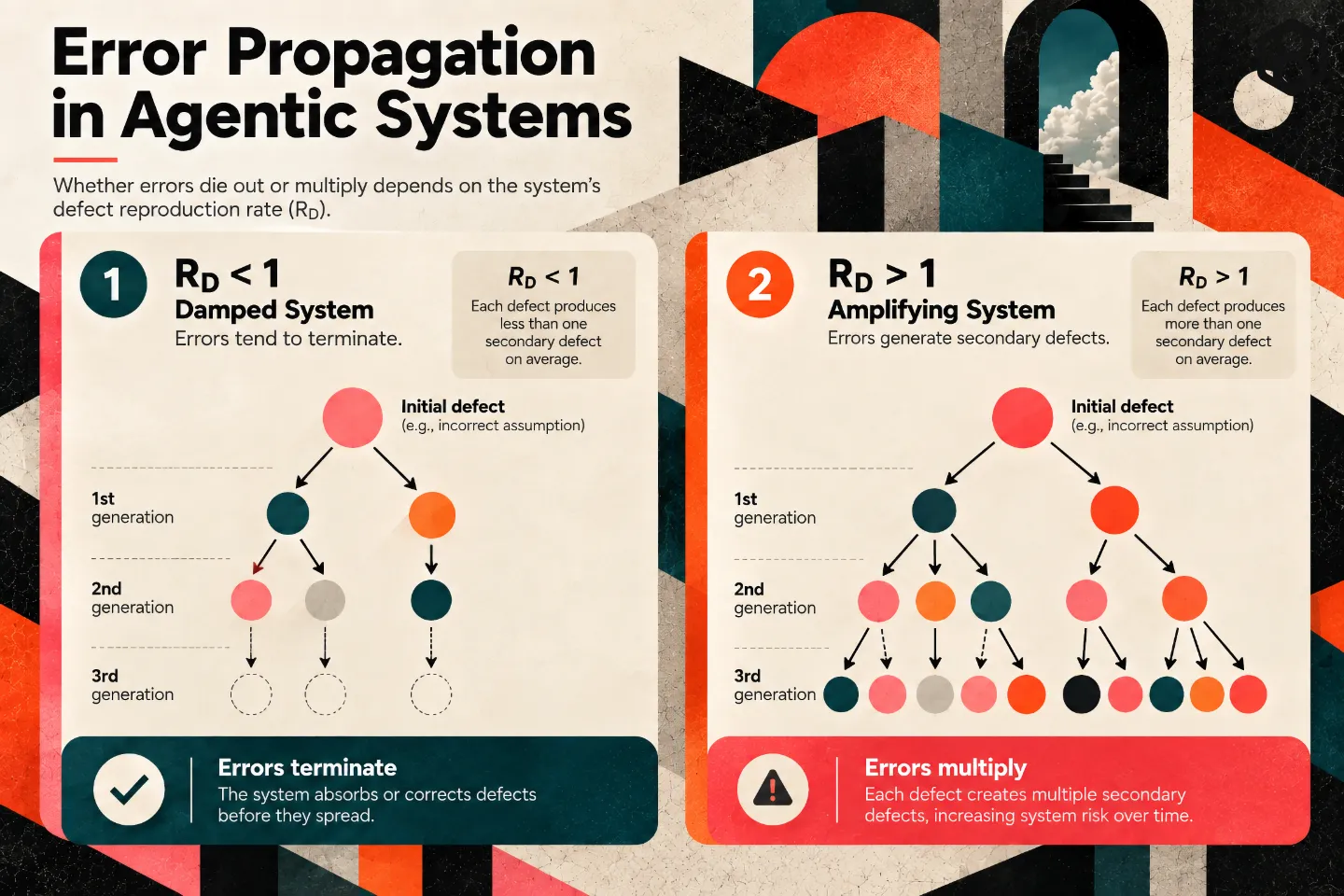
A useful metric is the Defect Reproduction Rate:
R_D = E[secondary defects caused by one upstream defect]
When:
R_D < 1
errors tend to die out.
When:
R_D > 1
the system amplifies them.
Not all defects are equal
A typo in an isolated UI label has low reproductive potential.
A false assumption in a domain model may have enormous reproductive potential.
It can alter database structure, API semantics, business logic, test fixtures, documentation, integration behavior, and future agent context.
This means engineering teams should evaluate defects partly according to propagation potential, not only severity at the point of discovery.
Where can this error travel?
What artifacts derive from it?
What processes will consume those artifacts?
Can future agents mistake the derived artifacts for independent evidence?
Reliability requires dampening
A mature agentic system should contain mechanisms that reduce reproduction.
Independent tests can stop a flawed implementation from propagating.
Protected requirements can prevent agents from silently redefining success.
Provenance can reveal that five agreeing artifacts share one mistaken ancestor.
Review gates can stop high-blast-radius assumptions before implementation.
Memory quarantine can prevent an unresolved claim from entering persistent context.
Rollback can contain a production failure.
Each mechanism acts as a form of dampening.
Its job is not necessarily to eliminate the original error.
Its job is to reduce how far the error can travel.
This changes how we think about quality
A factory with many defects can still improve if defects are quickly detected, contained, and prevented from reproducing.
A factory with relatively few defects may be fragile if each mistake spreads broadly before detection.
Reliability is therefore partly ecological.
We care about the reproduction dynamics of error inside the engineering environment.
That changes where teams should invest.
Finding every mistake at the instant it occurs may be impossible.
Building a system in which mistakes struggle to reproduce is much more achievable.
The practical question becomes:
When an error enters this factory, what makes it die?
That may become one of the defining reliability questions of agentic development.
Evidence
Sources & references
-
Component-based modeling of cascading failure propagation in directed dual-weight software networks
Supports: Provides direct support for modeling how failures propagate through interconnected software components as cascading processes.
Source checked
-
Reliability prediction for component-based software systems: Dealing with concurrent and propagating errors
Supports: Supports software reliability models that explicitly account for propagating errors and fault-tolerance mechanisms.
Source checked
-
Architecture Anti-Patterns: Automatically Detectable Violations of Design Principles
Supports: Empirically shows that architectural relationships can propagate error-proneness and change-proneness across large software systems.
Source checked