


Note: To give credit where credit is due, much of the material in this article is based on and inspired by the work of Gordon Pask, Paul Pangaro and related work on Conversation Theory.
Introduction
Generative artificial intelligence has made producing information remarkably easy.
A person can now create a report, summarize a meeting, draft software requirements, analyze customer feedback, or generate working code in minutes. Yet many organizations are discovering that faster production does not automatically lead to better decisions, stronger products, or more productive teams.
The problem is not always the capability of the AI.
Often, the problem is the quality of the conversation surrounding it.
When an AI system produces something vague, incorrect, or irrelevant, we tend to blame the prompt or the model. But prompts do not exist in isolation. They are part of an exchange between participants attempting to create meaning, reach agreement, and coordinate action.
That makes generative AI a surprisingly natural setting for revisiting Conversation Theory.
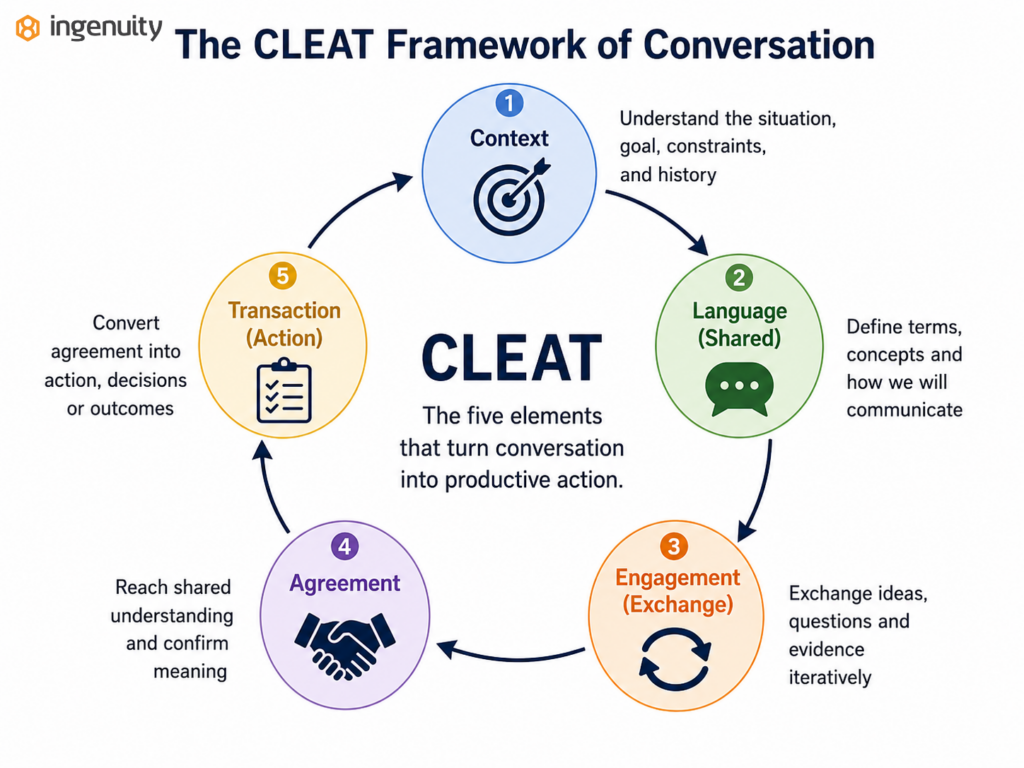
Developed by British cybernetician Gordon Pask, Conversation Theory examines how cognition and learning emerge through exchanges between participants. Rather than treating communication as the simple transmission of information, it focuses on how people develop shared understanding through interaction. Ingenuity’s internal training translates this process into five practical elements: Context, Language, Engagement, Agreement, and Transaction—CLEAT.
These ideas provide a useful framework for understanding why some people become dramatically more productive with AI while others generate little more than polished noise.
Information Is Not the Same as Meaning
Information theory gave us powerful ways to understand how information can be quantified, stored, and transmitted. But as the Ingenuity training emphasizes, information theory deals primarily with information—not necessarily with meaning.
Generative AI exposes the importance of this distinction.
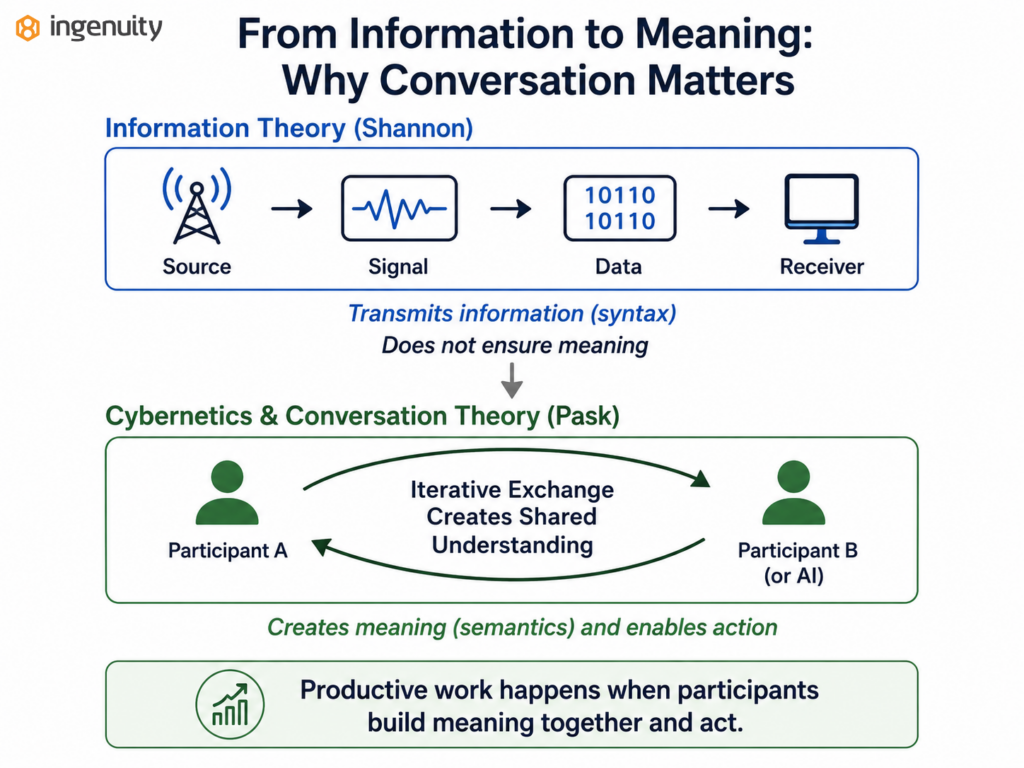
Information can be transmitted without being understood. Conversation turns information into shared meaning and coordinated action.
An AI system may produce a technically polished answer that is:
- based on the wrong assumptions,
- optimized for the wrong audience,
- disconnected from the actual business problem,
- inconsistent with organizational constraints, or
- incapable of supporting a real decision.
In other words, it may successfully transmit information without creating useful meaning.
Conversation Theory helps us move beyond the simplistic idea that productivity comes from giving an AI the perfect instruction. Instead, productivity emerges through an iterative process in which the participants clarify the situation, establish common language, evaluate responses, correct misunderstandings, and eventually agree on an action.
This is not merely philosophical. Research on generative AI in the workplace has found real productivity improvements, but those gains vary substantially between users and tasks. A large study of customer-support agents found an average productivity increase of approximately 14%, with the greatest gains among less experienced workers. (NBER) Another field experiment involving thousands of knowledge workers found that active users spent roughly two fewer hours on email each week, although individual access to AI did not automatically transform the overall composition of their work. (NBER)
The lesson is important: access to AI creates potential. How the interaction is structured determines how much of that potential becomes useful.
AI Productivity Through the CLEAT Framework
Ingenuity’s Conversation Theory training presents conversation as a progression:
Context → Shared Language → Engagement → Agreement → Transaction
Each element addresses a common failure point in human–AI collaboration.
1. Context: Help the AI Understand the Situation
Most weak AI interactions begin with insufficient context.
Consider a request such as:
Create a strategy for launching our new product.
The instruction is understandable, but almost everything necessary for a useful answer is missing.
- What product?
- For which market?
- At what stage of maturity?
- What resources are available?
- What constraints exist?
- What has already been tried?
- What would success look like?
Without this information, the AI must fill the gaps with assumptions. The resulting strategy may sound reasonable while being almost entirely detached from reality.
A stronger request defines the operating environment:
We are a 25-person software engineering and product design agency based in Davao. We want to introduce an AI readiness assessment for Philippine enterprise companies. Our buyers are likely to be CIOs, transformation leaders, and business-unit executives. We have limited marketing resources and need a strategy that can generate qualified conversations within three months.
The difference is not verbosity. It is situational clarity.
Context allows the AI to reason within the boundaries of the real problem. It also makes hidden assumptions visible so they can be questioned.
Before using AI for meaningful work, teams should establish:
- the objective,
- the audience,
- the constraints,
- the relevant history,
- the available evidence,
- the desired standard of quality, and
- the decision the output must support.
Context is not background decoration. It is part of the system.
2. Shared Language: Define What Important Words Mean
Human teams frequently use the same words while meaning different things.
Terms such as innovation, strategy, platform, prototype, AI-ready, enterprise-grade, and customer experience can conceal major disagreements. Generative AI often amplifies this problem because it can produce a plausible interpretation without revealing that its definition differs from ours.
Conversation Theory suggests that coordinated action requires a shared language.
When working with AI, this means defining important concepts before asking the system to apply them.
For example:
For this discussion, “AI readiness” refers to the organization’s ability to deploy AI reliably across five dimensions: information quality, technical infrastructure, governance, workforce capability, and operational integration.
This definition creates a common reference point. It reduces ambiguity and makes the output easier to evaluate.
Shared language can also include:
- terminology and acronyms,
- strategic principles,
- brand voice,
- technical conventions,
- decision criteria,
- definitions of quality,
- examples of acceptable outputs, and
- distinctions between closely related concepts.
This is one reason reusable context libraries, design systems, taxonomies, style guides, architectural decision records, and organizational knowledge models are becoming increasingly valuable. They give both humans and AI a more stable language for reasoning together.
The better an organization defines what it knows, the easier it becomes for AI to work within that knowledge.
CLEAT provides a practical structure for moving a conversation from initial context to shared understanding and productive action.
3. Engagement: Treat the Exchange as Iterative
The popular image of AI productivity is often transactional:
Write prompt.
Receive answer.
Copy result.
Move on.
But productive conversations rarely work this way.
The first response is usually the beginning of the work, not the end.
Engagement means examining the response, asking questions, introducing new evidence, testing alternatives, and allowing the exchange to change the participant’s understanding of the problem.
Instead of asking AI to “write the strategy,” a more productive sequence might be:
- Ask the AI to identify missing information.
- Request several competing interpretations of the problem.
- Examine the assumptions behind each interpretation.
- Generate possible approaches.
- Compare them against defined criteria.
- Challenge the strongest approach.
- Refine it using evidence and stakeholder feedback.
This turns AI from an answer generator into a reasoning partner.
It also protects against one of the most dangerous characteristics of generative AI: its ability to make incomplete thinking appear finished.
Engagement keeps the work open long enough for learning to occur.
4. Agreement: Confirm Understanding Before Acting
In Conversation Theory, conversation enables participants to reach agreement. Agreement does not necessarily mean that everyone holds the same opinion. It means that the participants have developed enough shared understanding to coordinate what happens next.
With AI, this step is often skipped.
A person receives an answer, sees that it looks polished, and immediately uses it in a presentation, proposal, product specification, or codebase. But no one has confirmed whether the output actually reflects the intended problem.
Before acting, ask the AI to restate its understanding:
Summarize the problem you believe we are solving, the assumptions you are making, and the criteria you are using to evaluate the solution.
This simple step can reveal substantial misunderstandings.
Agreement can also be tested by asking:
- What conclusions have we reached?
- What remains uncertain?
- Which assumptions require validation?
- What evidence supports the recommendation?
- What trade-offs are we accepting?
- What would cause us to change direction?
- Which parts require human approval?
Agreement should not be confused with trusting the AI.
It is a checkpoint for confirming that the human and the system are operating from a sufficiently aligned interpretation of the problem.
5. Transaction: Convert the Conversation Into Action
A conversation becomes productive when it changes what happens next.
The Ingenuity training describes the final element of CLEAT as a transaction or action. The conversation should produce something that can be done, tested, evaluated, or decided.
A weak AI exchange ends with a document.
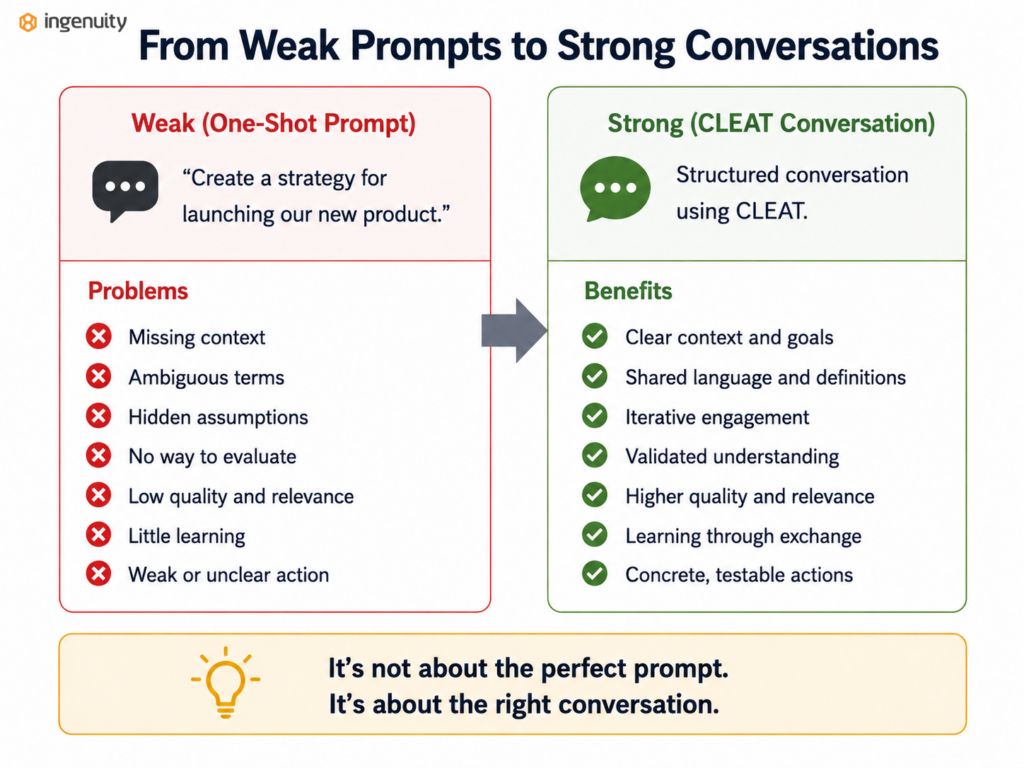
A stronger exchange ends with:
- a decision,
- a prioritized backlog,
- a testable prototype,
- an experiment,
- a customer interview plan,
- a revised process,
- an assigned responsibility,
- a measurable next step, or
- a clearly documented uncertainty.
For example, asking AI to “analyze customer complaints” may produce a useful summary. But the conversation becomes operational only when the insights are translated into actions:
Group the complaints by root cause, estimate their relative frequency, identify which causes are within our control, and propose three experiments the product team can run during the next sprint.
The goal is not merely to generate knowledge. It is to coordinate intelligent action.
From Prompts to Structured Conversations
One of the most practical ideas in Ingenuity’s training is the concept of structured conversations: reusable patterns of interaction designed to guide participants toward a particular objective. Examples include stand-up meetings, retrospectives, user stories, stakeholder maps, customer journeys, service blueprints, empathy interviews, prototypes, A/B tests, and Lean Canvases.
These tools are valuable because they reduce the cognitive burden of beginning from nothing. They establish roles, questions, sequences, boundaries, and expected outcomes.
The same principle can be applied to generative AI.
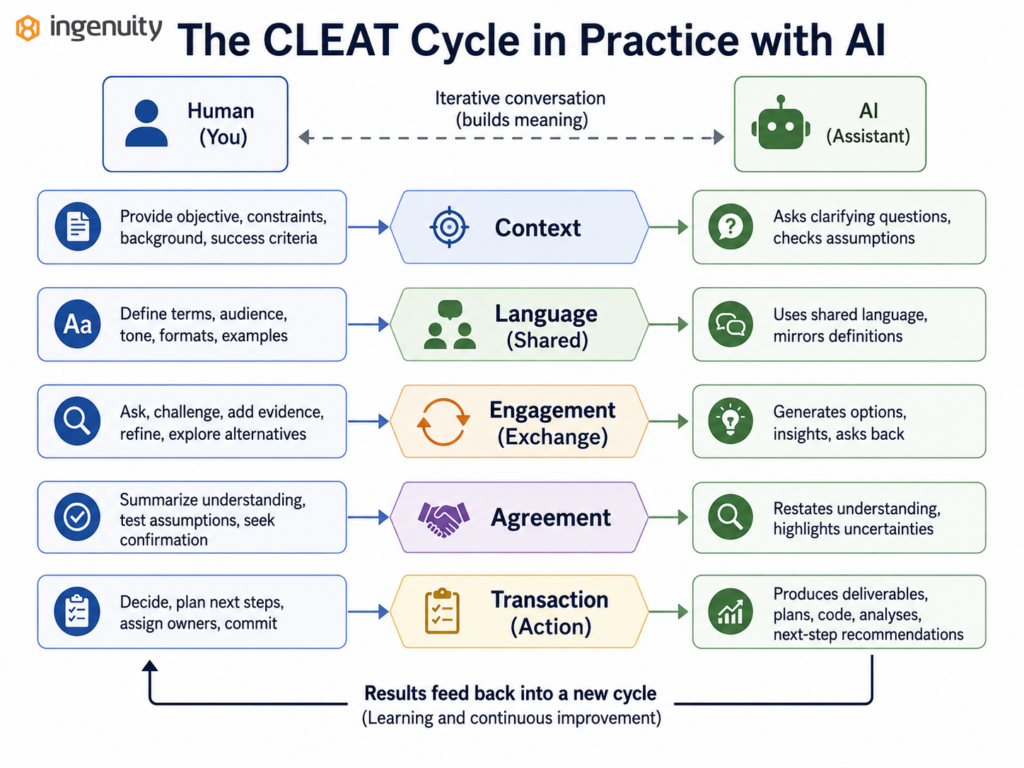
Productive AI use is an iterative exchange in which people provide direction, evaluate responses, confirm understanding, and turn results into action.
Instead of maintaining a collection of isolated prompts, organizations can design reusable AI-assisted conversations.
An AI-Assisted Decision Review
- Define the decision.
- Identify affected stakeholders.
- List known evidence.
- Surface assumptions.
- Generate competing options.
- Evaluate each option against agreed criteria.
- Identify risks and uncertainties.
- Recommend a decision.
- Define what would invalidate the recommendation.
- Assign the next action.
An AI-Assisted Product Discovery Conversation
- Describe the observed user problem.
- Separate observations from interpretations.
- Identify missing evidence.
- Generate alternative problem framings.
- Map stakeholder needs.
- Propose testable hypotheses.
- Design the smallest useful experiment.
- Define success and failure signals.
- Record what was learned.
An AI-Assisted Retrospective
- Summarize what was expected.
- Compare expectations with outcomes.
- Identify important deviations.
- Explore possible causes.
- Distinguish systemic causes from isolated events.
- Identify what should continue, stop, or change.
- Convert findings into owners and actions.
These structures make AI use more repeatable, teachable, and governable. They also prevent productivity from depending entirely on whether an individual happens to be a talented prompt writer.
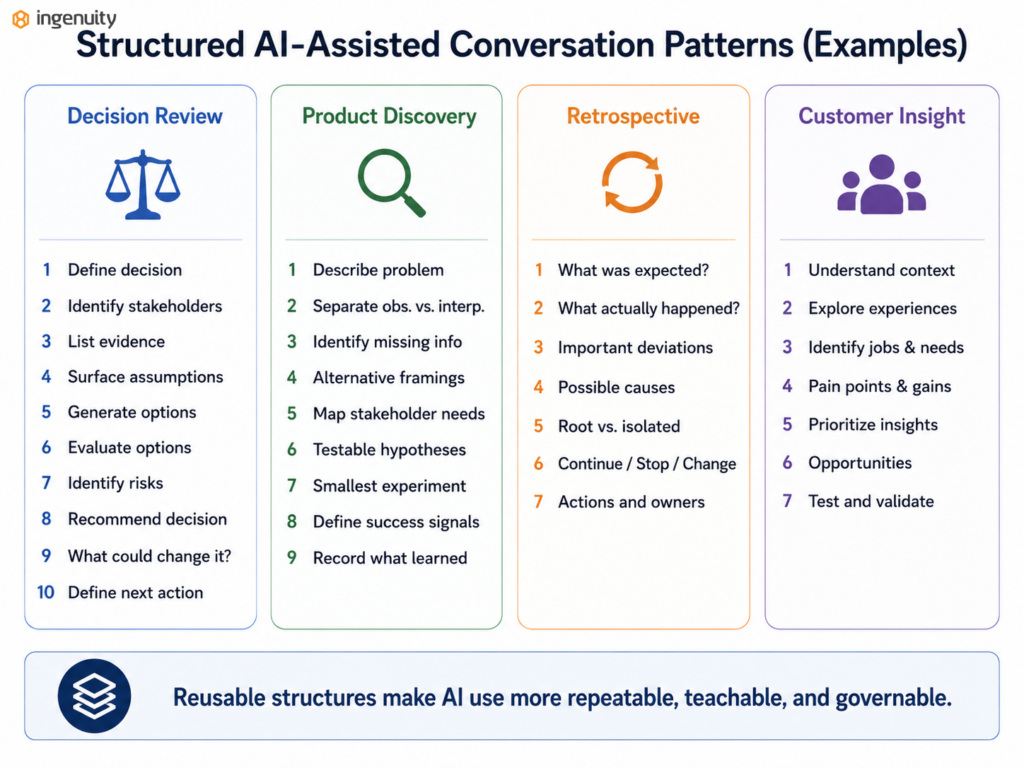
Reusable conversation structures make AI-assisted work more consistent, teachable, repeatable, and governable.
The organization is no longer designing prompts. It is designing conversations.
The Human Role Becomes More Important, Not Less
Conversation Theory also challenges the assumption that AI productivity comes from removing people from the process.
AI can accelerate synthesis, generation, comparison, and exploration. But humans remain responsible for defining purpose, interpreting context, evaluating meaning, negotiating trade-offs, and accepting accountability for action.
In fact, as the cost of producing content falls, these human capabilities become more valuable.
The scarce resource is no longer the ability to generate an answer.
It is the ability to determine:
- which question deserves attention,
- what information should be trusted,
- which constraints matter,
- what quality looks like,
- whether participants truly agree,
- and what action should follow.
The most productive AI users will not necessarily be those who type fastest or memorize the largest collection of prompts. They will be the people who can frame problems clearly, ask revealing questions, recognize ambiguity, evaluate evidence, and design conversations that move from uncertainty toward coordinated action.
Designing Better AI Conversations
The training offers several questions for evaluating a conversation: Is the first message clear? Does it offer value? Is the meaning easily understood? Does the exchange respect the participants’ context, interests, needs, and values? Does it maintain continuity while introducing something new?
Applied to generative AI, these questions become a practical design discipline.
Before beginning an important AI interaction, ask:
Context
- What does the system need to understand about the situation?
- Which constraints and previous decisions matter?
Language
- Which terms require explicit definitions?
- What examples establish the expected standard?
Engagement
- How will the response be questioned, tested, and refined?
- Which stakeholders or sources should be introduced into the exchange?
Agreement
- How will we confirm that the output reflects the intended problem?
- Which assumptions and uncertainties remain unresolved?
Transaction
- What decision, experiment, or action should result?
- Who is accountable for verifying and carrying it forward?
This approach does not make AI infallible.
It makes the interaction more capable of detecting and correcting failure.
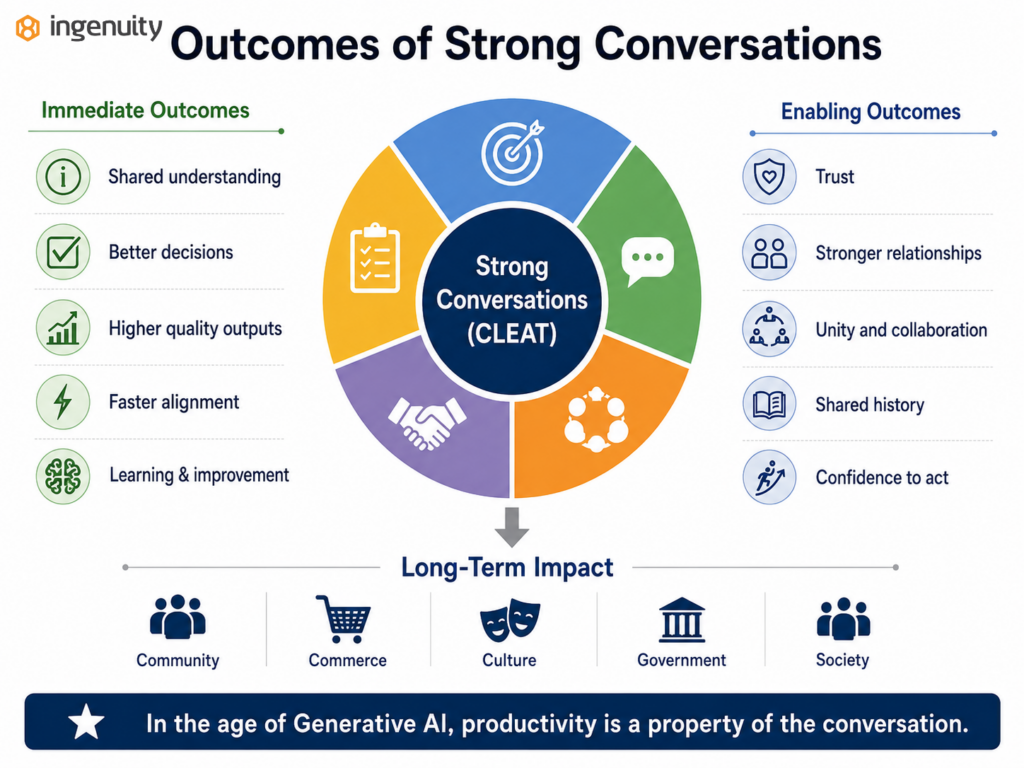
Strong conversations improve immediate work outcomes while building the trust, relationships, and shared history required for long-term collaboration.
Productivity Is a Property of the Conversation
Generative AI can reduce the time required to produce an artifact. But organizational productivity depends on much more than the speed of production.
It depends on whether the artifact creates shared understanding.
Whether the reasoning survives scrutiny.
Whether the right people can reach agreement.
Whether the output supports a useful action.
Whether the organization learns from what happens next.
Conversation Theory gives us a way to see AI not as an isolated machine producing answers, but as one participant within a wider system of people, language, knowledge, decisions, and actions.
That distinction matters.
The future of productive work will not be defined by how many prompts we send or how much content our systems generate.
It will be defined by our ability to design better conversations—between people, between teams, and increasingly, between humans and machines.
Because in the age of generative AI, the quality of the outcome will still depend on the quality of the conversation.
