


Filipino professionals are widely valued for their adaptability, warmth, technical capability, and commitment to helping clients succeed. These qualities have made the Philippines an important global destination for outsourcing, professional services, software development, design, customer support, and remote work.
Yet strong work does not always translate into strong client confidence.
In international service relationships, clients evaluate more than the final output. They also assess how clearly a provider communicates, how quickly problems are raised, how decisions are made, and whether responsibility is visibly owned.
This creates a potential gap between the quality of the work being delivered and the quality the client believes they are receiving.
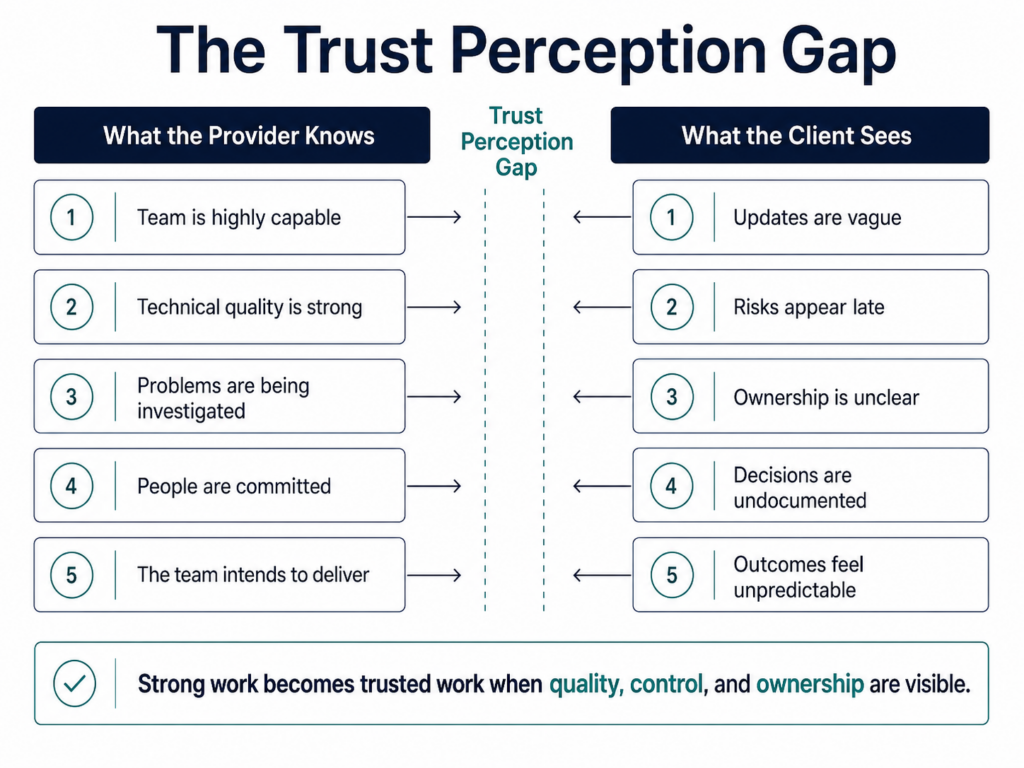
A team may be highly capable, hardworking, and well-intentioned. But if communication is vague, risks are raised too late, or accountability appears unclear, a foreign client may develop the wrong impression. They may assume the provider lacks control, maturity, confidence, or strategic judgment.
The good news is that these risks can be reduced. Filipino employees and business owners do not need to abandon the relational strengths that make them effective. They need to combine those strengths with clearer systems, more visible ownership, and more direct communication.
Understand How Clients Evaluate Service Quality
Many service providers assume that clients judge quality primarily by the finished deliverable.
In reality, clients often evaluate quality through the entire experience.
They notice whether:
-
- deadlines are realistic and consistently managed;
- risks are communicated before they become emergencies;
- decisions are documented;
- questions receive clear answers;
- commitments have named owners;
- problems are acknowledged without defensiveness;
- the provider offers recommendations instead of waiting for instructions;
- the client feels informed, supported, and in control.
A strong deliverable cannot always compensate for a stressful or unpredictable process.
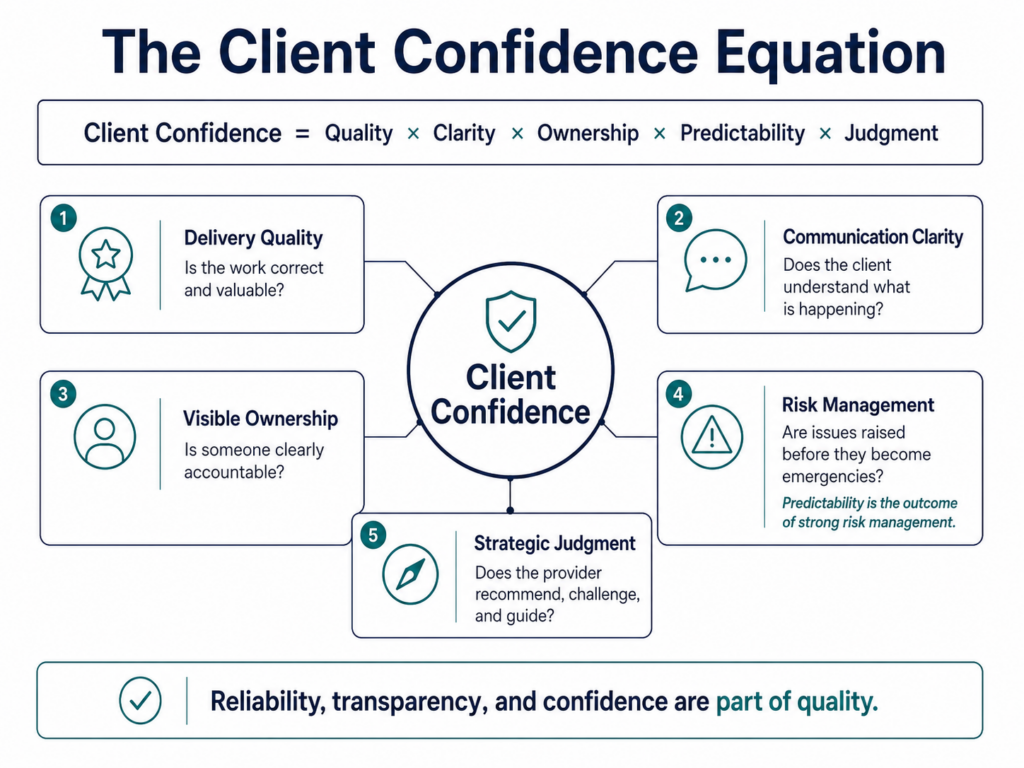
For many clients, reliability is part of quality. Transparency is part of quality. Confidence is part of quality.
Replace Vague Reassurance with Clear Information
Filipino professionals are often careful not to worry, disappoint, or embarrass clients. This may lead to well-intentioned reassurance such as:
-
- “We are still checking.”
- “There may be a slight delay.”
- “We will do our best.”
- “The team encountered some challenges.”
- “We are working on it.”
These statements may sound polite, but they do not provide enough information for a client to make decisions.
A better response explains the situation clearly:
“We identified an issue affecting the integration. The current estimate is a two-day delay. Maria owns the resolution, and we will provide the next update by 3:00 p.m. tomorrow. We are also reviewing an alternative approach that could reduce the impact.”
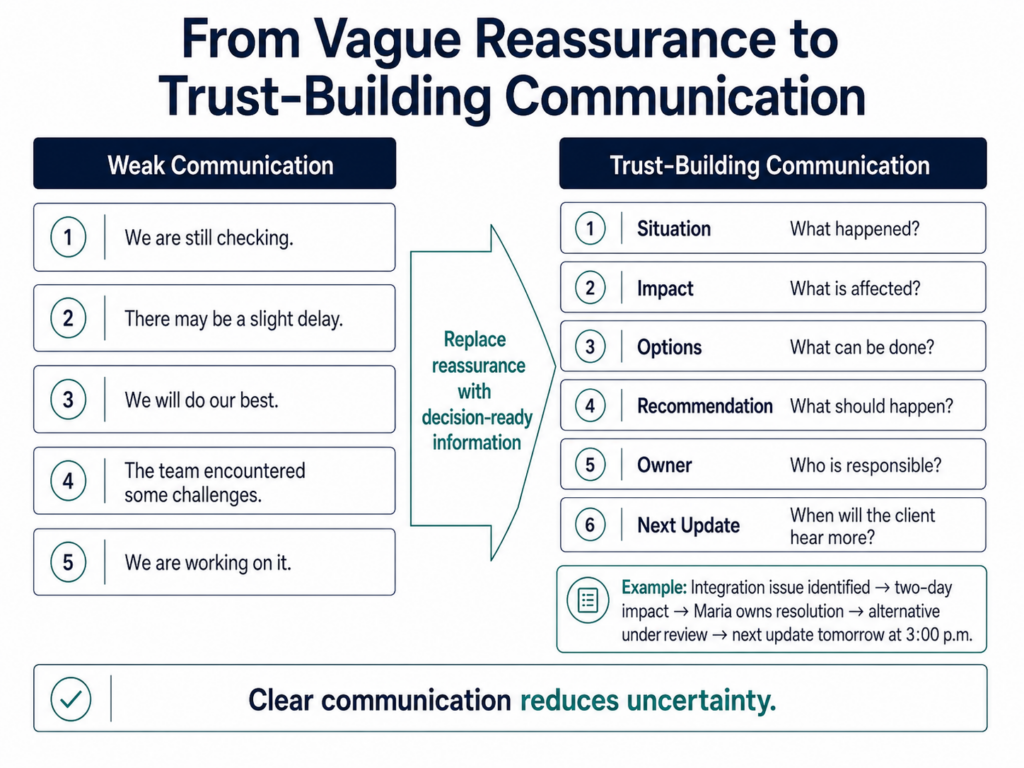
This type of communication does not create unnecessary alarm. It gives the client clarity.
The goal is not to sound harsh or overly formal. The goal is to remove ambiguity.
Raise Risks Before They Become Problems
One of the fastest ways to lose client trust is to reveal a problem only when the outcome can no longer be changed.
Teams sometimes delay escalation because they want to understand the issue fully, avoid appearing unprepared, or solve the problem before telling the client. While the intention may be good, the delay can make the client feel excluded or misled.
Early escalation communicates control.
Employees should be encouraged to raise concerns when:
-
- a deadline may be at risk;
- a requirement is unclear;
- a dependency is outside the team’s control;
- the current approach may create quality or security issues;
- additional budget, time, or client input may be required.
Business owners should make it safe for employees to communicate these concerns without fear of blame.
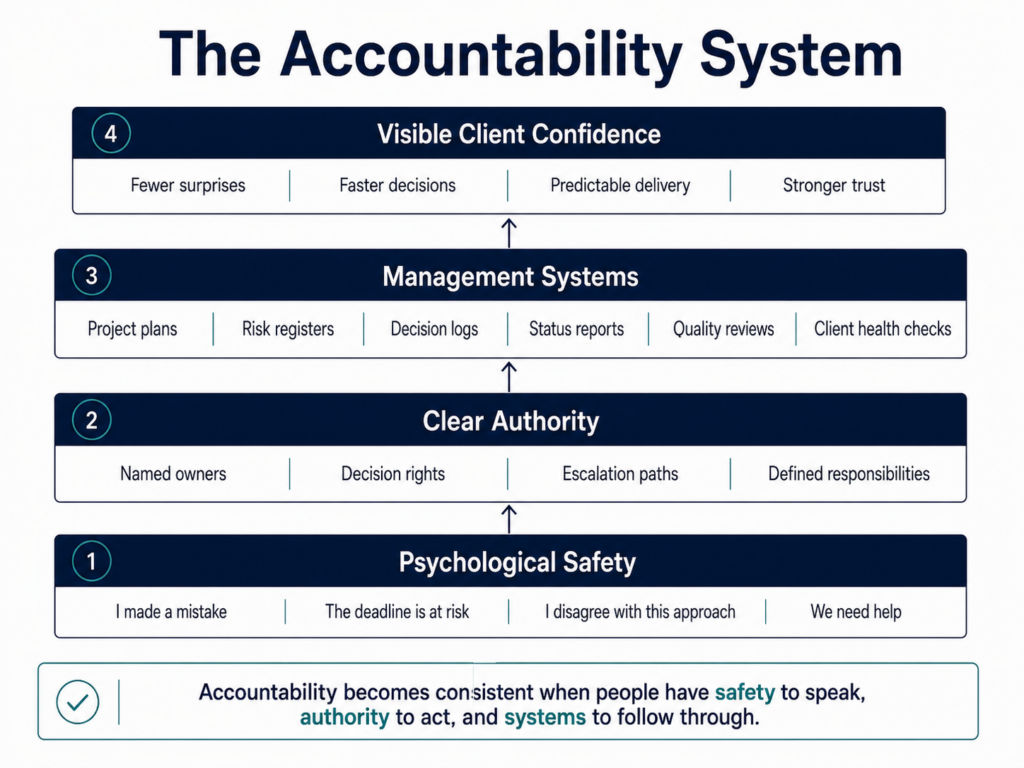
A useful escalation format is:
-
- What happened?
- What is the likely impact?
- What options are available?
- What does the team recommend?
- Who owns the next action?
- When will the client receive another update?
This turns escalation into a professional management practice rather than an admission of failure.
Make Ownership Visible
Clients lose confidence when responsibility appears to belong to everyone and no one.
Phrases such as “the team is handling it” or “we are checking internally” can make ownership unclear.
Every important deliverable, issue, and decision should have one named owner.
That person does not need to perform every task. They are responsible for ensuring that the work moves forward, updates are provided, and decisions are not lost.
Visible ownership can be reinforced through:
-
- project plans with named owners;
- written meeting summaries;
- decision logs;
- risk registers;
- weekly status reports;
- clearly assigned next steps;
- agreed deadlines and review dates.
This creates confidence because the client can see that the provider has control over the engagement.
Admit Mistakes Without Becoming Defensive
Some professionals fear that admitting a mistake will damage the client relationship.
In practice, clients often lose more trust when a provider avoids responsibility, minimizes the problem, or provides explanations that sound like excuses.
A mature response is direct:
“We missed this requirement during the review. That was our responsibility. We have corrected the issue and added a validation step to prevent it from happening again.”
This type of response does three things:
-
- acknowledges the problem;
- demonstrates accountability;
- shows that the organization is learning.
Accountability does not require self-blame or public embarrassment. It requires honesty, corrective action, and prevention.
Business owners should model this behavior. Employees are unlikely to admit mistakes if leaders punish transparency but tolerate concealment.
Distinguish Explanations from Excuses
Context matters, but excessive explanation can sound like avoidance.
Clients may need to understand why something happened, but they usually care more about what will happen next.
A weak response focuses on circumstances:
The delay happened because several people were unavailable and we were also waiting for another department.
A stronger response combines context with ownership:
“Two dependencies were not confirmed on time, and we did not escalate the risk early enough. We have reassigned the remaining work, adjusted the review process, and expect completion by Friday.”
The difference is subtle but important.
An explanation helps the client understand the situation. An excuse asks the client to accept the consequences without confidence that the problem is being managed.
Learn to Disagree Professionally
Foreign clients do not always expect agreement. In many cases, they expect their service provider to offer judgment.
A team that always says yes may appear cooperative, but it can also appear passive or inexperienced.
Employees should feel comfortable saying:
“We can follow that direction, but we believe it creates a risk to performance.”
“Based on the current scope, we recommend a phased approach.”
“We do not believe the proposed deadline is realistic without reducing the scope or adding resources.”
“Professional disagreement should be evidence-based, respectful, and solution-oriented.”
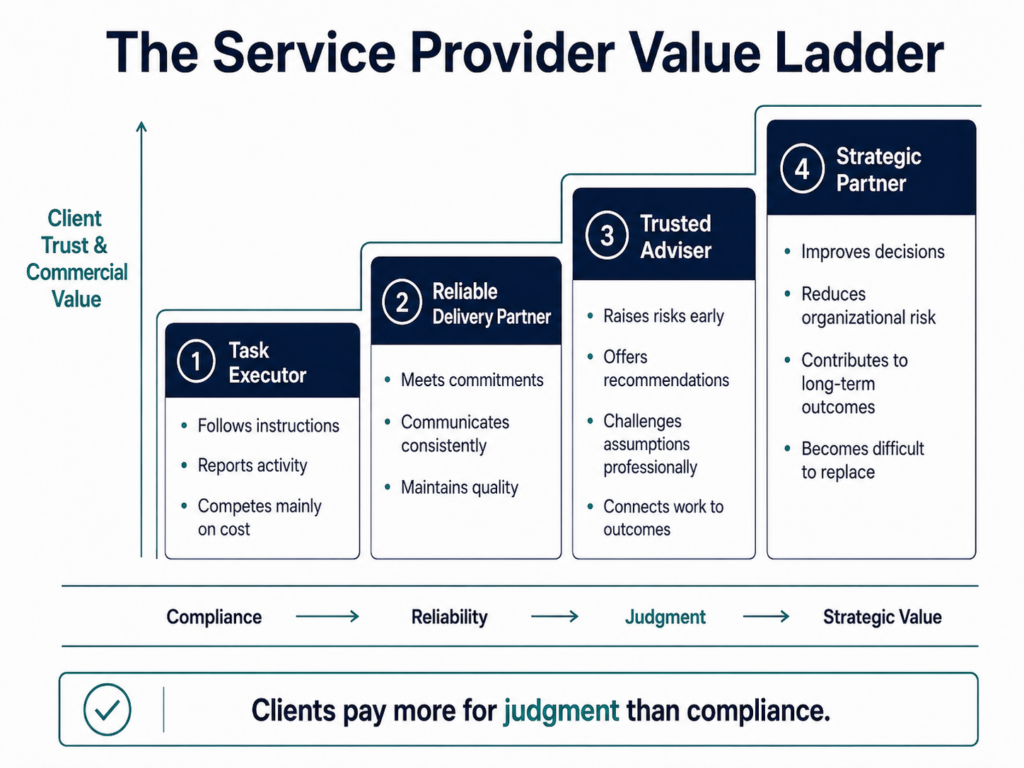
This is especially important for providers that want to move beyond execution work and become strategic partners.
Clients pay more for judgment than compliance.
Confirm Understanding Instead of Assuming It
Many misunderstandings begin because both sides believe they have agreed, while interpreting the agreement differently.
After meetings, providers should confirm:
-
- what was decided;
- what remains unresolved;
- who is responsible for each action;
- what will be delivered;
- when it will be delivered;
- what assumptions are being used.
A brief written summary can prevent days or weeks of confusion.
For example:
To confirm our agreement, we will deliver the revised prototype by August 14. The client will provide the final content by August 8. The current estimate does not include additional user-testing rounds.
This is not unnecessary bureaucracy. It is a form of client care.
Communicate Progress in Terms of Outcomes
Clients may not understand the effort behind the work. A long list of completed tasks does not always communicate value.
Instead of reporting only activity, connect the work to its business impact.
Rather than saying:
“We completed the dashboard components and updated the API.”
Say:
“The dashboard now gives managers a single view of operational performance, while the API changes reduce the risk of inconsistent data across departments.”
Service providers should regularly translate their work into:
-
- time saved;
- risks reduced;
- errors prevented;
- decisions improved;
- revenue supported;
- customer experience strengthened;
- operational effort removed.
When clients understand the outcome, they are less likely to evaluate the provider purely on hourly rates or staffing costs.
Do Not Make the Client Chase for Updates
Even good work can feel unreliable when the client must repeatedly ask for status.
Teams should establish a predictable communication rhythm, such as:
-
- weekly status updates;
- milestone reviews;
- risk notifications;
- monthly business reviews;
- regular demonstrations;
- post-project retrospectives.
A useful status update should answer:
-
- What was completed?
- What is in progress?
- What is at risk?
- What decisions are needed?
- What happens next?
Consistency reduces anxiety and gives the client confidence that the engagement is being actively managed.
Train for Cross-Cultural Communication
Clear communication is a professional skill, not a personality trait.
Business owners should train employees to communicate across cultures, especially in areas such as:
-
- direct versus indirect communication;
- giving and receiving feedback;
- raising risks;
- handling disagreement;
- asking clarifying questions;
- writing concise status updates;
- setting expectations;
- communicating delays;
- presenting recommendations.
The goal is not to remove Filipino warmth or courtesy.
The goal is to ensure that politeness does not obscure meaning.
Teams can remain respectful while being clear. They can preserve relationships while speaking honestly. They can be collaborative without becoming passive.
Build Systems That Support Accountability
Employees cannot maintain strong client communication if the organization itself lacks clear processes.
Business owners should create systems that make accountability routine.
These may include:
-
- clear roles and decision rights;
- documented project standards;
- quality review processes;
- defined escalation paths;
- regular client health checks;
- service-level commitments;
- project retrospectives;
- leadership oversight;
- consistent consequences for missed commitments;
- recognition for employees who raise risks early.
A strong culture is not created by telling people to “take more ownership.”
It is created by giving people clear authority, expectations, support, and consequences.
Avoid Overpromising to Win Approval
A common source of client dissatisfaction is the desire to be helpful at the beginning of an engagement.
Providers may accept unrealistic timelines, unclear scope, or underpriced work because they do not want to disappoint a prospective client.
This often creates a larger disappointment later.
A better approach is to set expectations honestly:
“Based on the current requirements, the project will take approximately ten weeks. We can target eight weeks if we reduce the initial scope or add another delivery team.”
This demonstrates competence.
Clients may not always like the answer, but they are more likely to trust a provider that explains tradeoffs clearly.
Create Psychological Safety Inside the Team
Client experience is often a reflection of internal culture.
When employees are afraid to speak up, problems stay hidden. When people are blamed for raising concerns, risks grow quietly. When leaders demand positive reports, clients eventually receive unpleasant surprises.
Business owners should create an environment where employees can say:
-
- “I do not understand the requirement.”
- “I think the deadline is at risk.”
- “I made a mistake.”
- “I disagree with this approach.”
- “We need help.”
- “The client may be expecting something different.”
Psychological safety does not mean lowering standards. It allows the organization to address problems while they are still manageable.
Preserve the Strengths of Filipino Service Culture
Filipino service providers should not assume that success requires becoming colder, more aggressive, or less relational.
Warmth, hospitality, loyalty, empathy, and adaptability remain valuable strengths.
The opportunity is to combine these strengths with:
-
- visible ownership;
- early escalation;
- disciplined communication;
- honest recommendations;
- consistent delivery;
- measurable value.
The most trusted providers are not those that never encounter problems. They are the ones that manage problems openly, intelligently, and professionally.
A Better Standard for Global Client Experience
Foreign clients should never have to guess whether a Philippine service provider is in control.
They should be able to see it through the way the provider communicates, makes decisions, manages risk, and responds when things do not go as planned.
For employees, this means speaking with greater clarity, confirming expectations, raising concerns early, and taking visible ownership.
For business owners, it means building systems that reward honesty, support accountability, and make the client experience consistent.
The goal is not simply to avoid a negative stereotype.
It is to create a standard of service that makes the client feel confident, respected, informed, and well supported.
That is how strong work becomes trusted work.
And trusted work is what transforms a service provider from an affordable vendor into a valued long-term partner.
