


Most founders don’t lose agility because they stop moving fast.
They lose it because they stop understanding what’s actually happening inside their organization.
Decisions still get made. Work still ships. Teams stay busy.
But outcomes become harder to predict, alignment feels fragile, and change starts to carry hidden risk.
This isn’t a leadership failure.
It’s a systems problem.
The Lie We Tell Ourselves About Organizations
We like to believe organizations work the way they look on paper:
- Clear structures
- Defined roles
- Formal processes
- Linear plans
But research on organizational agility—and lived experience—shows something else entirely.
Organizations behave as complex adaptive systems.
What actually drives outcomes are:
- Informal communication paths
- Trust networks
- Personal judgment
- Local decision-making
- Unwritten norms
In other words, the real organization is invisible.
And paradoxically, this informality is what enables speed, creativity, and innovation in the first place.
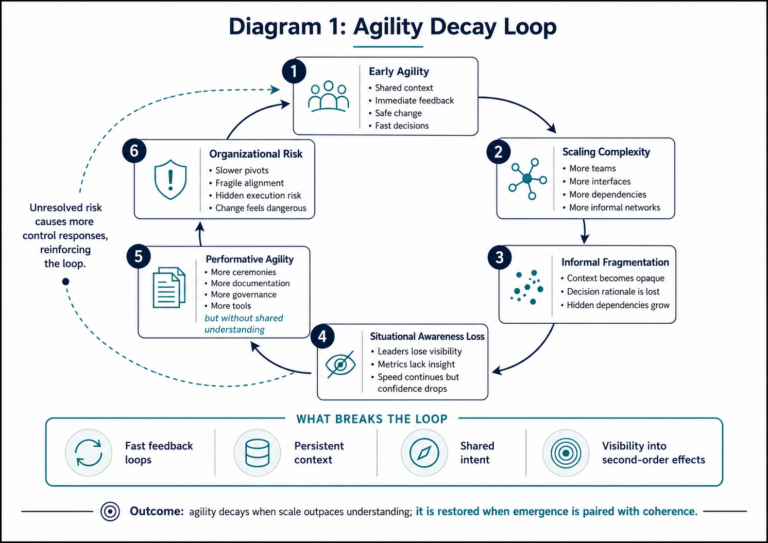
The Hidden Cost of Scaling
Early-stage companies thrive on informal networks:
- Everyone knows why decisions were made
- Context flows naturally
- Feedback is immediate
- Change is safe
As companies scale, those same dynamics begin to work against them.
Informal networks:
- Fragment
- Become opaque
- Create invisible dependencies
- Outlive the decisions that created them
Leadership starts to feel the effects:
- “Why did we build this?”
- “Who approved that?”
- “Why does changing this feel dangerous?”
- “Why are we fast but not confident?”
This is not chaos.
It’s emergent complexity.
Why More Process Makes It Worse
The instinctive response is to impose order:
- More Agile rituals
- More documentation
- More governance
- More tools
But formal structure doesn’t replace informal behavior—it just pushes it underground.
The result is performative agility:
- Ceremonies without shared understanding
- Metrics without insight
- Velocity without judgment
The organization keeps moving, but leaders lose situational awareness.
At scale, speed without understanding isn’t agility.
It’s risk.
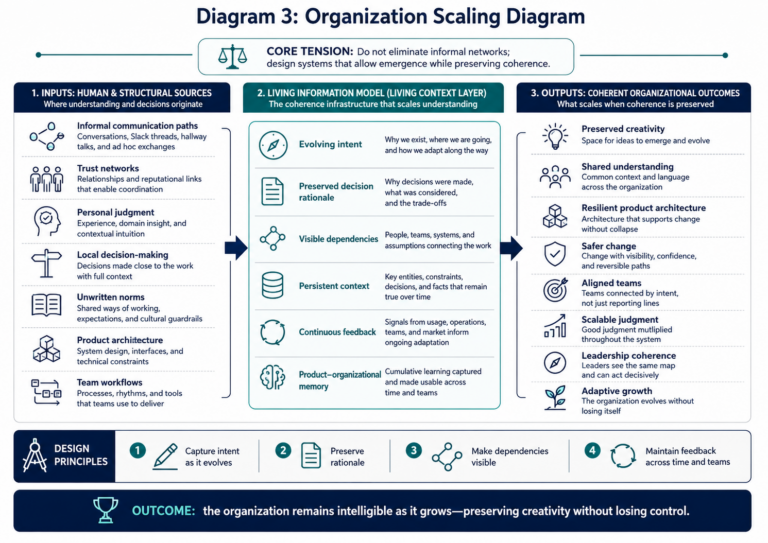
The Core Tension: Emergence vs Control
Here’s the uncomfortable truth:
You cannot eliminate informal networks without killing agility.
But you cannot ignore them without losing control.
Most organizations oscillate between these extremes:
- Over-control that slows everything down
- Under-control that creates fragility
The real challenge is not choosing between structure and freedom.
It’s designing systems that allow emergence while preserving coherence.
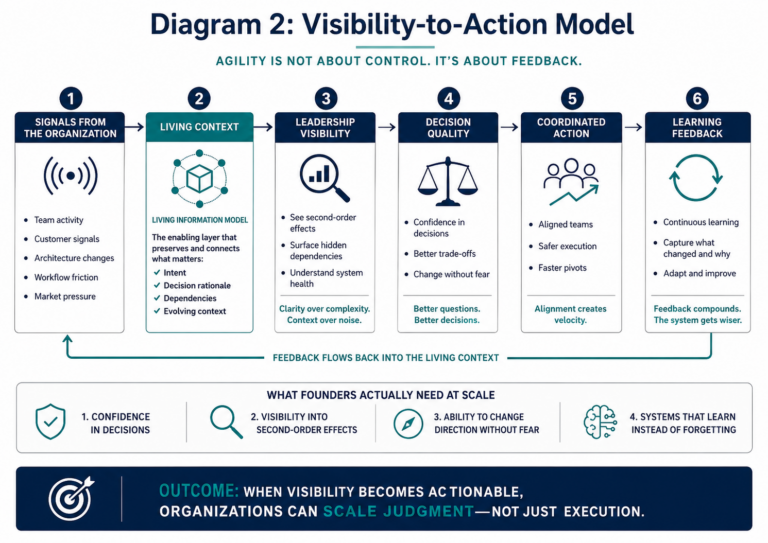
Agility Is Not About Control — It’s About Feedback
In complex systems, control is indirect.
You don’t command outcomes.
You shape conditions, observe signals, and adjust.
This requires:
- Fast feedback loops
- Persistent context
- Shared understanding of intent
- The ability to see second-order effects
Without these, leaders react late, decisions decay, and organizations relearn the same lessons over and over.
This is where most Agile transformations quietly fail.
From Informal Networks to Living Information
At Ingenuity, we’ve seen this pattern across industries, products, and growth stages.
The breakthrough comes when organizations stop trying to “fix” behavior and instead focus on how information lives inside the system.
This led us to the Living Information Model (LIM).
LIM does not attempt to formalize everything.
It doesn’t replace informal networks.
And it doesn’t add process for process’s sake.
Instead, it:
- Captures intent as it evolves
- Preserves decision rationale
- Makes dependencies visible
- Maintains feedback across time and teams
It turns invisible dynamics into shared, living context.
Product Design Is Where This Becomes Real
The paper makes an implicit but critical point:
Products and organizations co-evolve.
Architecture encodes assumptions.
Interfaces shape communication.
Design decisions lock in behavior.
When product design ignores organizational complexity:
- Change becomes expensive
- Teams become defensive
- Innovation slows
Ingenuity’s approach treats product design as a stabilizing force in complex systems:
- Products reflect shared understanding
- Architecture supports evolution
- Change is reasoned about before it’s executed
The result is not just better software—it’s a more resilient organization.
What Founders Actually Need at Scale
Founders don’t need more dashboards.
They don’t need more ceremonies.
They don’t need tighter control.
They need:
- Confidence in decisions
- Visibility into second-order effects
- The ability to change direction without fear
- Systems that learn instead of forgetting
True agility is not about moving faster.
It’s about remaining intelligible as you grow.
The Organizations That Will Win
The next generation of enduring companies will not be the most optimized.
They will be the ones that:
- Preserve informal creativity
- Without losing coherence
- Scale judgment, not just execution
- Treat information as a living asset
Agility is not something you install.
It’s something you design for.
That is the gap the Living Information Model exists to close—and the reason modern organizations must rethink how they scale.
