


”Innovation is easy. Trust is hard.
How Ingenuity Builds Trustworthy AI for Regulated Industries
In highly regulated sectors, any organization can build an AI prototype. Very few can deploy AI systems that withstand rigorous scrutiny from regulators, auditors, insurers, risk committees, boards, and enterprise clients.
This is where Ingenuity creates lasting value.
We partner with organizations in financial services, healthcare, utilities, education, and other enterprise environments where security, governance, accountability, and long-term maintainability are as critical as performance. Our clients require more than functional software—they need systems that can be defended in audits and boardrooms while truly understanding their business operations.
The Living Information Model (LIM): From Fragmented Data to Operational Intelligence
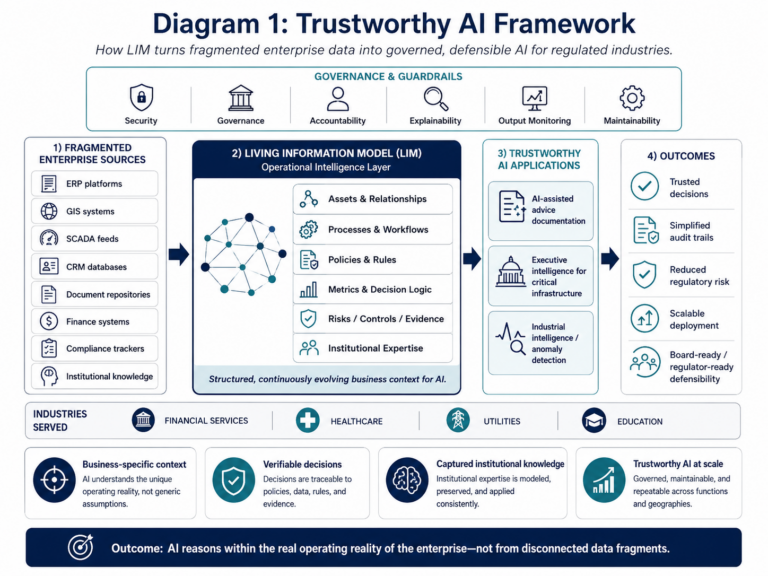
Most organizations are data-rich but context-poor. Critical information lives in silos across ERP platforms, GIS systems, SCADA feeds, CRM databases, document repositories, finance systems, compliance trackers, and institutional knowledge.
Traditional dashboards visualize fragments. Generic AI tools often hallucinate because they lack deep business context.
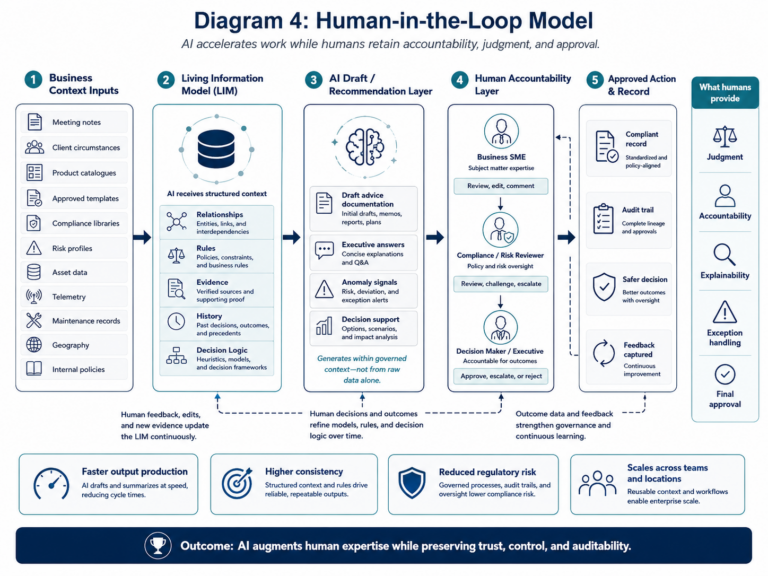
Ingenuity’s Living Information Model (LIM) changes this. It creates a continuously evolving, structured digital representation of an organization’s assets, processes, rules, metrics, relationships, and decision logic.
More than a database, LIM functions as an operational intelligence layer—providing AI systems with memory, structure, meaning, and real-time business context.
Why LIM Delivers Transformational Results in Regulated Environments
Without context, AI guesses. With LIM, AI reasons within the actual operating reality of the enterprise.
This enables:
- Metrics grounded in real operational drivers
- Automatic understanding of asset and process relationships
- Policies directly linked to workflows
- Risks connected to controls and evidence
- Decisions supported by verifiable, business-specific context
- Institutional expertise captured and preserved
For regulated industries, this distinction is critical. You don’t need an AI that sounds intelligent—you need one that deeply understands your business, compliance obligations, and risk framework, while aligning with frameworks such as the EU AI Act (Regulation (EU) 2024/1689) and U.S. sector-specific rules.
Real-World Application: AI-Assisted Advice Documentation in Financial Services
Financial advisers often spend significant time transforming client meeting notes, circumstances, product details, and recommendations into compliant, auditable records.
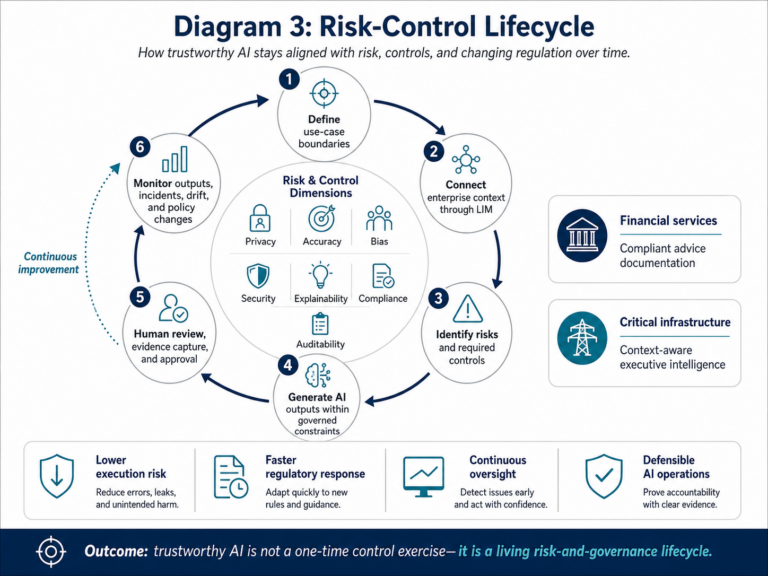
The Challenge: Accelerate drafting without introducing privacy risks, inaccurate advice, or regulatory exposure under rules such as SEC Regulation Best Interest, FINRA guidelines, Consumer protection requirements (U.S.), or MiFID II and DORA (EU).
How LIM Solves It: The model integrates product catalogues, approved advice templates, compliance libraries, risk tolerance profiles, fee structures, client relationships, historical patterns, and internal policies.
The AI no longer drafts from raw notes alone. It generates within a governed advisory framework.
Outcomes:
- Significantly faster document production
- Higher consistency and quality
- Simplified audit trails
- Reduced regulatory risk
- Easier scaling across teams and locations
Real-World Application: Executive Intelligence for Critical Infrastructure
Large utilities and infrastructure operators manage complex environments spanning reliability, outages, generation capacity, workforce readiness, capital projects, customer service, safety, and regulatory performance.
Most have dashboards. Few have genuine intelligence.
How LIM Transforms Visibility: It connects assets to geography, feeders to outage history, projects to reliability outcomes, weather events to network risk, and complaints to operational realities—supporting compliance with FERC and NERC standards (U.S.) and EU critical infrastructure requirements under the EU AI Act.
Executives can ask natural, context-aware questions such as:
- “Why did SAIDI increase in District 4 this week?”
- “Which substations are driving repeat outages, and what CAPEX relates to them?”
- “Which delayed maintenance activities are elevating operational risk?”
The result is an operational nervous system—shifting from static reporting to dynamic, evidence-based decision support.
Industrial Intelligence: Turning Raw Data into Competitive Advantage
Ingenuity excels at converting industrial data—sensors, telemetry, asset hierarchies, engineering drawings, maintenance records, field operations, and geographic relationships—into decision-grade intelligence.
For organizations facing aging assets, capital constraints, climate volatility, regulatory pressure, and workforce challenges, LIM preserves institutional knowledge while bridging legacy systems with modern AI capabilities.
Built Responsibly: Security, Governance, and Compliance
Ingenuity designs solutions with enterprise-grade standards that address key regulatory expectations:
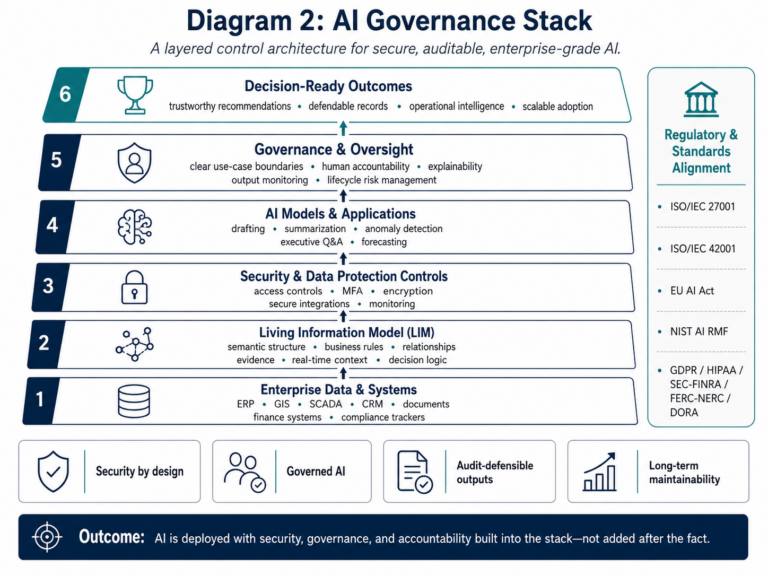
Security: Aligned with ISO/IEC 27001 principles, including robust access controls, MFA, encryption, secure integrations, and comprehensive monitoring.
AI Governance: Aligned with ISO/IEC 42001 and the risk-based requirements of the EU AI Act for high-risk systems (e.g., those in financial services, healthcare, and critical infrastructure). This includes clear use case boundaries, human accountability, explainability, output monitoring, and lifecycle risk management.
Regulatory Awareness: Deep understanding of:
Why Ingenuity Stands Apart
Many vendors deliver applications, dashboards, or chatbots. Ingenuity builds intelligence architecture—systems that learn alongside the organization, connect siloed operations, preserve expertise, and enable trustworthy AI at scale.
The Compounding Value of LIM
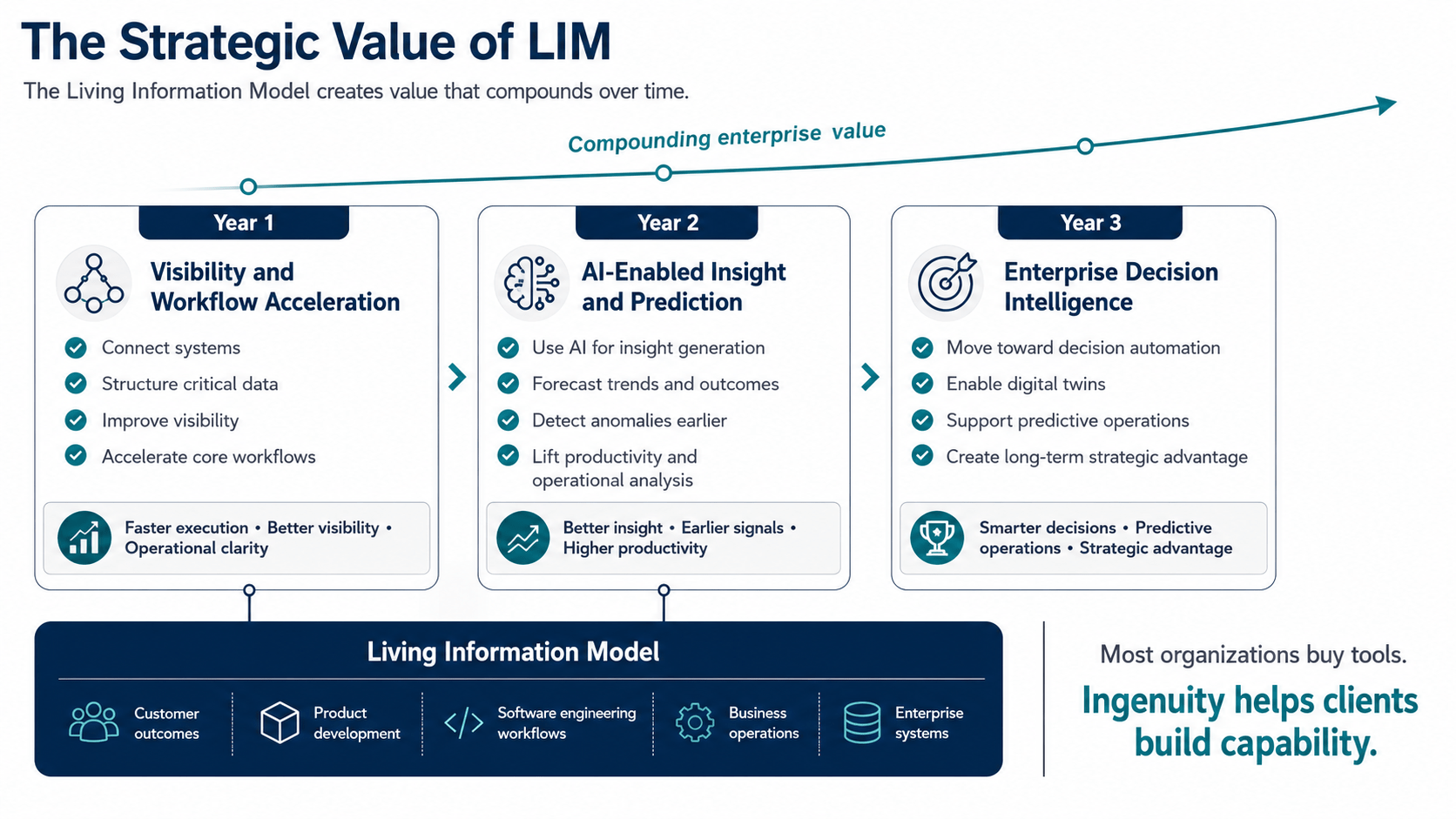
- Year 1: Integrated visibility and accelerated workflows
- Year 2: AI-powered insights, forecasting, anomaly detection, and productivity gains
- Year 3+: Decision automation, digital twins, predictive operations, and sustainable competitive advantage
The Future Belongs to Organizations with Living Intelligence
In an era of abundant data, competitive advantage will belong to those whose data is alive, structured, contextual, and actionable—while meeting stringent requirements under the EU AI Act, DORA, GDPR, and U.S. frameworks like HIPAA and SEC regulations.
Ingenuity’s Living Information Model makes AI not just innovative—but trustworthy, defensible, and deeply integrated with the realities of regulated operations.
This is how forward-thinking organizations in financial services, utilities, healthcare, and beyond modernize with confidence.
