


Every founder reaches the same inflection point.
You can no longer make every decision.
You don’t want to.
And you shouldn’t.
So you push authority outward—closer to customers, closer to the work, closer to reality.
At first, things speed up.
Then something subtler happens.
Alignment weakens.
Decisions start to conflict.
Change feels risky.
Leaders step back in—not to control, but to regain clarity.
This is often described as a leadership or culture problem.
It isn’t.
It’s an information design problem.
What “Power to the Edge” Actually Means
In Power to the Edge, the authors make a now-famous argument:
in complex, fast-changing environments, information—not hierarchy—is the source of power.
Centralized command fails because:
- Information moves faster than approval chains
- Complexity exceeds any single perspective
- Decision latency becomes existential risk
The solution is to push decision-making authority to the edges of the organization.
But there’s a critical qualifier that’s often ignored:
Decentralization only works when shared awareness is high.
Without that, “power to the edge” doesn’t create agility.
It creates fragmentation.
Why Most Decentralization Efforts Collapse
Many organizations decentralize execution while leaving understanding centralized—or worse, implicit.
Teams are told:
- “You’re empowered”
- “Move fast”
- “Make local decisions”
But they are not given:
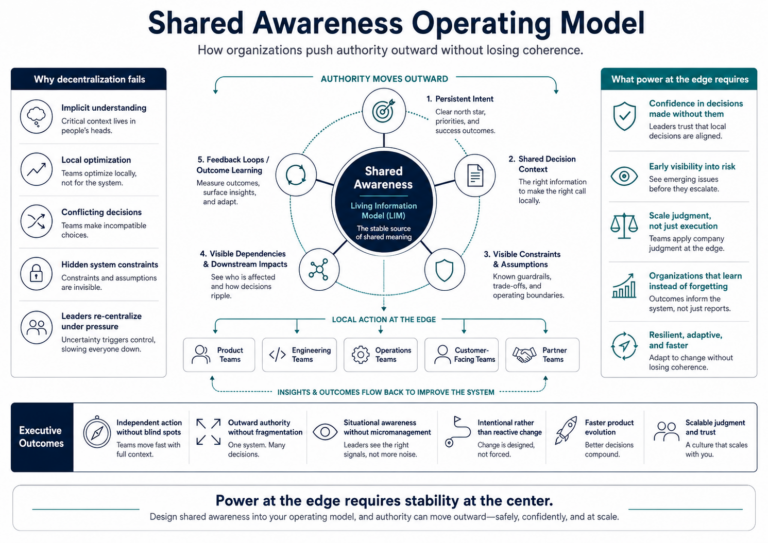
- Persistent intent
- Shared decision context
- Visibility into system-level constraints
- Feedback on downstream effects
The result is predictable:
- Teams optimize locally
- Decisions conflict silently
- Risk accumulates invisibly
- Leaders re-centralize under pressure
Founders feel this as:
“We’re moving fast, but we don’t trust our own system.”
That’s not autonomy.
That’s distributed confusion.
Control Has Changed—But Our Systems Haven’t
In the Information Age, control no longer comes from issuing instructions.
It comes from:
- Shaping understanding
- Preserving intent
- Making tradeoffs visible
- Maintaining feedback loops
Yet most organizations still rely on:
- Meetings to align
- Documents to remember
- Dashboards to react
- Leaders to arbitrate
These don’t scale understanding.
They scale activity.
And activity without shared meaning is indistinguishable from chaos at scale.
The Missing Layer: Shared Awareness by Design
Power to the Edge assumes something most organizations don’t actually have:
a durable, shared understanding of what matters and why.
This is where most decentralization strategies fail—not in execution, but in design.
At Ingenuity, we’ve seen that the organizations that scale successfully do one thing differently:
They design how information lives inside the system.
The Living Information Model
The Living Information Model (LIM) exists to solve the problem Power to the Edge describes but does not operationalize.
LIM is not a process or a framework.
It is a way of making shared awareness persistent and evolvable.
It does this by:
- Making intent explicit and durable
- Preserving decision rationale over time
- Surfacing assumptions and constraints
- Making dependencies and impacts visible
- Feeding outcomes back into shared understanding
In effect, LIM turns information into a control surface—not through authority, but through coherence.
Power at the Edge Requires Stability at the Center
True decentralization requires a stable core of meaning.
With LIM:
- Teams can act independently without acting blindly
- Authority moves outward without fragmenting the whole
- Leaders maintain situational awareness without micromanaging
- Change becomes intentional instead of reactive
This is the missing structural layer between autonomy and alignment.
Why This Shows Up First in Product Design
Decentralization breaks down fastest at the product level.
When product architecture:
- Hides assumptions
- Obscures tradeoffs
- Loses decision history
- Makes change hard to reason about
…teams slow down or become defensive.
Ingenuity’s approach treats product design as organizational design.
With LIM:
- Architecture encodes intent
- Decisions remain legible
- Evolution paths are explicit
- Teams can change systems without eroding trust
The product becomes a stabilizing force—not a liability—in a decentralized organization.
What Founders Actually Want
Founders don’t want control for its own sake.
They want:
- Confidence in decisions made without them
- Early visibility into risk
- The ability to scale judgment, not just execution
- Organizations that learn instead of forgetting
“Power to the edge” isn’t about stepping away.
It’s about designing systems that carry understanding with them.
The Real Competitive Advantage
The companies that will win in the next decade will not be the most centralized—or the most autonomous.
They will be the ones that:
- Push authority to the edge
- Preserve shared meaning at the core
- Move fast without losing coherence
- Treat information as a living asset
Decentralization is inevitable.
Whether it becomes a strength or a liability depends entirely on whether you design for shared awareness.
That is the gap the Living Information Model exists to close—and the real promise of power to the edge.
