

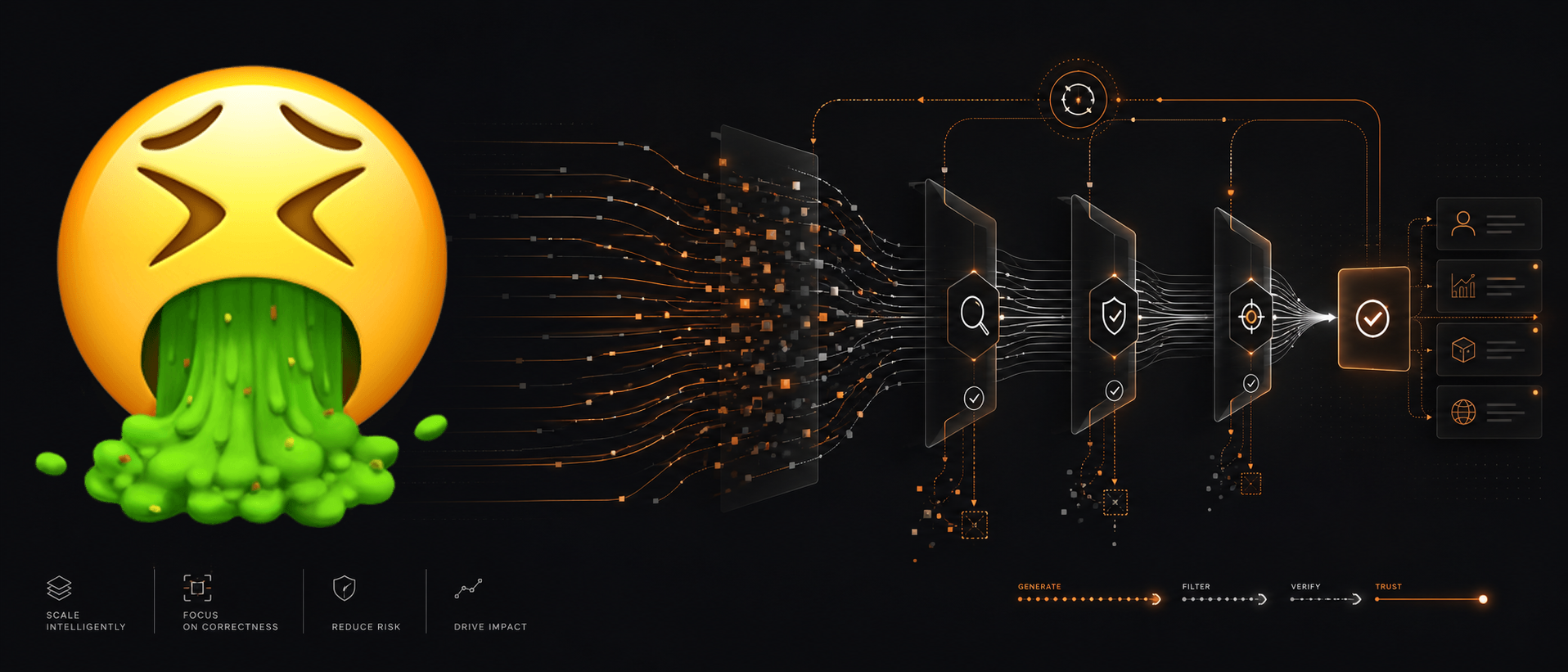
AI has made it easier than ever to produce.
A team can generate a strategy deck in minutes. A product manager can create user stories in seconds. An engineer can ask an AI assistant to scaffold code before the first meeting is over. A marketing team can produce ten campaign angles before lunch. An operations team can summarize documents, draft policies, and automate repetitive workflows without waiting for another department.
On the surface, this looks like a breakthrough in productivity.
And in many ways, it is.
But there is a hidden cost emerging inside AI-enabled organizations. It does not always show up immediately. It does not always appear in dashboards. It often disguises itself as speed, output, or efficiency.
That cost is the AI slop tax.
The AI slop tax is the extra effort teams spend reviewing, correcting, cleaning up, reworking, validating, and repairing low-quality AI-generated output. It is the cost of work that looks finished but is not actually correct. It is what happens when volume increases faster than judgment.
In the AI era, the companies that win will not be the ones that produce the most. They will be the ones that know what is true, what is useful, what is safe, and what is ready to ship.
Correctness is becoming more valuable than volume.
AI makes volume cheap
For most of modern business history, producing work took time. Writing a proposal, building a prototype, reviewing a document, creating a report, or developing a feature required human effort from start to finish.
AI changes that.
It lowers the cost of first drafts. It compresses research cycles. It accelerates documentation. It helps teams generate options quickly. It can assist with code, design directions, internal tools, customer support, data analysis, and operational workflows.
This is valuable. Used well, AI can remove bottlenecks that used to slow teams down. It can give people a faster way to think, explore, and execute.
But faster production creates a new problem.
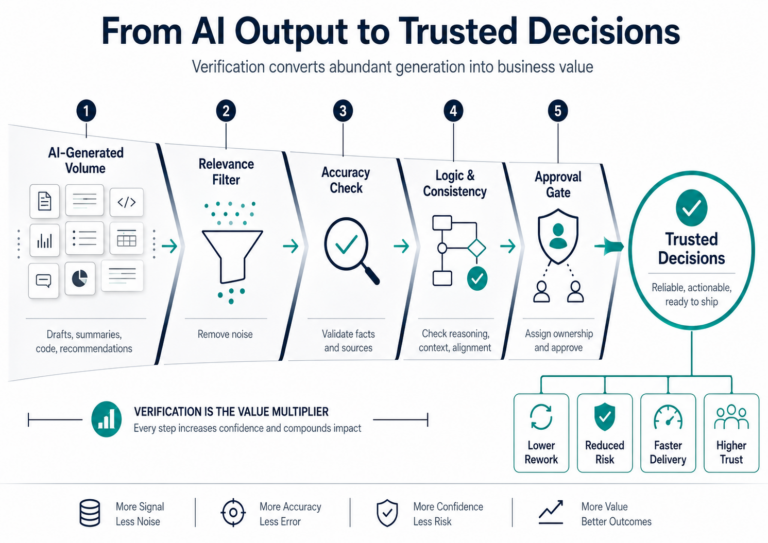
When output becomes easy to generate, organizations start producing more than they can properly evaluate.
More documents.
More ideas.
More code.
More summaries.
More dashboards.
More automation.
More recommendations.
More decisions that appear informed but may not be grounded.
This is where the danger begins.
AI can produce content that sounds confident, structured, and complete. But polished output is not the same as correct output. A document can read well and still contain weak assumptions. A summary can sound useful and still miss important context. A code suggestion can compile and still create security risks. A recommendation can look strategic and still be based on incomplete information.
The problem is not that AI produces bad work all the time. The problem is that AI can produce uncertain work with the appearance of certainty.
That creates a new burden for teams.
Someone still has to know what good looks like.
The hidden cost of AI-generated work
The AI slop tax appears when teams treat AI-generated output as finished work instead of unfinished material.
At first, this may seem harmless. A team uses AI to speed up a task. The result looks good enough. People move forward. The organization feels faster.
Then small errors begin to compound.
A product requirement includes an assumption nobody checked.
A technical document describes behavior that the system does not actually support.
A customer support response gives advice that conflicts with policy.
A generated code block introduces a vulnerability.
A meeting summary misses a critical decision.
An executive report simplifies a risk that should have been escalated.
A workflow automation moves data without enough validation.
None of these failures may look dramatic on their own. But together, they create drag.
People spend more time reviewing work. Teams lose trust in internal documents. Engineers rewrite AI-generated code. Managers ask for more clarification. Legal, compliance, or security teams need to intervene later than they should. Customers experience inconsistencies. Leadership decisions are made on top of shaky information.
The organization does not become faster. It becomes noisier.
This is the hidden cost of AI slop: more output creates more surface area for error.
The work expands, but confidence declines.
AI does not remove the need for expertise
One of the most misleading assumptions about AI is that it allows organizations to replace expertise with tools.
In reality, AI makes expertise more important.
The more AI generates, the more organizations need people who can judge the quality of what it produces. People who understand the business context. People who know the edge cases. People who can identify when something is incomplete, risky, misleading, or misaligned. People who can separate useful acceleration from expensive noise.
AI can help produce options, but humans still need to define the standard.
This is especially true in software, product design, and enterprise systems.
A prototype may be easy to generate, but someone must know whether the experience solves the right problem. A feature may be easy to scaffold, but someone must know whether the architecture will hold under real usage. A workflow may be easy to automate, but someone must know whether it fits the organization’s policies, controls, and operating realities.
In low-risk environments, AI slop may only cause inconvenience.
In high-stakes environments, it can damage trust.
This matters for regulated industries, financial systems, healthcare workflows, enterprise platforms, data-heavy operations, and any product where security, privacy, reliability, or compliance are non-negotiable.
The more important the system, the more expensive incorrectness becomes.
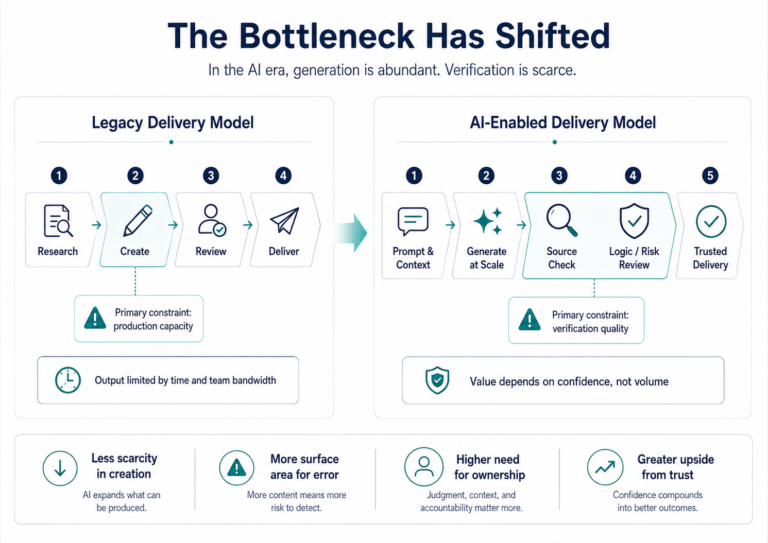
The new bottleneck is not production. It is verification.
Before AI, many organizations were constrained by production capacity. They did not have enough people, time, or budget to create everything they wanted.
Now, AI is shifting the bottleneck.
The constraint is no longer just “Can we produce this?”
The better question is “Can we verify this?”
Can we verify that the data is accurate?
Can we verify that the recommendation is grounded?
Can we verify that the code is secure?
Can we verify that the workflow follows policy?
Can we verify that the user experience matches real customer behavior?
Can we verify that the decision is based on the right context?
This shift changes how organizations should think about AI adoption.
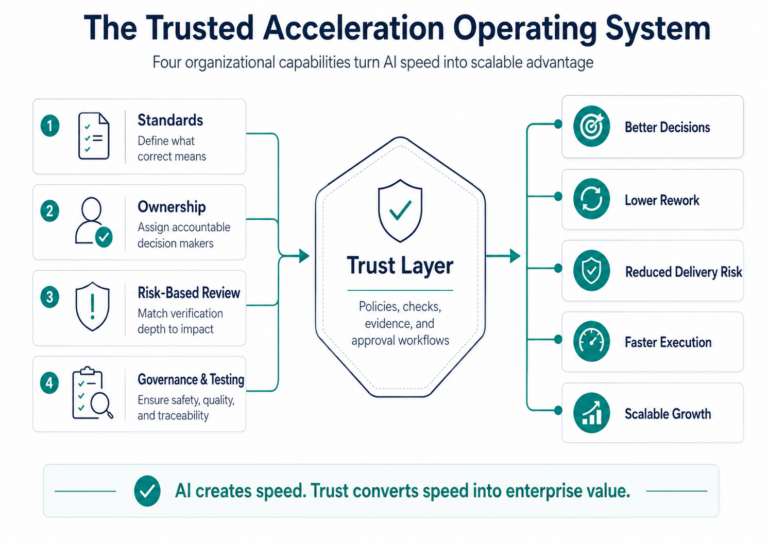
AI implementation is not simply about adding tools to the workflow. It is about building a system where output can be trusted.
That requires standards, review loops, ownership, testing, documentation, and governance. Not as bureaucracy, but as the operating discipline that makes speed safe.
Without verification, AI creates motion.
With verification, AI creates leverage.
Correctness-first teams will outperform volume-first teams
The temptation with AI is to measure success by output.
How many documents were generated?
How many tickets were created?
How many campaigns were drafted?
How many lines of code were produced?
How many tasks were automated?
These numbers may look impressive. But they do not tell the full story.
A volume-first team asks, “How much can we produce?”
A correctness-first team asks, “How much can we trust?”
That difference matters.
Correctness-first teams do not reject AI. They use it with discipline. They know which tasks can be accelerated and which require deeper human judgment. They define acceptance criteria before generating output. They review based on risk. They test assumptions early. They document decisions clearly. They create feedback loops so AI-assisted work improves over time.
They understand that the goal is not to make work look complete.
The goal is to make work dependable.
In software engineering, this means AI-generated code still needs architecture review, test coverage, security checks, and maintainability standards.
In product design, this means AI-generated flows still need user understanding, accessibility checks, and validation against real customer needs.
In business strategy, this means AI-generated insights still need source quality, market context, and executive judgment.
In operations, this means AI-generated automation still needs exception handling, auditability, and clear ownership.
Correctness-first organizations will move fast, but not blindly.
They will use AI to increase capacity while protecting trust.
How organizations can reduce the AI slop tax
Reducing the AI slop tax does not mean slowing down innovation. It means designing better systems around AI use.
Here are five practical ways organizations can start.
1. Separate drafts from decisions
AI is excellent for drafts, options, summaries, and exploration. But organizations should be careful about treating AI-generated output as a decision-ready artifact.
A draft is a starting point. A decision requires validation.
Teams should clearly label AI-assisted work according to its status. Is it exploratory? Reviewed? Approved? Ready for implementation? This simple distinction helps prevent unfinished thinking from becoming operational truth.
2. Define what “correct” means before using AI
Many teams use AI before defining the standard of quality. This leads to vague evaluation.
Before generating output, teams should clarify what correctness means for the task.
For code, correctness may mean passing tests, meeting security standards, and fitting the architecture.
For documentation, it may mean accuracy, completeness, and alignment with the current system.
For strategy, it may mean evidence quality, clear assumptions, and relevance to business goals.
For automation, it may mean reliability, exception handling, and auditability.
AI performs better when humans are clear about the target.
3. Build review loops based on risk
Not all AI-generated work requires the same level of review.
A low-risk internal brainstorming document may only need a quick human pass. A customer-facing policy, financial workflow, production feature, or compliance-sensitive system needs deeper validation.
Organizations should create review levels based on risk.
The higher the impact, the stronger the verification process should be.
This keeps teams from over-reviewing everything while still protecting critical work.
4. Assign ownership
AI should assist work. It should not obscure accountability.
Every AI-assisted output needs a human owner. Someone must be responsible for the quality, accuracy, and consequences of the final result.
This is especially important when AI is used across departments. Without ownership, errors become difficult to trace. Everyone assumes someone else checked the work.
A simple rule helps: AI can generate, but a human must own.
5. Measure rework, not just output
If organizations only measure volume, they will reward noise.
A better approach is to measure the cost of rework.
How often does AI-generated work need correction?
How many generated tickets are duplicates or unclear?
How much AI-assisted code needs rewriting?
How often do AI summaries miss key decisions?
How many AI-generated recommendations are rejected during review?
These signals reveal whether AI is creating true leverage or simply shifting work downstream.
The real opportunity: trusted acceleration
The promise of AI is not unlimited output.
The promise is trusted acceleration.
AI should help teams move faster toward better decisions, better products, better systems, and better customer outcomes. But that only happens when organizations combine AI speed with human judgment and operational discipline.
The companies that benefit most from AI will not be the ones that automate randomly. They will be the ones that know where AI belongs, where it does not, and how to verify what it produces.
They will build systems where speed does not come at the cost of correctness.
They will treat AI not as a shortcut around expertise, but as a force multiplier for expert teams.
They will understand that the future of work is not just more output from fewer people.
It is better judgment, applied faster.
Building AI systems that organizations can trust
At Ingenuity, we believe AI adoption should be designed around business value, technical integrity, and human trust.
That means helping organizations identify where AI can create meaningful leverage, not just where it can generate more activity. It means designing workflows with the right review loops. It means building software systems that are secure, maintainable, and aligned with real operational needs. It means treating correctness as a strategic advantage.
Because in the AI era, the ability to produce more will become common.
The ability to produce work that is accurate, reliable, and trusted will become rare.
That is where the real advantage will be.
The organizations that learn to manage the AI slop tax early will move faster with less waste, less risk, and more confidence.
They will not just use AI to do more.
They will use AI to do better.
