


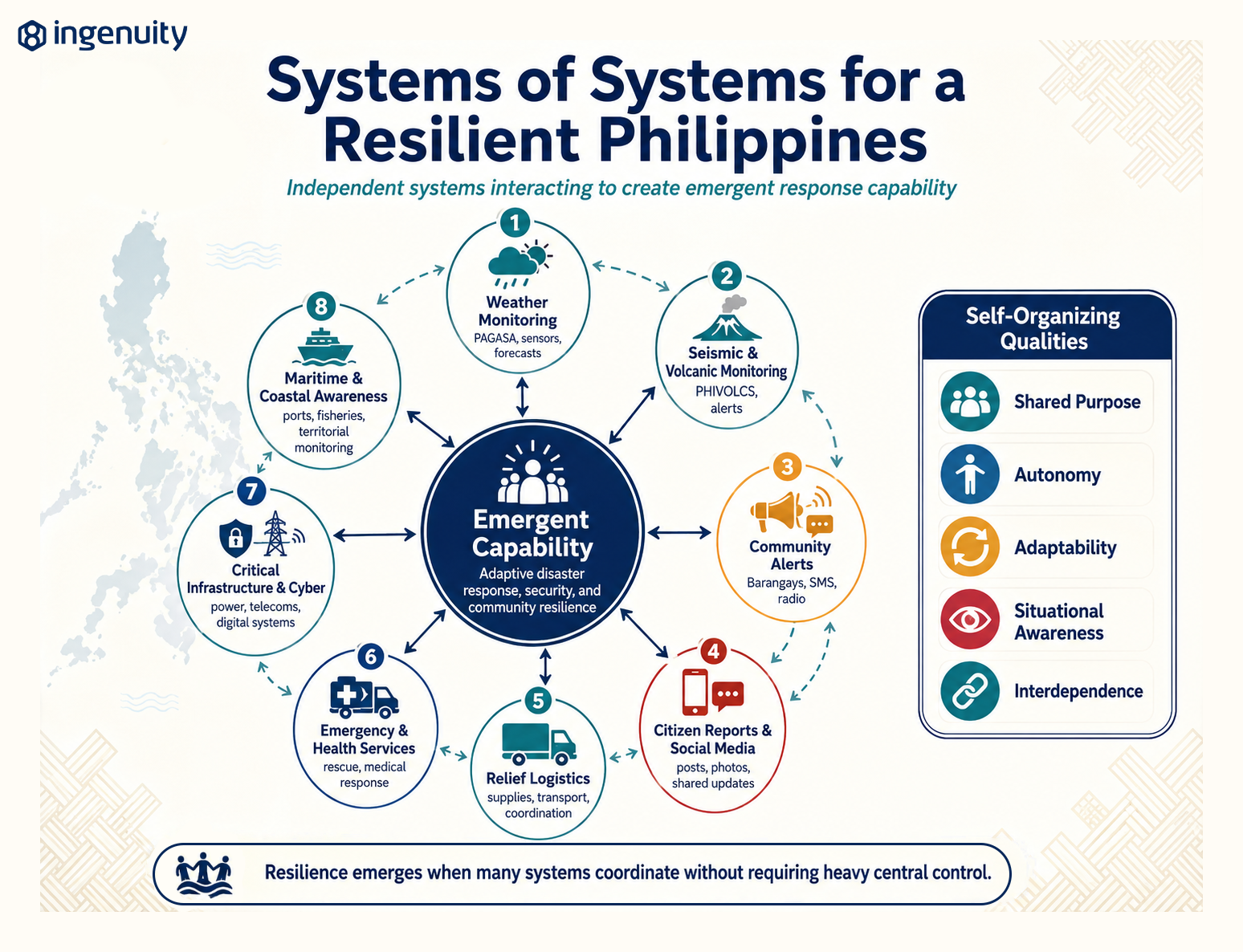
In the Philippines, we understand resilience deeply. Our archipelago faces relentless typhoons, earthquakes, volcanic eruptions, and complex human challenges—from disaster response and climate adaptation to maritime security, cybersecurity, and community governance. These are not isolated problems but interconnected Systems of Systems (SoS)—networks of independent yet interdependent elements that produce emergent behaviors greater than the sum of their parts.
A landmark 2011 discussion in systems engineering highlighted how traditional, static approaches fall short against dynamic threats. Today, concepts like self-organizing systems, stigmergy, and resilient security offer powerful frameworks. They align remarkably with bayanihan—our cultural tradition of collective, decentralized action for the common good. As the Philippines advances its digital transformation, disaster risk reduction, and national security strategies, these ideas can help us build smarter, more adaptive systems.
Understanding Systems of Systems and Self-Organization
A System of Systems emerges when multiple independent systems (e.g., weather monitoring, community alerts, relief logistics, and social media) interact to deliver new capabilities, such as real-time disaster response. These often exhibit self-organization: order and intelligence arise from local interactions without heavy central control, driven by shared purpose, adaptability, autonomy, situational awareness, and interdependence.
Traditional security focuses on building walls—static defenses against known threats. Adversaries, however, operate as dynamic, natural SoS: loosely connected groups sharing knowledge rapidly through media, online forums, and indirect signals. This creates persistent asymmetry: attackers need only one weakness; defenders must secure everything.
The solution? Shift to resilient, self-organizing security that tolerates breaches, recovers quickly, and evolves proactively—much like ecosystems or Filipino communities rebuilding after calamity.
Stigmergy: Indirect Coordination for Collective Intelligence
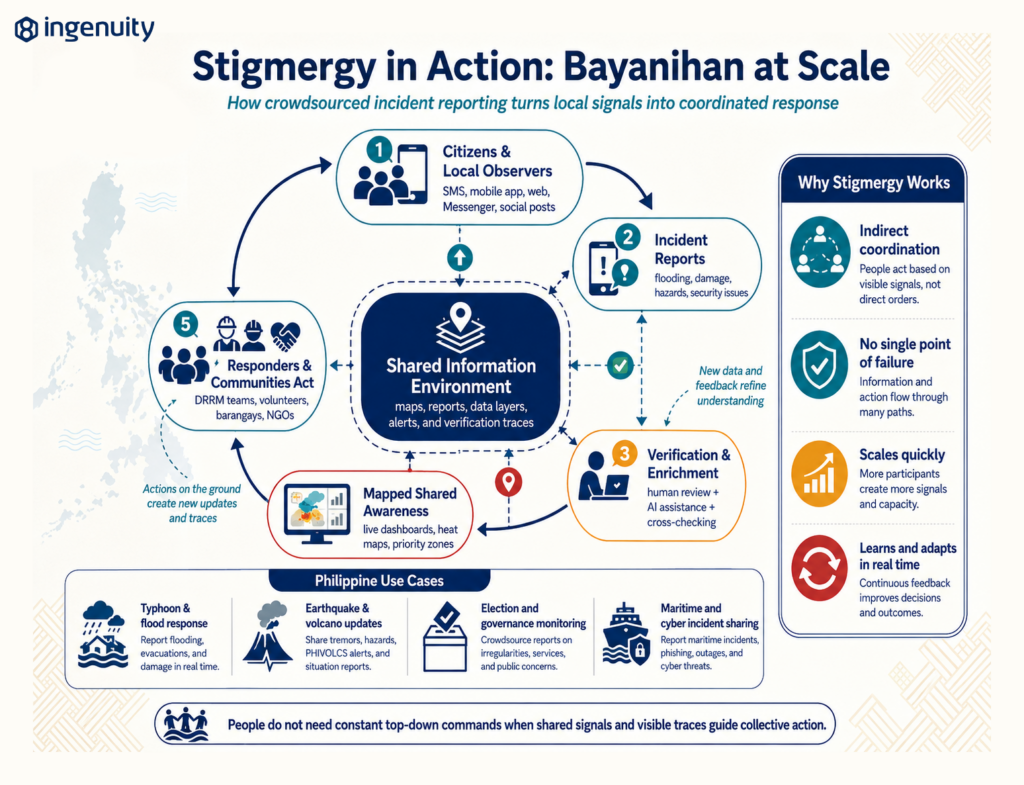
Stigmergy is a powerful mechanism for self-organization. Agents (people, devices, or organizations) influence each other not through direct commands but by modifying a shared environment, leaving “traces” that guide future actions. Think of ants laying pheromone trails or Wikipedia editors building on each other’s contributions.
In security and response contexts:
-
- Successful tactics (or reports) leave visible signals (maps, posts, data layers) that others amplify or adapt.
- This enables scalability, resilience (no single point of failure), and rapid innovation without top-down bureaucracy.
Recent advances in swarm robotics, cyber-physical systems, and mathematical modeling have made stigmergy actionable for engineered solutions, including autonomous drones for search-and-rescue or AI-enhanced monitoring networks.
For the Philippines, stigmergy resonates with bayanihan. Volunteers during Typhoon Yolanda (Haiyan) or recent events coordinated indirectly via social media, shared maps, and community updates—classic stigmergic behavior that saved lives and accelerated recovery.
 Ushahidi and Crowdsourced Incident Reporting: A Philippine-Relevant Model
Ushahidi (“witness” in Swahili), born in Kenya’s 2008 election crisis, exemplifies a self-organizing SoS pattern called Crowd Sourced Incident Reporting (CSIR). Citizens report via SMS, apps, or web; data is verified, mapped, and acted upon in near real-time. It features common purpose, autonomy, adaptability, and emergent awareness.
The platform has evolved significantly (versions 3 and 4 added APIs, analytics, and flexibility) and continues supporting global crises, preparedness mapping, and governance.
Relevance to the Philippines:
-
- Our disaster-prone geography and strong mobile penetration make CSIR natural. Tools like this could enhance Project NOAH, local DRRM councils, or Barangay-level alerts.
- During typhoons or seismic events, crowdsourced maps could integrate with PAGASA, Phivolcs, and community networks for faster, more accurate response.
- Applications extend to election monitoring, environmental reporting (e.g., illegal logging or coastal threats), maritime domain awareness in the West Philippine Sea, and cyber incident sharing.
This model turns citizens from passive victims into active sensors and responders—embodying bayanihan at scale.
Recent Innovations and Opportunities for the Philippines
Since the original 2011 discussions, progress includes:
-
- AI and Swarm Technologies: Stigmergic coordination in drone swarms for disaster assessment or border security.
- Resilient Architectures: Focus on redundancy, rapid reconfiguration, and human-AI collaboration in critical infrastructure.
- Open Platforms: Modernized Ushahidi-style tools combined with local innovations (e.g., integrating with GCash, Facebook Messenger, or government open data portals).
The Philippines can lead in tropical-archipelagic adaptations: hybrid human-machine SoS for climate resilience, community-driven cybersecurity awareness, or stigmergic supply chains for relief goods.
Recommendations: A Call to Filipino Systems Thinkers
-
- Adopt SoS Thinking in Policy: Integrate self-organizing principles into the National Disaster Risk Reduction and Management Framework, National Security Policy, and digital government initiatives. Emphasize resilience over perfection.
- Invest in Stigmergic Platforms: Support open-source tools for crowdsourced intelligence, with strong verification (human + AI) and privacy safeguards. Pilot expanded CSIR for multi-hazard early warning.
- Build Human-Centered Resilience: Leverage bayanihan by designing systems that amplify community strengths (local knowledge, social ties) while mitigating weaknesses (misinformation, digital divides). Cross-train engineers, security professionals, and disaster managers.
- Foster Innovation Ecosystems: Encourage collaboration among academe (e.g., UP, DOST), government (DICT, OCD), private sector, and civil society. Draw from global patterns while localizing solutions.
- Measure and Evolve: Develop metrics for “security resilience” in dynamic environments, mirroring advances in physical systems engineering.
Conclusion: Toward a Self-Organizing, Resilient Philippines
The frontier of systems engineering teaches that in a world of intelligent adversaries and unpredictable disruptions, static systems fail. Dynamic, self-organizing ones—coordinated through shared purpose and environmental traces—thrive.
This mirrors the Filipino ethos. By embracing Systems of Systems, stigmergy, and self-organizing security, we can amplify our natural resilience. Whether facing super typhoons, cyber threats, or geopolitical tensions, we have the cultural foundation and technological opportunity to lead.
Let us move from reactive recovery to proactive, emergent strength. The traces we leave today—through open platforms, community networks, and innovative policies—will guide a safer, more adaptive tomorrow for the Philippines and beyond.
* This article draws on foundational systems engineering concepts and their evolution. Filipino innovators, engineers, and policymakers are invited to adapt and advance these ideas locally.
