


Modern organizations are already virtual.
Remote teams.
External partners.
Specialized vendors.
Rapid onboarding and offboarding.
Work is distributed by default.
And yet many companies still rely on tribal knowledge to maintain alignment — the unspoken understanding held by a few key individuals.
It works.
Until it doesn’t.
When People Become the System
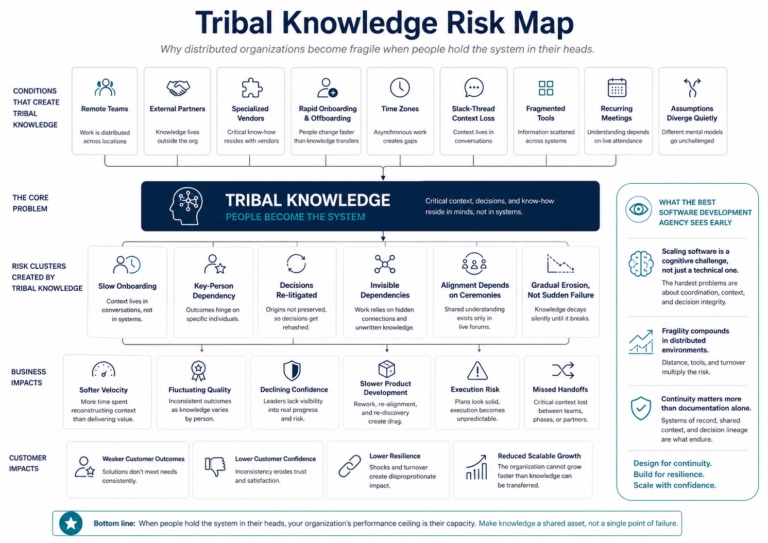
Tribal knowledge creates fragile organizations.
New hires ramp slowly because context lives in conversations, not systems.
Key departures trigger regressions no one anticipated.
Decisions are re-litigated because their origin was never preserved.
Alignment depends on recurring meetings instead of durable clarity.
When people become the system, the system inherits human limits.
In distributed environments, this fragility compounds.
Time zones widen the gaps.
Context thins across Slack threads.
Assumptions diverge quietly.
The result is rarely dramatic failure.
It is gradual erosion.
Velocity softens.
Quality fluctuates.
Confidence declines.
The best software development agency recognizes this pattern early.
Because scaling software is not just a technical challenge. It is a cognitive one.
Virtual Organizations Require Shared Models
Agile competitors distribute work.
Exceptional organizations distribute sense-making.
That means building a shared, evolving representation of:
• Intent
• Constraints
• Decisions
• Boundaries
• Change impact
This is not documentation in the traditional sense.
Documents freeze.
Meetings dissipate.
Tools fragment.
What distributed organizations need is continuity.
They need a living model.
Beyond Coordination: Designing Shared Cognition
A living model does more than track tasks. It preserves reasoning.
Why a decision was made.
What tradeoffs were accepted.
Which constraints shaped the architecture.
How change impacts adjacent systems.
When this model exists, onboarding accelerates.
Departures do not destabilize progress.
Alignment becomes structural, not ceremonial.
This is the difference between coordination and coherence.
And it is what separates a capable vendor from the best software development agency.
Because the best software development agency does not simply write code.
It designs systems that remember.
It builds environments where shared cognition scales alongside complexity.
In a distributed world, that is no longer optional.
It is foundational.
