“Keep a human in the loop” has become one of the safest-sounding recommendations in AI.
It is also incomplete.
A human reviewing every artifact generated by an increasingly productive agent system can quickly become the slowest and least reliable part of the process.
The better question is not:
Where can we insert a human?
It is:
Where does human judgment have the greatest effect on everything downstream?
That is the leverage point.
Review upstream, not only downstream
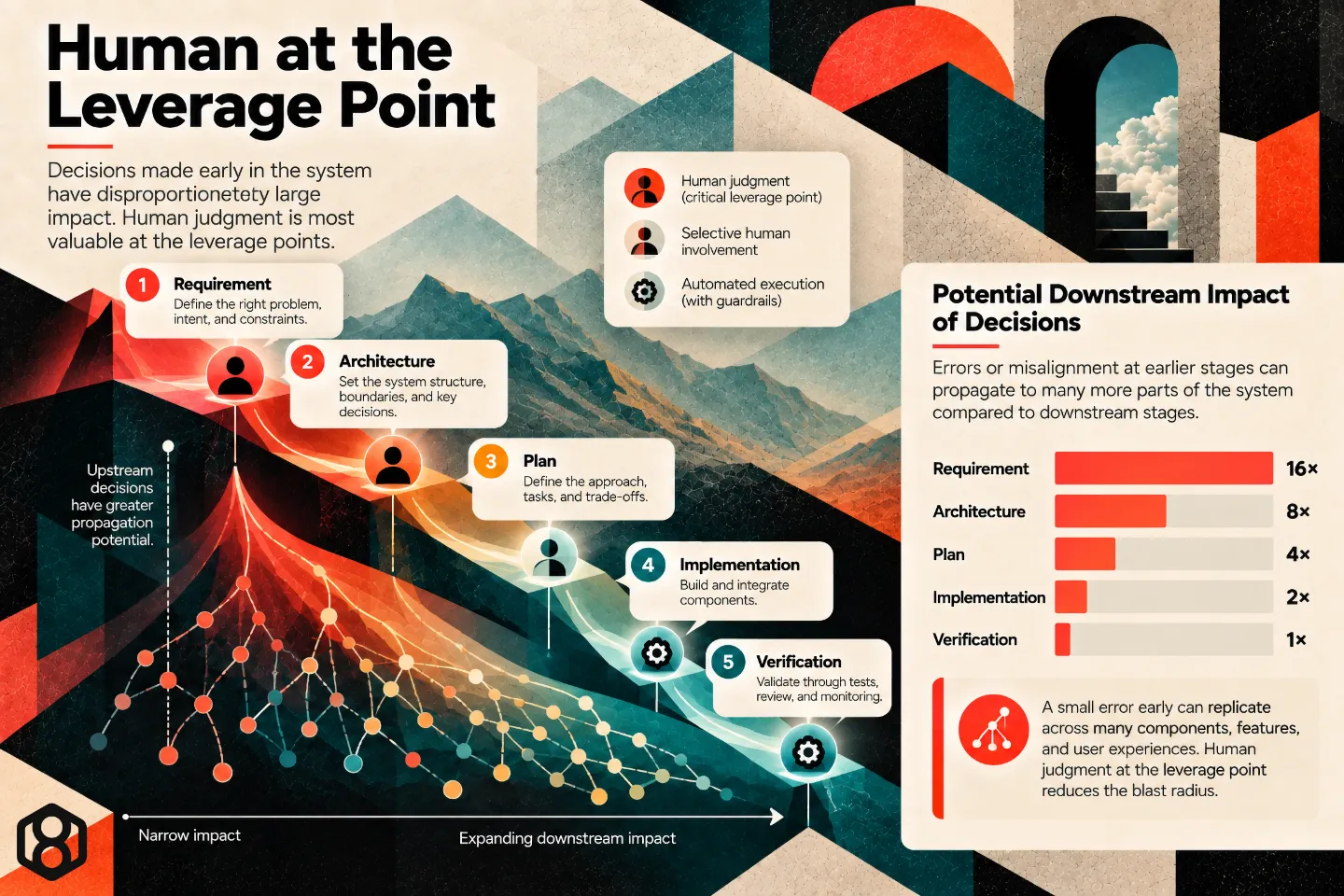
Imagine a development workflow:
Requirement ← HUMAN
↓
Architecture ← HUMAN
↓
Plan ← selective review
↓
Implementation ← agents
↓
Verification ← independent agents/tools
A mistaken requirement can contaminate everything below it.
A poor architectural choice may generate dozens of locally correct implementation decisions that collectively create the wrong system.
By the time a human reviews the final pull request, the expensive mistake may already have propagated through code, tests, documentation, dependencies, and deployment assumptions.
The highest-value intervention therefore often occurs earlier.
Intent deserves disproportionate attention
Agents are becoming increasingly effective at answering the question:
How can I accomplish this task?
Humans remain especially important in deciding:
Is this the right task?
That includes validating intent, resolving ambiguous priorities, deciding what trade-offs are acceptable, defining system boundaries, and distinguishing literal requirements from the outcome stakeholders actually need.
One minute spent correcting intent can prevent hours of perfectly executed downstream work.
Architecture is another leverage point
Architecture creates future constraints.
A decision about tenancy, identity, data ownership, event boundaries, or source-of-truth systems can shape thousands of implementation choices.
This makes architecture particularly suitable for deliberate review.
Not because agents cannot propose architectures.
They can.
But because architectural errors have unusually high propagation potential.
Human intervention should therefore correlate with blast radius, not simply artifact type.
Review exceptions, not everything
A mature agentic system should increasingly route ordinary work through automated assurance while escalating abnormal cases.
Human review becomes especially valuable when:
- requirements conflict;
- confidence is low;
- evidence disagrees;
- a protected boundary must change;
- an operation is irreversible;
- consequences extend across multiple systems;
- the agent is leaving a known operating envelope.
The human becomes less of an approval clerk and more of an authority invoked when the system encounters ambiguity or consequence.
Human attention is a scarce control resource
This reframing has an important organizational consequence.
Human attention should be budgeted like any other scarce engineering resource.
If reviewers must approve hundreds of low-consequence outputs, they will eventually skim.
A nominal control can therefore make the system feel safer while reducing actual assurance.
Better systems concentrate human attention where judgment changes the trajectory.
The goal is not to remove humans.
It is to stop wasting them.
Human-in-the-loop describes location. Human-at-the-leverage-point describes purpose.
As agentic systems become more capable, that distinction will matter.
Evidence
Sources & references
-
Ironies of Automation
Supports: Establishes the classic automation paradox in which humans remain responsible for abnormal situations even as routine work is automated, supporting more deliberate placement of human oversight.
Source checked
-
Leverage Points: Places to Intervene in a System
Supports: Supports the premise that interventions differ dramatically in leverage and that rules, information flows, goals, and system structure can matter more than surface-level controls.
Source checked