


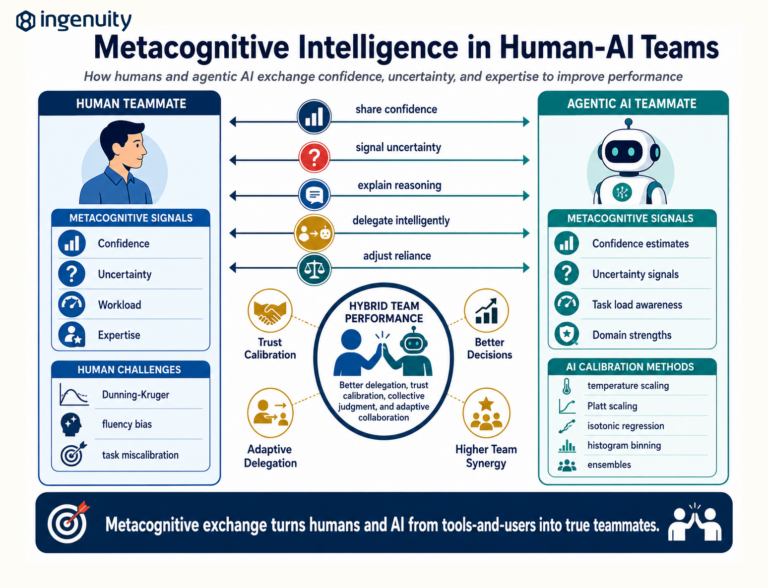
In an era where agentic AI systems—proactive, autonomous agents capable of planning, reasoning, and executing complex tasks—are becoming genuine teammates, organizations face a critical question: How do we build hybrid teams where humans and AI collaborate at peak effectiveness? A compelling answer lies in metacognitive intelligence: the ability to monitor, evaluate, and communicate one’s own cognitive states, such as confidence, uncertainty, workload, and expertise.
Aaron S. Benjamin’s Santa Fe Institute seminar, Metacognitive Intelligence in Human-AI Teams, highlights how sophisticated metacognitive exchange powers high-performing human groups—and why it must extend to human-AI systems. This insight has profound implications for Human Resources Management (HRM), which is uniquely positioned to orchestrate these hybrid teams. However, realizing this potential requires rethinking not only HR practices but also traditional IT governance, which can sometimes hinder rather than help hybrid collaboration.
Why Metacognition Matters in Hybrid Teams
Human teams succeed not just through raw expertise but through sharing metacognitive signals: confidence appraisals, explanations of challenges, and subtle cues. These enable better delegation, collective judgment, and leveraging diverse strengths.
Calibration techniques help AI provide reliable signals. Neural networks often produce miscalibrated probabilities. Methods like temperature scaling, Platt scaling, isotonic regression, histogram binning, and ensembles align AI confidence with reality.
Humans, however, exhibit metacognitive illusions—such as the Dunning-Kruger effect, fluency biases, or poor calibration on ambiguous tasks—that can undermine teamwork. Well-designed AI can accommodate these illusions strategically, sometimes compromising raw accuracy to improve overall team outcomes.
HR’s Strategic Opportunity—and the Pitfalls of Traditional IT Governance
HR professionals excel at managing team dynamics, talent development, performance, and culture. These skills translate powerfully to hybrid environments through role clarity, trust-building, metacognitive training, and hybrid performance metrics.
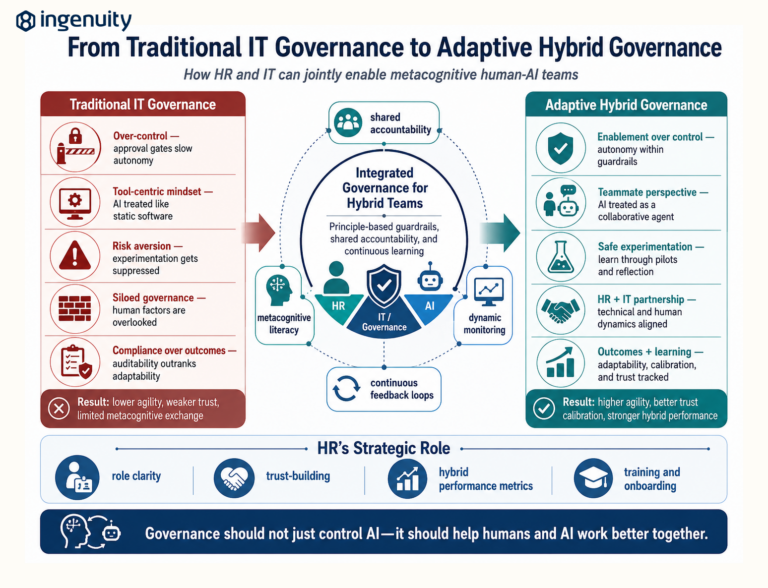
Yet many organizations default to traditional IT governance models—emphasizing control, compliance, risk aversion, centralized approval gates, rigid policies, and treating technology as a managed tool or asset. In hybrid teams with metacognitively aware agentic AI, these approaches can prove counterproductive:
- Over-Control Stifles Agency and Metacognitive Flexibility: Agentic AI thrives on autonomy within guardrails. Heavy-handed approval processes, strict rule-based oversight, or treating AI like static software can limit its ability to exercise calibrated judgment, share uncertainty signals in real time, or adapt dynamically. This reduces the very metacognitive exchange that Benjamin’s research shows drives team performance.
- Tool-Centric Mindset vs. Teammate Perspective: Traditional governance views AI as an IT asset subject to procurement, security reviews, and version control. This discourages treating AI as a collaborative partner with evolving “mental states” (confidence, workload awareness). It can foster human over-reliance or dismissal rather than nuanced, trust-based interaction informed by metacognitive signals.
- Risk Aversion Hinders Experimentation and Illusion Management: Rigid compliance frameworks prioritize minimizing errors and avoiding liability, which may discourage the experimental integration needed to learn how AI can accommodate human illusions or how humans can best interpret AI calibration. Overly cautious policies can slow adoption and prevent teams from discovering optimal hybrid workflows.
- Siloed Governance Ignores Human-AI Dynamics: IT governance often operates separately from HR, talent, and team processes. This creates fragmentation: technical controls without attention to psychological safety, trust calibration, or cultural integration—factors essential for metacognitive alignment in hybrid teams.
- Compliance Over Outcomes: Check-the-box audits and static policies struggle with the fluid, context-dependent nature of agentic behavior and metacognitive communication. They may prioritize auditability over the adaptability and continuous learning required for high-performing hybrid teams.
A Better Path: Integrated, Adaptive Governance for Hybrid Teams
Effective oversight of metacognitively aware hybrid teams demands a hybrid governance model that blends IT rigor with HR insight:
- Shift from Control to Enablement: Implement lightweight, principle-based guardrails focused on transparency, ethical alignment, and metacognitive visibility (e.g., mandatory confidence signaling) rather than micromanagement.
- Cross-Functional Collaboration: Create joint HR-IT governance bodies that address both technical compliance and human factors like trust, illusion mitigation, and role evolution.
- Dynamic Monitoring and Feedback: Treat AI agents with identity management, behavioral baselines, and performance tracking similar to employees—while encouraging continuous calibration improvement and human-AI reflection loops.
- Foster Metacognitive Literacy Organization-Wide: Invest in training that equips leaders, managers, and teams to navigate calibration, illusions, and appropriate reliance—turning governance into a capability-builder rather than a gatekeeper.
Practical Recommendations for Leaders
- Audit Governance Practices: Assess how current IT policies may constrain agentic and metacognitive capabilities. Pilot more adaptive frameworks in select teams.
- Integrate HR and IT: Establish shared accountability for hybrid team success, with metrics covering calibration quality, trust, synergy, and illusion reduction.
- Design Metacognitive Training and Onboarding: Help humans interpret AI signals and manage personal biases.
- Update Performance and Talent Systems: Incorporate hybrid outcomes and treat AI as evolving teammates with governance protocols suited to agency.
- Lead Cultural Change: Promote psychological safety around uncertainty and experimentation.
The Path Forward
As agentic AI proliferates, organizations that master metacognitive intelligence in human-AI teams will gain a decisive edge. Traditional IT governance, while essential for stability, risks becoming a bottleneck if applied rigidly to dynamic hybrid systems. HR leaders, working in partnership with IT, can bridge this gap—becoming architects of collaborative intelligence that is more capable, resilient, and human-centered than either humans or AI alone.
The future of work is hybrid. The organizations that thrive will align governance with the metacognitive realities of teamwork in the agentic era.
