
The most expensive technology decision an enterprise makes is not always the one that fails.
Sometimes, it is the decision the organization never makes.
Consider an enterprise planning to modernize its core operating systems. Leadership recognizes the limitations of its existing technology. Engineering teams understand the architectural constraints. Business units see opportunities to improve productivity, automate workflows, and deliver better customer experiences.
The technology exists. The business case is credible. The organization has the resources to proceed.
Yet the initiative struggles to move forward.
Procurement raises concerns about becoming dependent on a single provider. Enterprise architects recommend additional abstraction layers to preserve portability. Compliance teams request further assurances. Business units disagree about ownership. Leadership asks for more alternatives.
Each concern is reasonable. Each recommendation can be defended.
But as the organization continues evaluating how to protect itself against future technology dependencies, the systems it intended to replace remain in operation.
Technical debt accumulates. Operational inefficiencies persist. Innovation slows.
Meanwhile, competitors face the same technological opportunities and make different decisions.
This is the enterprise risk-avoidance trap: when individually rational efforts to minimize uncertainty collectively undermine an organization’s ability to adapt.
The problem is not that enterprises take technology risk seriously. They should.
The problem emerges when risk management becomes disconnected from the strategic consequences of inaction.
Vendor Lock-In is a Legitimate Concern – But It Is Not the Whole Risk Equation
Fear of vendor lock-in in digital transformation is neither new nor irrational.
Enterprise technology history contains numerous examples of organizations becoming deeply dependent on proprietary software, infrastructure, licensing arrangements, or specialized systems that proved expensive to replace.
Modern cloud platforms, enterprise SaaS applications, and artificial intelligence ecosystems introduce similar considerations.
As organizations integrate these technologies into critical operations, switching providers can require significant investment.
Data may need to be migrated. Business logic may depend on proprietary services. Integrations may require redesign. Employees may need retraining. Existing contracts may impose financial or operational restrictions.
For organizations operating in financial services, healthcare, utilities, government, and other regulated environments, these concerns can be particularly consequential.
Vendor dependency is also a recognized market issue.
The UK’s Competition and Markets Authority concluded its cloud services market investigation in July 2025, identifying barriers to competition associated with switching costs, interoperability, and software licensing. In March 2026, the authority announced further action on cloud interoperability and data transfer charges, reflecting the continuing importance of these concerns to enterprise customers. [1] [2]
The US National Institute of Standards and Technology has likewise identified portability and interoperability as important considerations in cloud adoption and standardization. [3]
The implication is clear: vendor dependency deserves deliberate architectural, contractual, and operational management.
However, recognizing a legitimate risk does not establish that avoiding the risk at almost any cost is the correct strategy.
Enterprises must also consider what they sacrifice by refusing to commit.
A proprietary technology platform may introduce switching costs while simultaneously providing capabilities that would take years to develop internally.
A managed cloud service may reduce direct infrastructure control while improving scalability, reliability, and time to market.
A specialized AI platform may introduce external dependencies while enabling the organization to automate work that was previously impractical.
The relevant question is therefore not simply:
How do we avoid becoming dependent on this provider?
It is:
Does the value of this dependency justify its cost, and can we govern the risks sufficiently to preserve our ability to adapt?
This distinction changes the conversation from eliminating dependency to making informed strategic commitments.
When Organizational Psychology Turns Caution Into Resistance
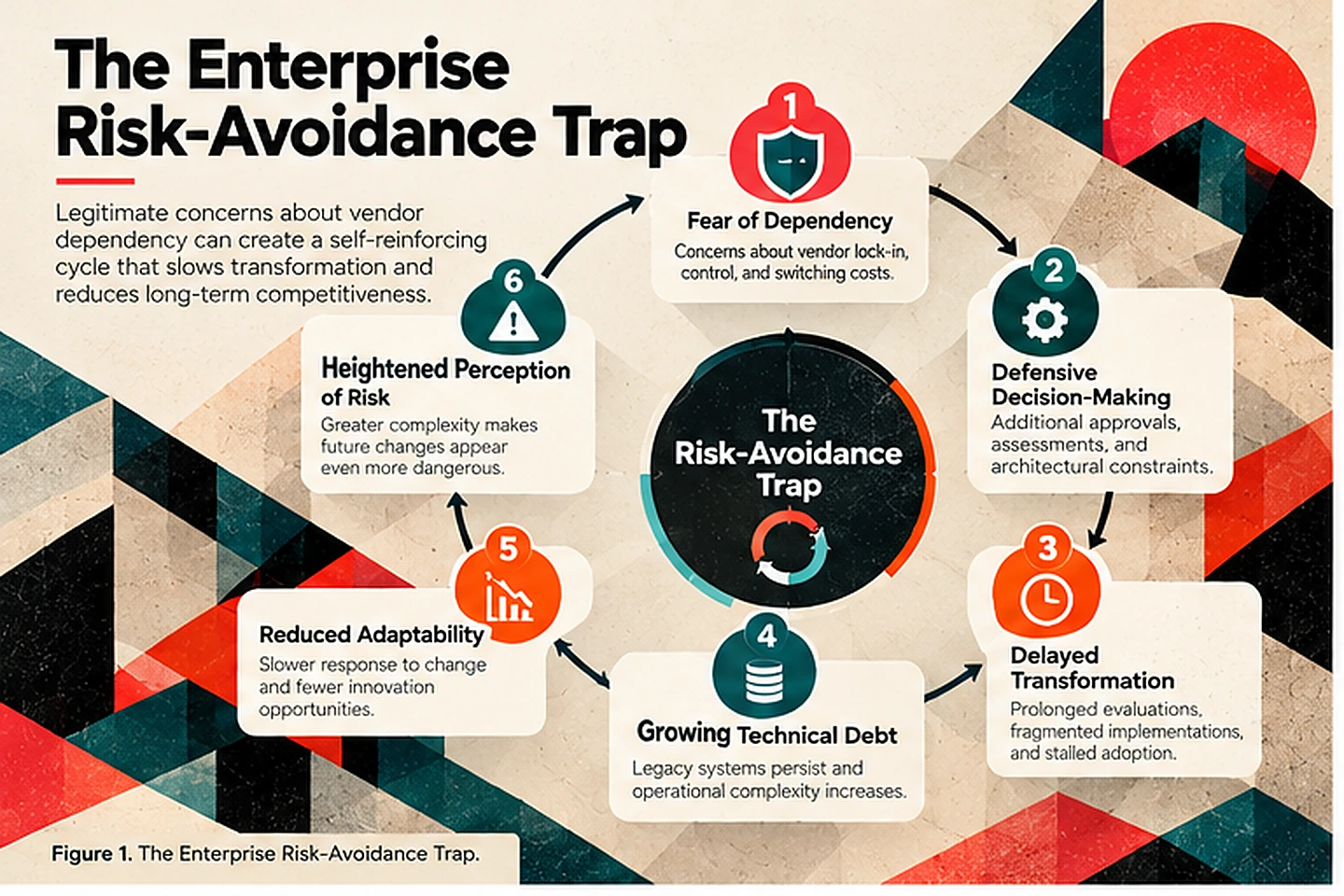
Enterprise technology decisions are rarely determined by economic or architectural considerations alone.
They are also influenced by organizational psychology.
People do not evaluate risk in isolation from their professional responsibilities, incentives, experience, or institutional culture.
Behavioral research has long demonstrated that individuals tend to favor existing arrangements even when alternatives may offer advantages.
Samuelson and Zeckhauser’s research on status quo bias found that decision-makers disproportionately prefer maintaining existing conditions. [4]
Kahneman and Tversky’s work on prospect theory provides a broader explanation of how perceived gains and losses influence decisions under uncertainty. [5]
These findings are not specific to enterprise technology procurement, but they help explain why technological change can encounter resistance even when its potential benefits are substantial.
Within an enterprise, several dynamics are particularly relevant.
The risks of action are visible. The costs of inaction are not.
An executive who approves a major technology investment may be held accountable if implementation fails, costs increase, or the organization becomes dependent on an unsuitable provider.
The consequences are visible and attributable.
By comparison, an executive who postpones the decision may face little immediate scrutiny.
The resulting costs – lost productivity, delayed innovation, declining customer experience, and missed competitive opportunities – are distributed across departments and accumulate over time.
This creates an asymmetry in accountability.
Decision-makers may be rewarded for avoiding visible mistakes rather than for producing the best long-term outcomes.
Familiar systems create a perception of safety
Legacy systems often remain in operation because their weaknesses are understood.
Their limitations have become part of the organization’s normal operating environment.
A modern alternative introduces uncertainties that the enterprise has not yet experienced.
Consequently, familiar inefficiencies can appear less threatening than unfamiliar opportunities.
Over time, organizations may become increasingly comfortable with the known costs of outdated technology while becoming disproportionately concerned about the potential costs of replacing it.
Professional identity becomes entangled with architecture
Technology decisions can also threaten established responsibilities and expertise.
When an enterprise moves from internally maintained infrastructure to managed cloud services, or from manual processes to AI-enabled workflows, the change may alter who controls critical systems and how their work is valued.
Resistance may consequently reflect concerns about authority, competence, professional relevance, or organizational influence – not merely the technical merits of the proposed solution.
These concerns are often expressed through legitimate architectural or governance language, making them difficult to distinguish from purely technical objections.
Organizations become more rigid under perceived threats
Organizational research describes a phenomenon known as threat rigidity: under perceived threat, people and institutions may narrow their attention, centralize control, and rely more heavily on familiar responses.
Staw, Sandelands, and Dutton explored these dynamics in their foundational research on organizational behavior. [6]
In enterprise transformation, the implication is significant.
When a proposed technology is perceived as a threat to control or stability, the organization may respond by adding approval requirements, restricting experimentation, or demanding increasingly elaborate safeguards.
The governance processes intended to support responsible innovation can begin preventing innovation altogether.
The organization starts optimizing for the avoidance of future regret rather than the creation of future value.
This is where a legitimate technology concern becomes a strategic problem.
The Hidden Cost of Trying to Keep Every Option Open
One of the more consequential responses to vendor dependency concerns is the pursuit of maximum architectural flexibility.
Enterprises may insist that systems remain interchangeable, workloads remain portable across multiple infrastructure providers, and applications avoid proprietary capabilities wherever possible.
These objectives can be valuable when supported by genuine business requirements.
However, flexibility is not free.
Maintaining multiple technology environments requires additional engineering, security, integration, testing, monitoring, and operational expertise.
Abstraction layers introduce their own maintenance obligations. Redundant systems increase complexity. Integration frameworks require ongoing development.
When these investments are disproportionate to the risks they are intended to mitigate, the enterprise begins paying a substantial premium for flexibility it may never need.
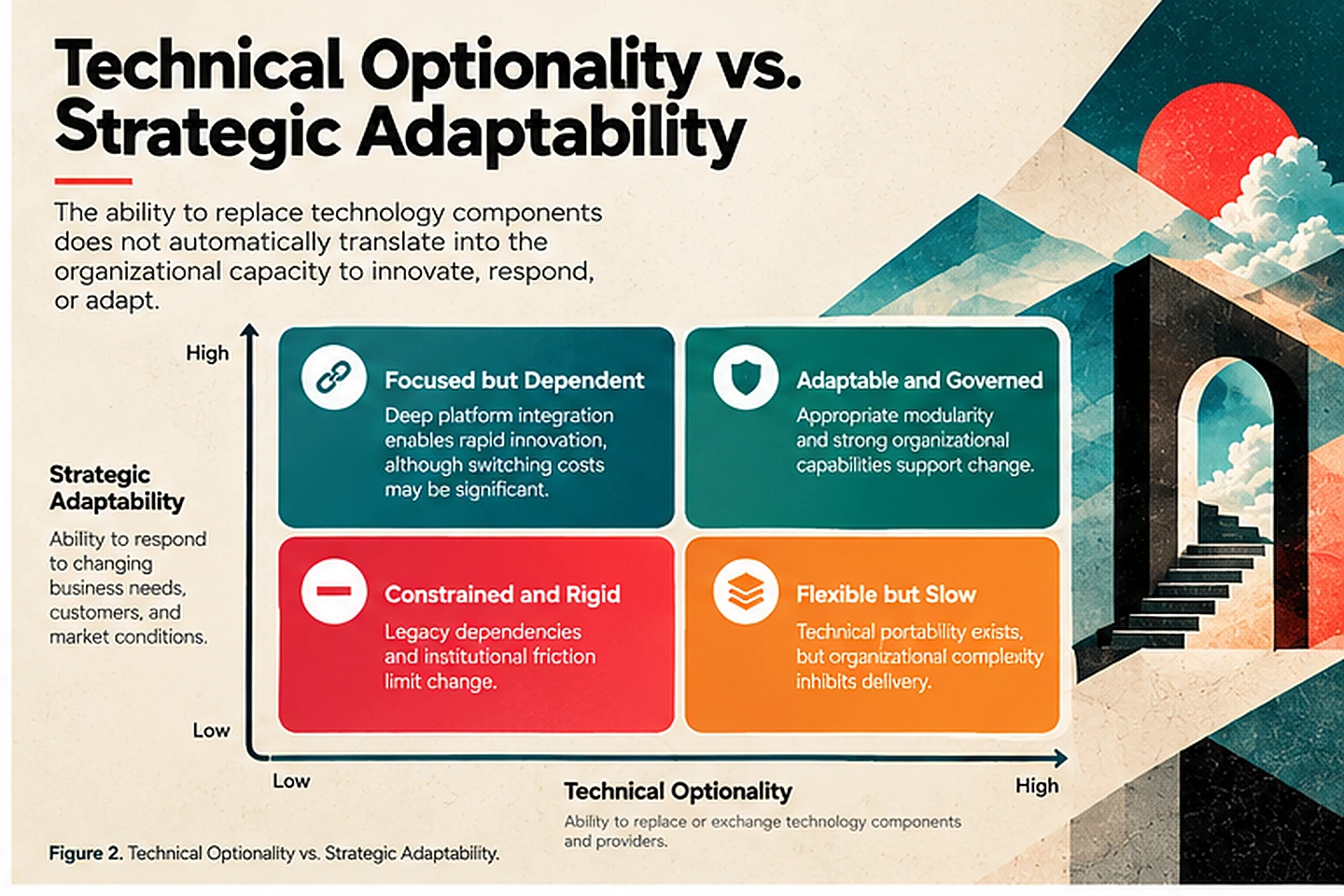
There is also an important distinction between technical optionality and strategic adaptability.
Technical optionality is the ability to replace a technology component or provider.
Strategic adaptability is the ability to respond to changing customer expectations, market conditions, operational requirements, and competitive threats.
The two are related, but they are not interchangeable.
An enterprise may design an architecture that allows multiple cloud providers to be substituted while remaining unable to introduce a new product feature without navigating months of approvals and integration work.
It has preserved infrastructure flexibility without improving its ability to change.
An organization can become highly optimized for replacing technology providers while remaining poorly equipped to respond to its competitors.
The objective of enterprise architecture should not be theoretical independence from every provider.
It should be an operating environment that supports reliable delivery, appropriate control, and continuous business evolution.
The Dependency Enterprises Underestimate: Their Existing Systems
Vendor dependency is often discussed as a risk introduced by adopting new technologies.
But enterprises are already dependent on their existing systems.
They depend on legacy applications that may be difficult to maintain.
They depend on specialized employees who understand undocumented business logic.
They depend on integrations developed over years of incremental changes.
They depend on manual processes, spreadsheets, and workarounds that compensate for limitations in their technology.
They may even depend on particular consultants or systems integrators simply to keep their infrastructure operational.
These dependencies are not necessarily less dangerous because they exist within the organization.
Consider a business-critical system maintained by a small number of employees.
The enterprise may technically own its source code, infrastructure, and data.
Yet if those employees leave, the organization may discover that much of the knowledge required to maintain or modify the system has never been documented.
It owns the technology but lacks the practical independence needed to evolve it.
Similarly, an organization may reject a modern SaaS platform because it fears future licensing increases while continuing to operate internally developed software with substantial maintenance costs and limited adaptability.
In both situations, the organization may be evaluating the risks of the proposed technology more rigorously than the risks of its existing environment.
This creates an incomplete picture of enterprise dependency.
A more useful approach evaluates the entire dependency landscape, including internal systems, external providers, specialized knowledge, operating processes, and organizational constraints.
The central question becomes:
Which dependencies create value, which create unnecessary constraints, and which threaten our ability to operate and adapt?
That question is more strategically useful than simply distinguishing between technology the enterprise owns and technology it purchases.
Why Excessive Caution Creates Opportunities for Disruption
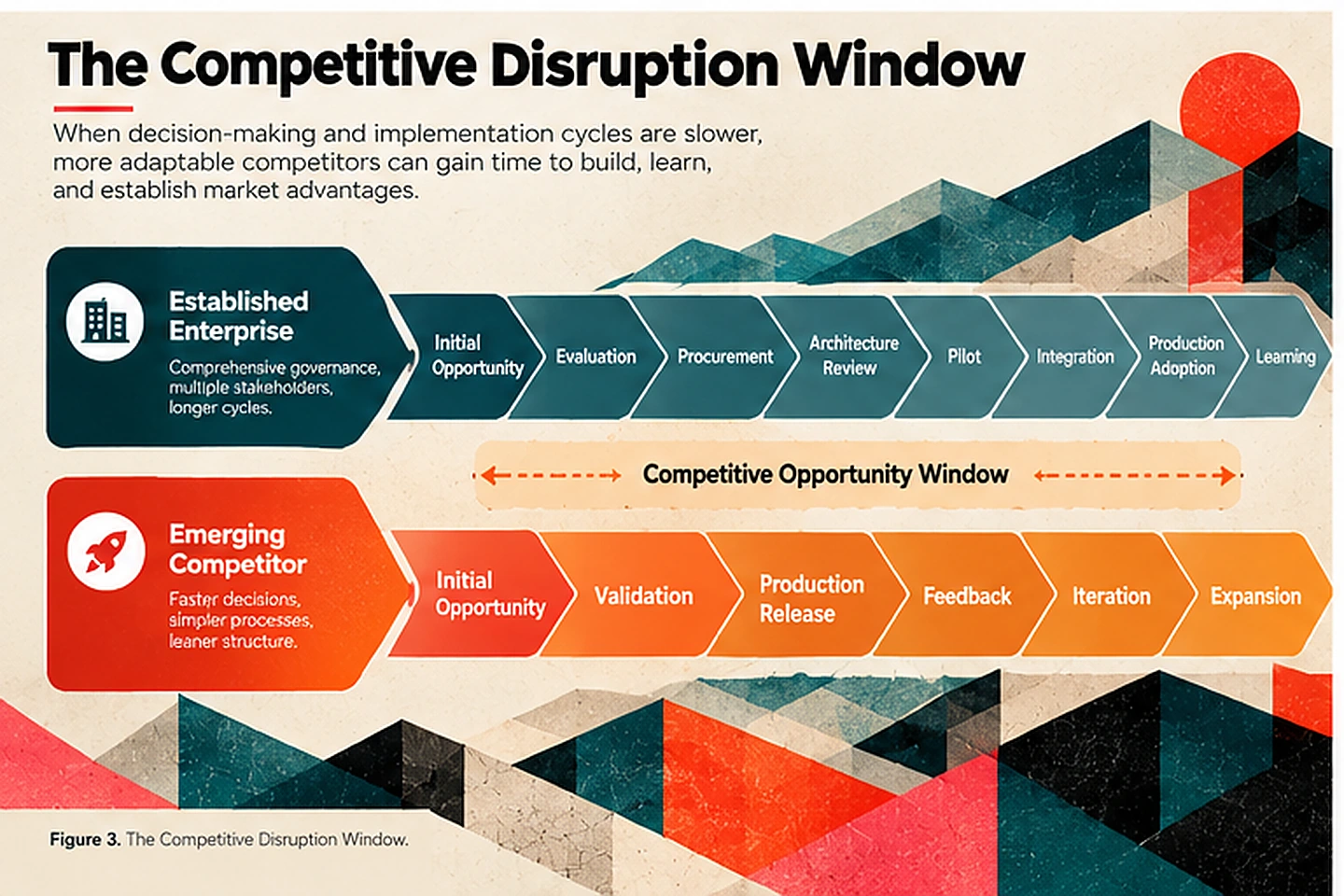
The consequences of enterprise risk aversion extend beyond delayed technology projects.
They can alter an organization’s competitive position.
Smaller organizations and emerging competitors often operate with fewer structural constraints.
They may have limited legacy infrastructure, simpler decision-making processes, and fewer established organizational interests to protect.
Rather than investing heavily in preserving the ability to replace every technology component, they can prioritize acquiring capabilities that help them enter a market or serve customers more effectively.
Cloud infrastructure allows them to establish sophisticated computing environments without building data centers.
SaaS platforms provide enterprise-grade operational capabilities without requiring large internal software teams.
AI services make certain forms of automation, content processing, analytics, and intelligent assistance more accessible.
These technologies do not eliminate the challenges of building a successful business. Nor do they automatically provide competitive advantage.
But they can reduce the resources and time required to develop capabilities that previously demanded substantial investment.
This changes the competitive environment.
The incumbent’s disadvantage is often organizational rather than technological
Established enterprises frequently possess advantages that smaller competitors cannot easily replicate.
They have established customer relationships, extensive operational knowledge, financial resources, distribution networks, proprietary information, and recognized brands.
Yet these advantages may be difficult to mobilize quickly.
Research by Rebecca Henderson and Kim Clark on architectural innovation helps explain why established organizations can struggle when technological change affects the relationships between existing capabilities.
Their work demonstrated how knowledge embedded in organizational structures and processes can make certain forms of innovation difficult for incumbents to recognize and accommodate. [7]
The relevance to contemporary transformation is significant.
A competitor may not need to develop superior versions of every system an enterprise operates.
It may only need to reorganize how technology, information, and people work together to deliver a substantially better customer outcome.
An established enterprise might require extensive coordination across departments to introduce that same operating model.
The resulting competitive disadvantage is not necessarily a lack of access to technology.
It is an inability to reorganize around the opportunities that technology creates.
AI makes organizational adaptability more important
Artificial intelligence makes this dynamic particularly relevant.
The competitive value of AI does not come exclusively from access to increasingly capable models.
It also depends on an organization’s ability to integrate those models into useful workflows, connect them with reliable information, maintain appropriate controls, and continuously improve their performance.
Google Cloud’s 2025 DORA research characterized AI as an amplifier of existing organizational capabilities and weaknesses.
Its findings emphasize that realizing value from AI depends on the broader system of engineering practices, organizational structures, and operational capabilities surrounding the technology. [8]
This creates an important implication for enterprise leadership.
An organization that adopts AI tools without addressing fragmented information, unclear accountability, ineffective processes, or slow decision-making may simply amplify its existing inefficiencies.
But an organization that can coordinate technological change with operational improvement may capture benefits that extend beyond individual AI features.
The competitive advantage emerges from the interaction of technology and organizational capability.
Enterprises that remain trapped in prolonged evaluation cycles risk allowing more adaptable competitors to accumulate experience, refine their products, and establish new customer expectations.
Disruption does not require the collapse of an incumbent
Competitive disruption is not necessarily a dramatic event in which a startup suddenly replaces an established enterprise.
It can emerge gradually.
A smaller competitor introduces a more convenient customer experience.
Another provides faster service through automation.
A specialized provider develops a more efficient operating model.
An emerging platform removes friction that customers have long accepted as unavoidable.
Each improvement may initially appear limited.
But collectively, these developments can change customer expectations and the economics of an industry.
The enterprise may retain its existing market position for some time while gradually losing the ability to influence how that market evolves.
Not every emerging competitor will succeed, and not every established enterprise will struggle. Scale, trust, regulation, and established relationships remain meaningful competitive advantages.
Nevertheless, the slower an enterprise becomes at translating technological opportunities into operational improvements, the longer the opportunity window available to more adaptable competitors.
This is the strategic cost of excessive caution.
The Alternative: Governed Strategic Dependency
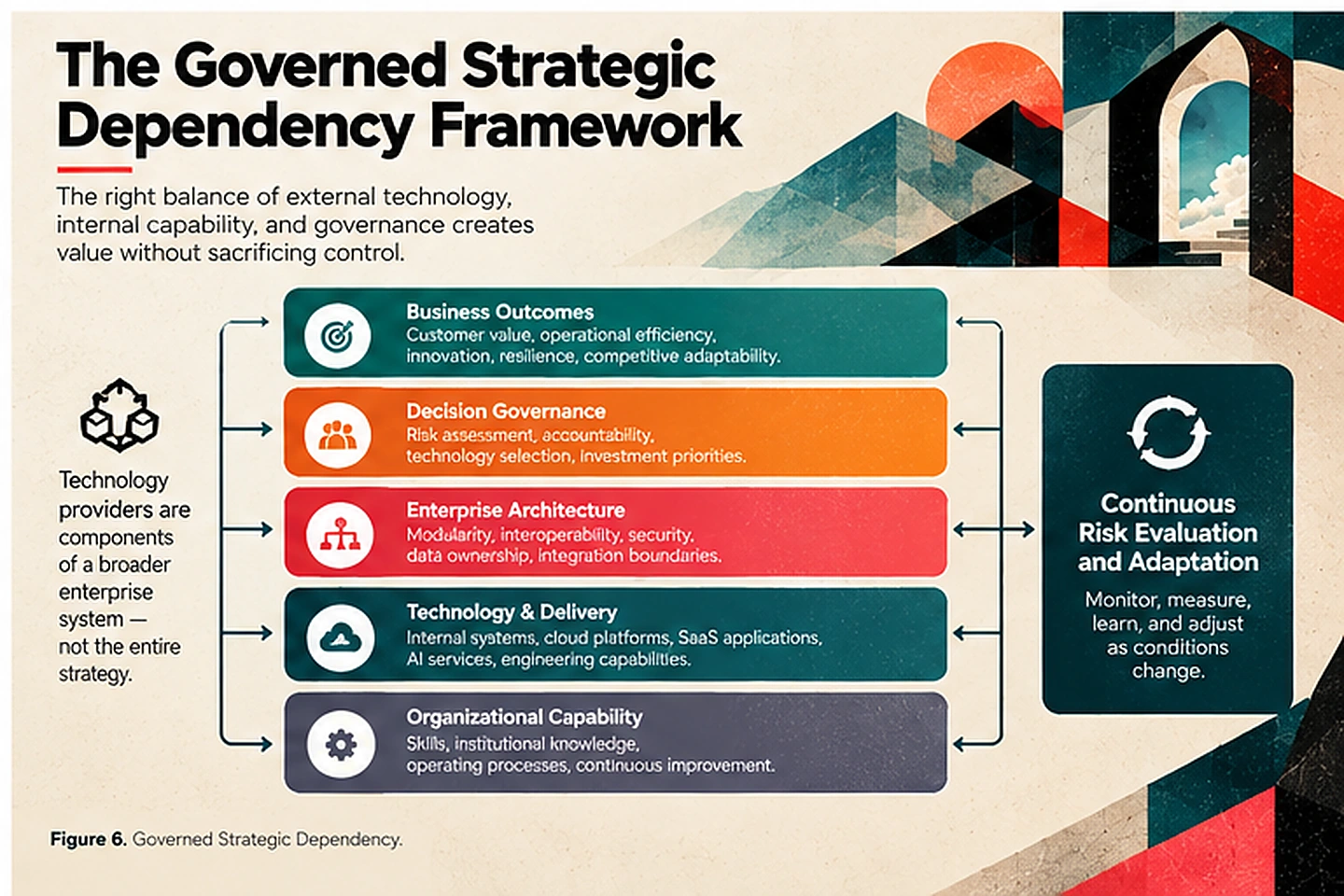
The appropriate response is not to abandon procurement discipline, architectural governance, or technology risk management.
It is to recognize that complete technological independence is neither achievable nor necessarily desirable.
Modern enterprises create value through networks of internal capabilities, external platforms, specialist providers, operating processes, and information systems.
The objective should be to govern those relationships so they strengthen rather than constrain the organization.
At Ingenuity, we believe this requires a shift from avoiding dependencies to engineering them deliberately.
A practical approach involves six principles.
1. Begin with business outcomes, not technology preferences
Transformation decisions should begin with the operational or competitive improvement the enterprise needs to achieve.
Is the objective to shorten product delivery cycles?
Improve customer experience?
Reduce operating costs?
Increase organizational responsiveness?
Modernize a critical system without disrupting essential services?
These outcomes should determine the required capabilities and acceptable trade-offs.
A technology architecture should be evaluated against its ability to produce those outcomes – not simply its conformity with a preferred platform strategy.
This aligns with research from MIT’s Center for Information Systems Research, which emphasizes that digitally capable enterprises combine operational efficiency, customer experience, modular capabilities, and effective partnerships. [9]
2. Evaluate dependencies according to their actual consequences
Not all dependencies require the same level of protection.
An enterprise should distinguish between technologies that are easily replaceable, those that are strategically important, and those whose failure or loss would threaten essential operations.
A third-party collaboration tool does not necessarily require the same portability architecture as a platform supporting financial transactions or critical infrastructure.
Architecture, contractual protections, operational safeguards, and exit planning should reflect these differences.
The goal is proportionate governance.
3. Preserve control over the assets that matter most
Organizations should retain appropriate control over their critical business information, core operating rules, important intellectual property, and essential decision processes.
Practical safeguards may include documented interfaces, clearly defined data ownership, reliable export mechanisms, accessible configuration records, and contractual provisions for continuity or transition.
Where appropriate, business logic can be separated from provider-specific infrastructure.
However, the organization should avoid creating unnecessary layers of abstraction simply to make every component theoretically interchangeable.
The objective is to preserve meaningful strategic control without sacrificing the advantages of modern technology.
4. Design for resilience, not just portability
The ability to replace a technology provider is only one dimension of resilience.
An enterprise must also consider how systems behave when services fail, information becomes unavailable, integrations break, or operational conditions change.
Reliable monitoring, recovery procedures, security controls, incident response, and clear operational ownership often provide more immediate value than the theoretical ability to migrate an entire system.
For critical workloads, portability and exit plans should be practical enough to validate.
An exit strategy that exists only in architectural documentation may provide false confidence.
The most important question is whether the organization can continue delivering essential services when its operating environment changes unexpectedly.
5. Build internal capability alongside external partnerships
Engaging technology providers should not mean surrendering institutional knowledge.
Enterprises need enough internal expertise to understand their systems, evaluate technology decisions, oversee providers, and maintain accountability for business outcomes.
This does not require reproducing every specialized external capability.
Instead, it requires deliberate investment in architecture knowledge, documentation, technical governance, operational ownership, and skills transfer.
A well-structured technology partnership should leave the client organization more capable of operating and evolving its systems.
The objective of a successful partnership is not to make the enterprise permanently dependent on its provider, but to increase the enterprise’s ability to create value.
6. Make the cost of inaction part of every major decision
Technology risk assessments should evaluate the consequences of proceeding and the consequences of delay.
This means considering not only implementation costs and potential switching risks, but also the operational inefficiencies, competitive disadvantages, and missed opportunities associated with maintaining the status quo.
A decision to defer transformation may be entirely appropriate.
However, it should be supported by a deliberate assessment of the risks being accepted.
Doing nothing should be treated as a strategic choice with consequences, not as the default risk-free alternative.
Enterprise leadership must redefine what effective risk management looks like
The broader challenge is organizational.
Enterprises can implement strong architectural standards and carefully structured vendor agreements while continuing to struggle with transformation.
If their decision-making processes reward caution more consistently than progress, technical safeguards alone will not solve the underlying problem.
Leadership must examine the incentives, responsibilities, and governance practices surrounding major technology decisions.
Who is accountable for realizing transformation benefits?
Who has authority to accept a manageable technology risk?
What evidence is sufficient to move from evaluation to implementation?
How are concerns escalated and resolved?
What happens when stakeholders disagree?
And who is accountable for the consequences of postponing a decision?
These questions are as important as the choice of cloud platform, enterprise software product, or AI provider.
An organization that requires unanimous confidence before making consequential decisions may struggle to adapt in an environment where uncertainty cannot be eliminated.
Instead, enterprises need governance that supports informed commitment.
That means identifying the risks that genuinely threaten operations, establishing controls appropriate to their consequences, and enabling decisions when the available evidence is sufficient.
It also means creating opportunities to learn through implementation.
Incremental modernization, limited production releases, staged migrations, and carefully governed experiments allow enterprises to validate assumptions without committing every critical system to a single irreversible change.
Effective governance should make responsible progress possible.
It should not require the absence of uncertainty before progress can begin.
The real measure of strategic independence
There is a tendency to associate technological independence with ownership.
Organizations may feel more secure when they control their infrastructure, own their source code, or rely primarily on internal teams.
These arrangements can provide important advantages.
But ownership is not the same as adaptability.
An enterprise can own a system while lacking the institutional knowledge necessary to maintain it.
It can control its infrastructure while remaining dependent on obsolete architecture.
It can avoid external providers while becoming increasingly reliant on expensive internal workarounds.
Conversely, an enterprise can depend on external technology platforms while maintaining strong operational resilience, independent governance, capable internal teams, and the flexibility to change as its business evolves.
The more useful definition of strategic independence is therefore not the absence of dependency.
It is the ability to make and execute important business decisions without being constrained by dependencies the organization does not understand or cannot manage.
This is ultimately an engineering and organizational design challenge.
The systems, information, processes, decision rights, and external relationships surrounding an enterprise must work together to support continuous change.
A modern technology platform cannot deliver that capability on its own.
Neither can an elaborate procurement process or a theoretically vendor-neutral architecture.
It emerges when technology choices are supported by coherent enterprise architecture, effective governance, internal expertise, and leadership willing to make informed commitments.
How Ingenuity approaches enterprise transformation
At Ingenuity, our approach to Enterprise Digital Transformation begins with understanding the business and operating environment before selecting the technology.
We examine the systems, information flows, workflows, dependencies, decision structures, and operational constraints surrounding the problem.
Our objective is not to recommend the greatest possible level of technological independence or the deepest possible commitment to a particular vendor.
It is to develop an architecture and delivery approach appropriate to the organization’s business objectives, operating requirements, and long-term capabilities.
This often means modernizing incrementally rather than attempting an immediate replacement of every legacy system.
It can also mean establishing clearer integration boundaries, improving information governance, strengthening internal engineering practices, or transferring knowledge that has become concentrated among particular individuals or providers.
For example, in our ERP-HR modernization engagement with Davao City Water District, implementation included documentation, end-user training, and programmer training for the client’s internal technical team.
These activities supported the organization’s ability to understand and maintain the system beyond the initial implementation. The project illustrates an important delivery principle: external engineering expertise and internal organizational capability can be developed together.
Our Software Delivery Risk Assessment similarly examines dependencies as part of a broader delivery system – including architecture, technical debt, integration complexity, operational ownership, and organizational conditions.
The objective is to distinguish risks requiring intervention from those that can be managed during delivery.
These practices reflect a simple principle:
Technology should expand an organization’s capacity to act, not create unnecessary constraints on its future.
The greater risk is becoming unable to change
Vendor dependency will remain an important consideration in enterprise technology strategy.
As cloud platforms, AI systems, and specialized software ecosystems become more deeply integrated into business operations, enterprises will need increasingly sophisticated approaches to managing external relationships and technological concentration.
But protecting an organization against future dependencies must not come at the expense of its ability to innovate today.
Every enterprise already operates within a network of dependencies.
Some are visible and contractual. Others are embedded in legacy systems, organizational structures, operating practices, and institutional knowledge.
The strategic challenge is to understand and govern those dependencies while preserving the organization’s ability to evolve.
Enterprises that approach the problem successfully will not necessarily be those that avoid the greatest number of external commitments.
They will be those that make the right commitments, maintain appropriate control, develop durable internal capabilities, and continuously adapt their operating models.
The greatest obstacle to digital transformation may therefore be less about the limitations imposed by technology providers and more about the limitations organizations impose upon themselves.
The question enterprise leaders must confront is not simply whether a new technology could make their organization dependent on someone else.
It is whether their fear of that dependency is making them increasingly dependent on a future they are no longer equipped to compete in.
Ready to make your next transformation decision with greater confidence?
Digital transformation requires balancing architectural flexibility, operational resilience, business value, and the ability to adapt.
Ingenuity helps enterprises understand complex technology environments, evaluate dependencies, modernize critical systems, and build digital capabilities designed for long-term use.
Whether you are considering a platform modernization, an enterprise-wide transformation initiative, or the adoption of AI-enabled systems, we can help identify the risks that matter and establish a practical path forward.
Evidence
Sources & references
-
Cloud services market investigation
Supports: Documents the 2025 final decision and concerns related to barriers to cloud switching, interoperability, and competition.
UK regulatory investigation of cloud market competition and customer switching barriers.
Source checked
-
CMA announces package of actions on business software and cloud services
Supports: Evidence of continuing regulator scrutiny of cloud egress fees, interoperability, and business software licensing.
Official March 2026 announcement on cloud switching, interoperability, and market choice.
Source checked
-
NIST Cloud Computing Standards Roadmap (SP 500-291r2)
Supports: Supports the technical importance of interoperability, portability, standards, and migration considerations.
NIST guidance on cloud standards, portability, and interoperability.
Source checked
-
Status quo bias in decision making
Supports: Foundational evidence for a tendency to favor existing arrangements over alternatives.
Samuelson and Zeckhauser (1988), research on status quo bias in decision-making.
Source checked
-
Prospect Theory: An Analysis of Decision under Risk
Supports: Provides foundational behavioral theory concerning how people weigh potential losses, gains, and uncertainty.
Kahneman and Tversky (1979), foundational research on decisions involving risk.
Source checked
-
Threat Rigidity Effects in Organizational Behavior: A Multilevel Analysis
Supports: Analyzes restricted information processing and constricted control in individual, group, and organizational responses to threat.
Staw, Sandelands, and Dutton (1981), foundational analysis of threat-rigidity responses.
Source checked
-
Architectural Innovation: The Reconfiguration of Existing Product Technologies and the Failure of Established Firms
Supports: Explains how organizationally embedded architectural knowledge can make incumbents less able to adapt to architectural innovation.
Henderson and Clark (1990), research on innovation and established organizations.
Source checked
-
2025 State of AI-assisted Software Development
Supports: Research finding that AI tends to amplify existing organizational capabilities and weaknesses.
DORA research on how organizational systems affect outcomes from AI-assisted software development.
Source checked
-
Pathways to Future Ready
Supports: Connects enterprise digital transformation to operational efficiency, customer experience, modular capabilities, and partner ecosystems.
MIT CISR perspective on future-ready organizations and digital operating models.
Source checked