

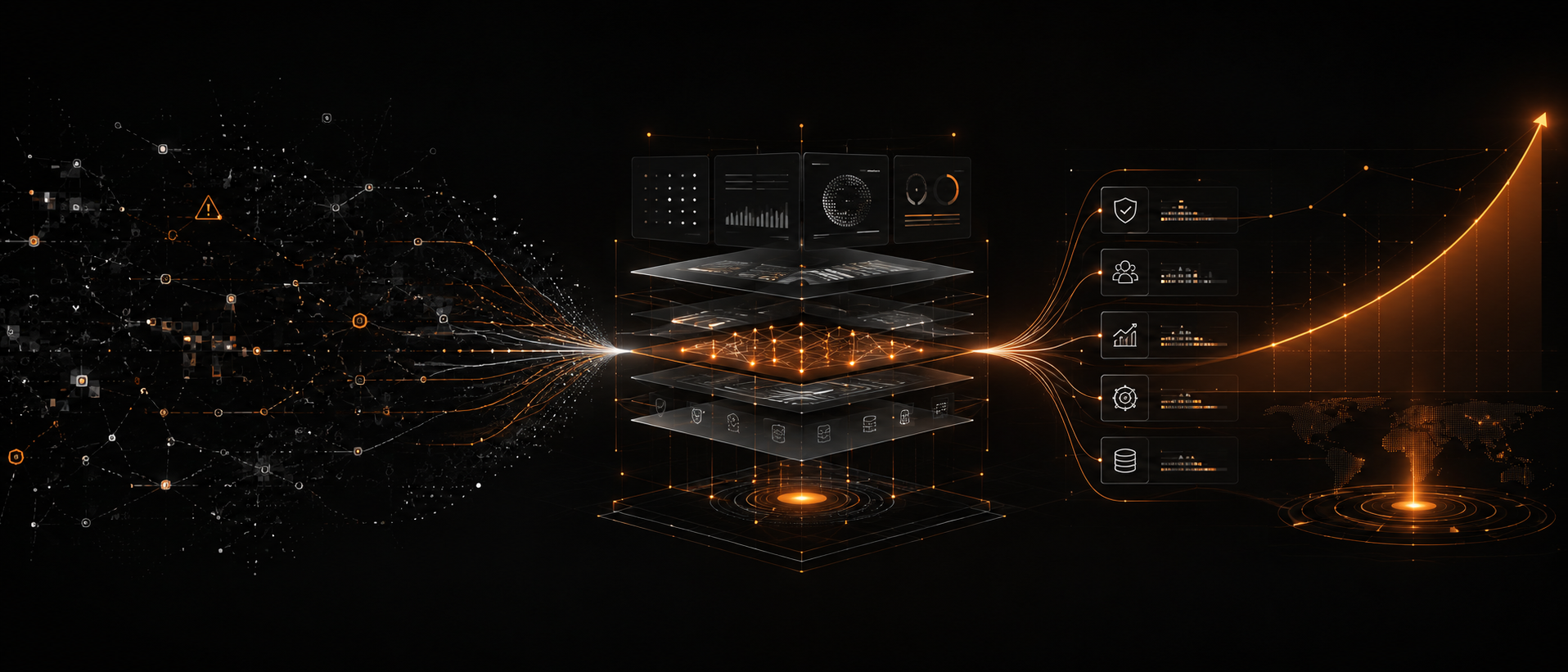
Artificial Intelligence is not simply a technology wave — it is a structural shift in how organizations perceive, govern, and operationalize information. The enterprises that will lead in the next decade will not be those that experiment with the most AI tools, but those that build the most trusted, adaptive, and strategically governed information environments.
At Ingenuity, we believe that AI advantage is fundamentally an information advantage. And information advantage can only be sustained when security, architecture, and decision-making are engineered as a unified system.
The Real Constraint on AI is Not Algorithms — It Is Information Coherence
Many organizations approach AI through isolated pilots, disconnected data initiatives, or tool-driven experimentation. This often results in fragmented intelligence: models that cannot scale, insights that cannot be trusted, and innovations that fail to translate into operational impact.
The underlying issue is rarely technical capability. It is informational entropy.
Without a continuously governed model of how data is defined, secured, integrated, and used, AI initiatives create more complexity than value. Models drift. Meanings diverge. Risk accumulates silently.
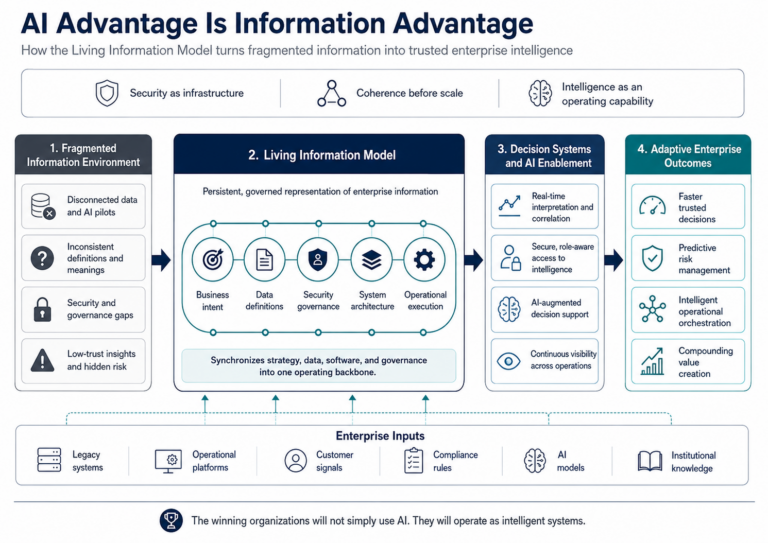
Ingenuity’s Living Information Model addresses this challenge by creating a persistent, evolving representation of enterprise information — one that aligns business intent, system architecture, and operational execution. This transforms AI from an experimental capability into an institutional competency.
Security as Strategic Infrastructure for Intelligence
In high-value sectors — energy, finance, industrial operations — the data that powers AI is often the organization’s most sensitive asset. Treating security as a compliance exercise limits the organization’s ability to extract value from this data. Treating security as strategic infrastructure enables confidence, speed, and scale.
Ingenuity’s approach embeds security governance directly into how information systems are designed and operated. This includes:
- Delivery models that allow sensitive data to remain fully within client-controlled ecosystems
- Fine-grained access governance aligned to operational roles and decision authority
- Secure collaboration frameworks that protect intellectual property embedded in AI models
- Continuous visibility into information flows across legacy and modern platforms
By reducing uncertainty around data exposure and system integrity, organizations can deploy AI solutions more aggressively — without compromising trust or regulatory alignment.
From Data Silos to Decision Systems
The Living Information Model enables organizations to transition from static data repositories toward dynamic decision systems. Instead of merely storing historical information, enterprises gain the ability to continuously interpret, correlate, and act on real-time signals across their operations.
This capability unlocks new forms of value creation:
- Autonomous optimization of industrial and energy assets
- Predictive risk management across financial and operational domains
- Intelligent orchestration of supply chains and customer engagement
- AI-augmented leadership decision-making grounded in trusted information
In this paradigm, AI is not an overlay on existing systems. It becomes an integral layer of enterprise cognition.
Creating Adaptive Enterprises
The most significant impact of AI will not be automation — it will be adaptation. Organizations that can rapidly learn from their data, evolve their operating models, and align teams around shared informational truth will outperform competitors that remain constrained by fragmented systems and opaque decision processes.
Ingenuity’s Living Information Model provides the structural backbone for this evolution. By continuously synchronizing strategy, data architecture, software platforms, and governance practices, clients can move toward a state of operational intelligence where value creation becomes compounding rather than episodic.
The Future Belongs to Organizations that Can Trust Their Intelligence
AI technologies will continue to advance. Models will become more powerful. Tools will become more accessible. The differentiator will not be access to capability — it will be the ability to deploy intelligence securely, coherently, and at scale.
Ingenuity partners with forward-looking organizations to build this foundation. Through disciplined information security practices and the Living Information Model, we help clients transform information from a risk to be managed into a strategic asset to be leveraged.
Because in the emerging competitive landscape, the organizations that win will not simply use AI. They will operate as intelligent systems.
